Request Quote

Request a quote from Nidec Drive Technology America Corporation.

This quote form is intended for customers and partners in North America seeking information about Nidec Drive Technology America Corporation’s Precision Gearing Technologies. For inquiries related to the Nidec motor group division or from outside this region, please visit the global Nidec Group website to find the appropriate regional or product-specific contact.

Subscribe to Nidec Newsletter

Subscribe to our email newsletter to stay current with our precision gearing solutions, featured products, company updates, and industry news.

2026 Top Machine Tool Types for Global Buyers?

Choosing the right machine tool in 2026 requires more than comparing spindle speed, table size, or catalogue prices. Global buyers face different production targets, labour costs, power conditions, and service networks. A compact CNC turning centre may suit a high-volume automotive supplier, while a five-axis machining centre may better serve aerospace parts with complex geometries. The best choice depends on evidence from real production needs.

This guide examines leading machine tool types, including CNC lathes, machining centres, grinding machines, laser cutting systems, and hybrid equipment. It considers accuracy, material compatibility, automation, energy use, software integration, and operator training. It also looks beyond the initial quotation. Installation quality, spare-parts access, remote diagnostics, and local technical support can decide whether a machine earns money or creates delays. Small details matter. A ten-minute setup issue, repeated across three shifts, becomes a serious annual cost.

Reliable purchasing decisions should combine supplier documentation with factory-level verification. Buyers should request sample parts, inspect test results, confirm applicable certifications, and clarify warranty conditions before signing. No ranking can fit every factory. Some published specifications may also hide practical limitations, especially under heavy cutting loads or unstable power supplies. That is worth questioning.

The 2026 market offers impressive choices, but advanced features are not automatically valuable. Buyers should match proven capability with measurable production goals, realistic budgets, and long-term service confidence. This overview provides a practical starting point for comparing machine tool options across global markets.

2026 Top Machine Tool Types for Global Buyers?

What Are Machine Tools and Why Do Global Buyers Need Them in 2026?

Machine tools are industrial systems that remove, shape, or finish material with controlled precision. They include lathes, milling machines, grinders, presses, and multi-axis machining centers. A CNC controller directs tool movement through programmed instructions. Yet the machine is not the whole process. Cutting tools, fixtures, coolant, inspection, and operator training affect results. In a real workshop, a brilliant specification can still produce poor parts.

Global buyers need machine tools because modern production demands repeatability, shorter lead times, and flexible manufacturing. In 2026, manufacturers also face skilled-labor shortages and stricter energy expectations. A reliable machine can hold stable dimensions across hundreds of components. That matters when producing medical housings, vehicle parts, or industrial shafts.

For example, a turning center may produce accurate cylindrical parts efficiently. A five-axis unit may reduce multiple setups for complex surfaces. However, more axes do not automatically mean better value. They can increase programming demands, maintenance needs, and training costs.

Experienced buyers should compare complete production requirements, not only machine price. Ask for test cuts using comparable materials and tolerances. Check spindle load, positioning accuracy, chip evacuation, and inspection methods. Service access matters. A machine that waits weeks for a minor repair can damage delivery schedules. Energy use deserves attention, too, especially during long shifts. Shop-floor evaluations often reveal inconvenient details that brochures miss. The overlooked issue is training time. A cheaper machine may cost more when operators struggle with setup and process control. No machine fits every factory.

How to Classify the Main Machine Tool Types

How to Classify the Main Machine Tool Types

For global buyers in 2026, machine tools are best classified by their cutting action, movement, and production purpose. This method is clearer than grouping machines by appearance. Turning machines rotate the workpiece against a fixed tool. Milling machines rotate a cutter across a secured workpiece. Drilling machines create or enlarge holes with axial movement. Grinding machines remove tiny amounts of material with an abrasive wheel. The finish can feel almost polished.

Other categories serve specialized requirements. Gear machines shape teeth with controlled tool movement. Electrical discharge machines remove conductive material through precisely managed sparks. Forming machines change metal through pressure instead of cutting. CNC systems add programmed control, repeatable positioning, and easier production monitoring. However, CNC describes the control method, not a separate cutting process. This distinction prevents costly misunderstandings during sourcing.

A reliable comparison should examine accuracy, work envelope, spindle speed, rigidity, automation, and maintenance access. Check the actual material, batch size, tolerance, and surface-finish target. A small milling center may outperform a larger one when setup time matters. Coolant flow, chip removal, and operator access also affect daily output. Buyers sometimes choose impressive specifications without reviewing real parts. That is a common mistake. Classification is useful, but it cannot replace a process trial, technical drawings, and verified acceptance criteria. Machines may fit several categories, so rigid labels can mislead.

2026 Top Machine Tool Types for Global Buyers

Machine tools are commonly classified by their primary cutting or forming operation. The chart compares representative standard configurations by the number of simultaneously controlled axes: turning and grinding machines generally use fewer axes, while machining centers and EDM equipment can support more complex multi-axis work.

Which Machine Tools Fit Different Manufacturing Applications?

2026 Top Machine Tool Types for Global Buyers

Choosing a machine tool should begin with the part, not the brochure. CNC turning centers suit shafts, bushings, and other rotational components. Vertical machining centers fit prismatic parts, molds, and small-batch production. Five-axis machining reduces repositioning for aerospace-style contours, but it demands stronger programming skills and careful fixture design.

Grinding remains valuable when surface finish and micron-level accuracy matter. Laser cutting works well for sheet-metal profiles, while press brakes form them afterward.

For flexible factories, automation is becoming practical rather than fashionable. The International Federation of Robotics reported 541,302 industrial robots installed worldwide in 2023.

This supports combining machining centers with loading systems, especially where labor availability is uncertain. Still, automation can expose weak process planning. That part is often ignored.

Tips: Match spindle speed, torque, travel, and work envelope to the material and part size. Check thermal stability during a full shift, not only during a showroom test. Ask for measured cycle times, repeatability records, energy data, and service-response terms.

AMT’s U.S. Manufacturing Technology Orders reports show that investment demand changes with industrial cycles. Therefore, a low purchase price may not equal low operating cost. Calculate tooling, coolant, maintenance, training, and downtime before approval.

A smaller machine may win. Or fail quickly.

What Technologies Define Modern Machine Tools in 2026?

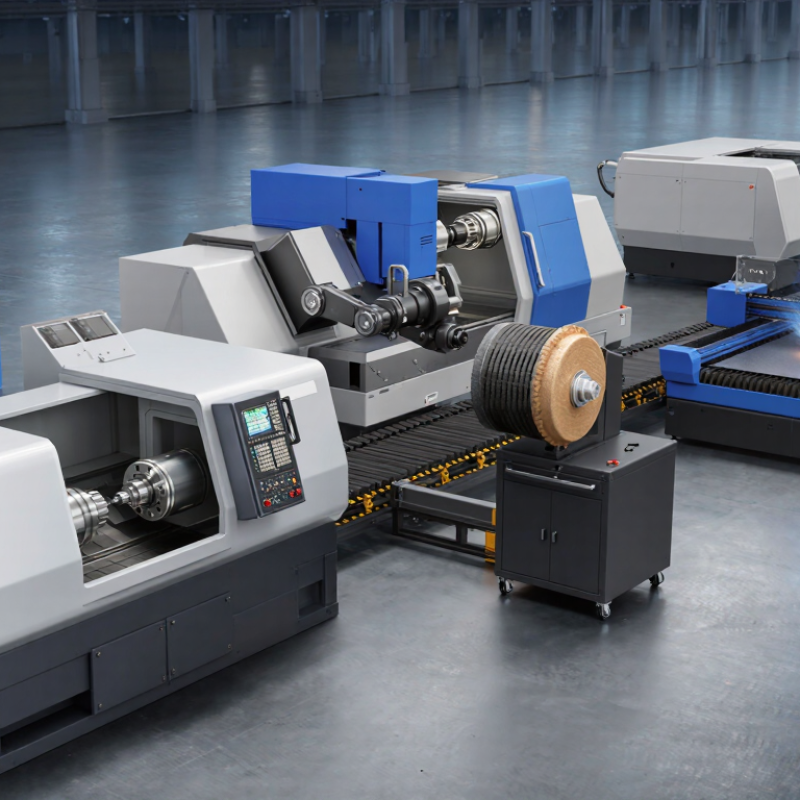
Modern machine tools in 2026 are defined by connected control, not cutting speed alone. Five-axis machining centers, multitasking lathes, laser systems, and hybrid machines increasingly combine sensing with automated decision-making. Real-time spindle load, vibration, temperature, and tool-wear data can adjust cutting conditions before a damaged edge ruins a batch.

The demand is measurable. The International Federation of Robotics reported 541,302 industrial robots installed worldwide in 2023, with the operational stock exceeding 4.2 million units. This supports greater interest in robotic loading, machine vision, and lights-out production.

However, automation is not always the answer. A small workshop producing irregular prototypes may lose money through complex integration. Simple fixtures can still outperform expensive software.

Digital twins are also moving from demonstrations toward practical use. They help simulate collision risks, cycle times, energy use, and tool paths before metal is removed. The Wohlers Report 2024 valued the global additive manufacturing market at more than 20 billion dollars, encouraging hybrid machines that print, mill, and inspect one component.

Yet a digital twin can still be wrong when machine geometry, material behavior, or operator habits are poorly measured.

Energy monitoring matters too. Buyers now examine standby consumption, compressed-air demand, regenerative drives, and coolant management. Data from the U.S. Manufacturing Technology Orders report shows that capital equipment demand shifts with production confidence, so payback remains critical.

The best machine is not the most advanced one. It is the one that delivers stable parts, traceable data, and manageable maintenance in real working conditions.

How Should Global Buyers Evaluate and Select Machine Tools?

Selecting a machine tool in 2026 requires more than comparing spindle speed and purchase price.

Start with the part, not the brochure. For aerospace components, five-axis machining can reduce setups and alignment errors. For repetitive shafts, a turning center with bar feeding may deliver better output.

Gardner Intelligence’s 2023 World Machine Tool Survey estimated global consumption at approximately 86 billion US dollars.

That figure signals strong demand, but global averages can mislead.

Deloitte’s 2024 Smart Manufacturing Survey found that 92% of manufacturers view smart manufacturing as important for competitiveness within three years.

Buyers should therefore examine connectivity, data access, and automation readiness.

Ask whether the control system supports common industrial communication standards. Check if production data can leave the machine without expensive restrictions.

Demand a realistic cycle-time demonstration using your material and tooling. Not a showroom sample.

Total cost matters more than the invoice.

Include installation, training, tooling, energy, preventive maintenance, software, and downtime. A cheaper machine may become expensive after two years.

Review accuracy using ISO 230-1 principles, and verify repeatability under thermal changes.

Speak with service engineers, not only sales teams. Their answers reveal response times, spare-parts availability, and common failure points.

My preference is a conservative specification, although that can increase initial cost. Buyers should still question whether every option earns its place. Fancy automation sometimes waits unused.