Request Quote

Request a quote from Nidec Drive Technology America Corporation.

This quote form is intended for customers and partners in North America seeking information about Nidec Drive Technology America Corporation’s Precision Gearing Technologies. For inquiries related to the Nidec motor group division or from outside this region, please visit the global Nidec Group website to find the appropriate regional or product-specific contact.

Subscribe to Nidec Newsletter

Subscribe to our email newsletter to stay current with our precision gearing solutions, featured products, company updates, and industry news.

Why Choose Powder Coating Equipment for Your Business?

Why Choose Powder Coating Equipment for Your Business?

Powder coating is moving from a finishing option to a strategic production decision. Grand View Research valued the global powder coatings market at approximately USD 15.34 billion in 2023. Its report projects continued growth through 2030, supported by demand for durable, lower-emission finishes. That growth matters to manufacturers evaluating Powder Coating Equipment for metal furniture, automotive parts, appliances, and architectural components.

The Powder Coating Institute explains that powder coating uses dry particles applied electrostatically and cured inside an oven. The U.S. Environmental Protection Agency also identifies powder coating as a process with negligible volatile organic compound emissions during application. Kevin Coursin, a recognized Powder Coating Institute expert, has described powder coating as “one of the most environmentally friendly finishing technologies available.” The practical benefit is visible: fewer liquid drums, cleaner work areas, and reusable overspray when the system is designed correctly.

Still, equipment does not create efficiency by itself. Poor grounding can leave thin edges or uneven coverage. An undersized oven can slow production and waste energy. Market reports often emphasize growth, but they cannot measure every factory’s maintenance discipline. That part is less comfortable.

A reliable system should match product size, coating volume, color-change frequency, curing requirements, and operator skill. Energy use must also be measured, not guessed. The right Powder Coating Equipment can reduce rework and improve finish consistency, but only after careful process testing. Growth is promising. Fit matters more.

Why Choose Powder Coating Equipment for Your Business?

What Powder Coating Equipment Is and How It Works

Why Choose Powder Coating Equipment for Your Business?

What Powder Coating Equipment Is and How It Works

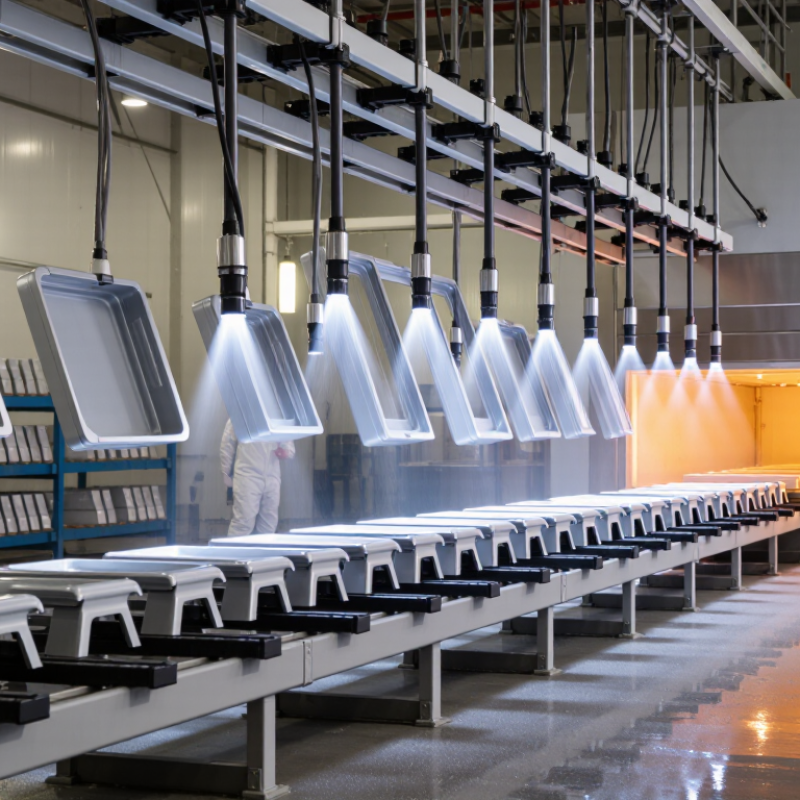
Powder coating equipment applies dry, electrically charged powder to prepared metal surfaces. A typical setup includes a spray gun, powder hopper, air supply, control unit, and curing oven. The gun charges particles as compressed air carries them toward the grounded workpiece. Opposite electrical charges create temporary adhesion. The coating looks almost weightless. Yet preparation controls much of the final result. Oil, rust, moisture, or poor grounding can cause uneven coverage and weak adhesion.

After spraying, the coated part enters a controlled oven. Heat melts the powder and, in many formulations, starts chemical cross-linking. The particles flow together, forming a continuous protective film. Operators monitor time, temperature, airflow, and part thickness. A thin bracket may cure differently from a heavy steel frame. This detail matters. Using an oven thermometer and recording each batch improves repeatability. Still, readings can drift, and conveyor speed may be overlooked.

For a business, the equipment can reduce liquid waste and support consistent finish quality. It also requires ventilation, grounding checks, suitable protective equipment, and trained operation. Practical testing should begin with sample panels, not expensive production parts. Inspectors can check color, gloss, film thickness, and adhesion after curing. Some defects appear later. Blaming the powder too quickly is a common mistake. Sometimes the real cause is contamination or an incorrect oven profile. Clear maintenance records help technicians investigate failures with evidence. Good equipment does not replace judgment.

Key Benefits of Powder Coating for Different Businesses

Powder coating equipment can support different businesses without adding solvent-heavy complexity. The U.S. Environmental Protection Agency identifies powder coating as a process with negligible volatile organic compound emissions. Its dry overspray can also be collected and reused, depending on the system and color requirements. Less waste, usually.

Furniture makers benefit from durable finishes on steel frames, shelving, and outdoor fixtures. Appliance manufacturers gain consistent coverage on panels and handles. Automotive component suppliers often value resistance to chipping, corrosion, and repeated handling. These gains matter when products face warehouse racks, road vibration, or daily cleaning.

Market data supports continued investment. Grand View Research estimates the global powder coatings market at about USD 15.5 billion in 2023, with growth expected through 2030. MarketsandMarkets also forecasts steady expansion, driven by demand for efficient and lower-emission finishing processes. Equipment selection still requires judgment. A small workshop may need a compact booth, dependable curing oven, and simple reclaim system. A high-volume plant needs airflow control, automated application, and quick color changeovers. An oversized oven can waste energy. An undersized one can produce weak adhesion.

Practical testing remains essential. Operators should check substrate preparation, film thickness, cure temperature, and transfer efficiency. Results can vary with humidity and part geometry. Powder coating is not automatically perfect. A poorly grounded part may show thin edges, while rushed curing can reduce durability. Real production trials often reveal problems that brochures do not.

Why Choose Powder Coating Equipment for Your Business?

Powder coating is widely used in furniture, appliance, automotive component, and architectural metal manufacturing. The benchmarks below compare typical material transfer efficiency with conventional liquid coating processes.

Powder coating systems commonly achieve approximately 90–98% transfer efficiency, while conventional liquid coating systems typically achieve about 60–80%. Actual results vary according to part geometry, spray equipment, operator settings, and overspray recovery.

Essential Components of a Powder Coating System

A powder coating system is more than a spray gun and an oven. Its essential components must work as one controlled process.

The pretreatment line removes oil, scale, and fingerprints from the metal surface. Poor cleaning often causes early corrosion or peeling. It is an easy detail to underestimate.

The powder booth contains overspray and supports clean color changes. A feed hopper, air supply, and electrostatic gun then deliver charged powder evenly. Proper grounding matters. Without it, transfer efficiency falls and surface defects increase.

The curing oven must maintain stable temperature and airflow across every rack position. Under-curing weakens the film, while excessive heat can damage the substrate. Filters and recovery equipment also reduce airborne powder and material waste.

The U.S. Environmental Protection Agency’s AP-42, Chapter 4.2, identifies powder coating as a low-solvent surface-finishing method, although curing emissions still require process control.

Equipment selection should match part size, production volume, coating chemistry, and expected color changes.

MarketsandMarkets estimated the global powder coatings market at about USD 15.9 billion in 2023, with continued growth projected through 2028. That expansion does not make every system efficient. A small workshop may lose money on an oversized oven and complex recovery unit. In practice, operators should measure oven uniformity, compressed-air quality, grounding resistance, and powder utilization before buying. The numbers can be inconvenient. They are still more reliable than attractive equipment brochures.

How to Choose Equipment for Your Production Needs

Choosing powder coating equipment should begin with production facts, not catalogue features. The Powder Coating Institute emphasizes that curing depends on the part’s metal temperature, not simply oven air temperature. Therefore, record part length, weight, geometry, coating thickness, and hourly output before requesting quotations. A 2024 Fortune Business Insights report valued the global powder coatings market at about $15.9 billion in 2023. That growth increases equipment choices, but it also makes poor sizing more expensive.

For small batches, a compact booth, manual guns, and a properly tested batch oven may provide better control. For continuous production, calculate conveyor speed from actual cure time and part spacing. Leave room for irregular frames. They need more dwell time.

Check the oven’s usable zone, airflow uniformity, and temperature recovery after loading. A curing chart from three points on the heaviest part is more useful than a large heating rating. I learned this the hard way: an oversized oven can waste energy while still leaving corners under-cured.

Recovery equipment deserves equal attention. A 2023 industry analysis by Grand View Research reported continued demand for efficient powder coating systems, partly because manufacturers seek lower material waste. Ask for reclaim efficiency data under your own powder colors and textures. Fine powders behave differently. Also compare filter replacement intervals, compressed-air quality, grounding, operator access, and cleaning time. A fast gun is not automatically productive. The best system matches your daily mix, available floor space, maintenance skills, and realistic future volume. Forecasts can be wrong. Your production records should decide.

Operating, Maintaining, and Upgrading Powder Coating Equipment

Powder coating equipment earns its value through disciplined operation, not purchase price alone. The U.S. Environmental Protection Agency reports that powder coating can achieve transfer efficiency above 95% in suitable systems. That efficiency depends on grounded workpieces, stable airflow, and correct gun settings. Operators should record voltage, powder flow, booth pressure, and curing temperature each shift. Small changes often reveal larger problems.

Maintenance should feel practical and visible. Clean booth filters before pressure rises, inspect reclaim lines, and check grounding points with a calibrated meter. The U.S. Department of Energy notes that compressed-air leaks can waste 20% to 30% of system capacity. A leaking hose may look harmless, yet it increases energy use and weakens application consistency. I have seen teams replace expensive parts before checking simple connections. That habit deserves reconsideration. Upgrading controls, airflow monitoring, or oven insulation can improve results, but only after measuring current losses. Industry forecasts from Grand View Research place the global powder coatings market on a continuing growth path through 2030, increasing pressure for reliable, repeatable production.

Tips: Keep a maintenance log beside the control panel. Photograph unusual buildup before cleaning it. Test one upgrade at a time. Review rejected parts weekly, because the powder often exposes process issues before operators do. A perfect setup does not exist. Continuous adjustment does.

Why Choose Powder Coating Equipment for Your Business? - Operating, Maintaining, and Upgrading Powder Coating Equipment

Management Area Key Dimension Typical Operating Guidance Business Value Maintenance or Upgrade Action
Operating Curing temperature Usually 160–200°C metal temperature, with the exact time and temperature determined by the powder manufacturer's technical data sheet. Promotes complete film formation, adhesion, hardness, and corrosion performance. Use a calibrated temperature profiler to verify the part temperature rather than relying only on the oven air display.
Operating Curing time Commonly 10–20 minutes after the workpiece reaches the required metal temperature; thick or complex parts may require more time. Reduces under-cured or over-cured defects and improves coating consistency. Record oven settings, part temperature, line speed, and powder batch for process control.
Operating Workpiece grounding Maintain clean metal-to-metal contact and verify grounding regularly. Many powder-coating systems target a ground resistance of less than 1 megohm. Improves transfer efficiency and helps reduce electrical safety risks. Clean hooks and contact points frequently; replace worn hooks and test the grounding path with suitable equipment.
Operating Spray-gun settings Set voltage, current, powder flow, and atomizing air according to part geometry, powder type, and required film build. Excessive voltage can contribute to back-ionization. Supports uniform coverage while limiting overspray and surface defects. Use lower-energy settings for recesses and Faraday-cage areas, and adjust powder flow before increasing voltage.
Operating Film thickness Many general-purpose powder coatings are applied at approximately 60–100 micrometres, but the product specification should determine the target range. Balances appearance, protection, material consumption, and rework risk. Check thickness with a calibrated gauge and monitor results by part type and production shift.
Operating Compressed-air quality Use clean, dry, oil-free air suitable for powder application. Moisture or oil contamination can cause uneven flow, clumping, craters, and poor finish. Improves powder delivery reliability and reduces coating defects. Drain filters and receivers, inspect dryers, and replace filter elements according to pressure drop or service condition.
Operating Booth ventilation Maintain stable airflow sufficient to contain overspray without disturbing the spray pattern. The required airflow depends on booth design, opening size, and safety requirements. Helps protect workers, control contamination, and support safe powder collection. Check fan operation, duct condition, filter loading, and booth pressure regularly; follow applicable workplace-safety requirements.
Maintenance Daily cleaning Remove accumulated powder from the booth, guns, hoses, pumps, hooks, and accessible surfaces using approved cleaning methods. Reduces color contamination, ignition hazards, blockages, and inconsistent coating quality. Avoid creating airborne dust clouds and use cleaning tools and procedures designed for combustible powder environments.
Maintenance Filters and recovery equipment Inspect cartridge or final filters for loading, damage, and pressure changes. Recovery performance depends on correct airflow, cyclone or filter condition, and powder compatibility. Maintains capture efficiency and can lower powder waste when reclaimed powder is suitable for reuse. Replace damaged filters promptly and validate reclaimed powder quality before blending or reuse.
Maintenance Oven inspection Check burners or heating elements, circulation fans, door seals, temperature sensors, and exhaust systems on a planned schedule. Prevents temperature variation, energy waste, and curing failures. Compare multiple oven-zone readings and arrange periodic calibration of temperature controls and sensors.
Maintenance Preventive maintenance interval Perform visual checks daily, functional checks weekly or monthly, and a documented full inspection at least annually, adjusted for production intensity. Reduces unplanned downtime and extends equipment service life. Base the schedule on operating hours, powder volume, environmental conditions, and the equipment manufacturer's instructions.
Upgrading Automatic gun control Automatic guns and programmable reciprocators can provide repeatable spray paths, stable powder output, and consistent coverage on high-volume parts. Improves productivity and reduces dependence on manual application variability. Consider the upgrade when production volume, repeat part geometry, or labor constraints justify automation.
Upgrading Quick color-change capability Dedicated cleaning access, removable powder paths, and modular booth components can shorten changeover time between colors. Reduces idle time and cross-color contamination during mixed-product production. Prioritize upgrades that simplify cleaning of hoses, pumps, guns, booth surfaces, and recovery paths.
Upgrading Powder recovery system Recovery systems can collect suitable overspray for controlled reuse, while reclaim ratios vary with color, powder chemistry, part mix, and system design. May reduce virgin powder consumption and waste-disposal volume. Use separate recovery streams for incompatible colors or finishes and establish quality controls for reclaimed powder.
Upgrading Process monitoring Digital records for film thickness, oven temperature, airflow, grounding, powder usage, and defects provide measurable process control. Supports traceability, faster troubleshooting, and continuous improvement. Set practical limits, review trends by shift or product family, and investigate deviations before they become recurring defects.
Safety Combustible powder control Control powder accumulation, ignition sources, static electricity, ventilation, and housekeeping in accordance with applicable local regulations and recognized safety standards. Protects personnel and reduces the risk of fire, explosion, and regulatory non-compliance. Train operators, document inspections, and ensure electrical and dust-control systems are suitable for the installation.