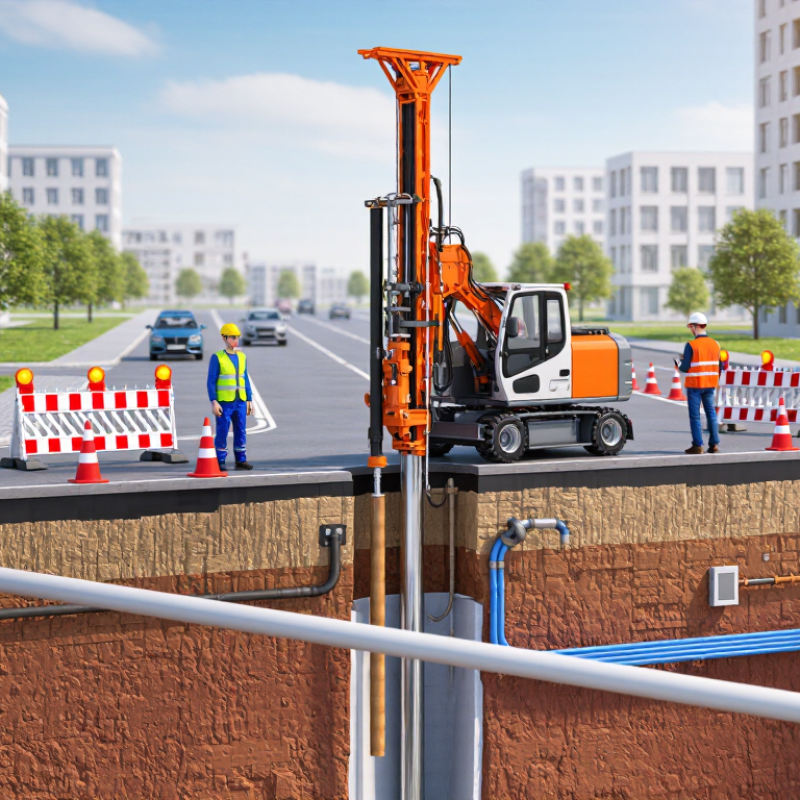
| Surface excavation | Approximately 10–40% of the work corridor, depending on entry and exit pits | Approximately 100% of the pipe alignment normally requires a continuous trench | Can reduce surface excavation by approximately 60–90% in suitable ground and alignment conditions |
| Typical exposed work area | Two compact work zones: a drilling entry area and a receiving or pullback area | A continuous trench, spoil-storage area, equipment access route, and pipe-laying zone | Less disruption to roads, landscaping, agricultural land, and developed sites |
| Road and railway crossings | Crossings can often be completed below the surface without opening the full pavement or rail corridor | Usually requires lane closures, pavement removal, trench shoring, and surface reinstatement | Fewer traffic interruptions and less pavement reconstruction |
| Waterway crossings | Designed to pass beneath rivers, canals, and drainage channels without a full-width surface trench | May require cofferdams, temporary diversion, open excavation, or extensive bank restoration | Lower direct disturbance to banks and surface water features when properly designed and permitted |
| Spoil and excavated material | Limited excavation is concentrated at the entry and exit areas; drilling fluid is commonly recycled or separated where required | Large quantities of trench spoil must be handled, stored, tested, hauled, or disposed of | Reduced spoil handling and fewer truck movements on many projects |
| Typical installation depth | Commonly installed several metres below grade, with depth selected to avoid existing utilities, foundations, and obstacles | Often installed at shallower trench depths, subject to utility clearance, soil conditions, and required cover | Provides greater flexibility for crossing obstacles and maintaining surface access |
| Typical pipe diameter range | Commonly used for small service lines through large utility installations; feasible size depends on machine capacity, soil, length, and product pipe | Broadly suitable for many diameters, but trench width and shoring requirements increase with pipe size and depth | HDD is especially valuable where large open trenches are unsafe, costly, or impractical |
| Traffic and public access | Usually maintains more of the existing road, driveway, sidewalk, or access route during construction | Continuous trenching can require longer closures, detours, temporary crossings, and access restrictions | Improves continuity of transport, pedestrian movement, and property access |
| Restoration requirement | Restoration is generally concentrated around entry and exit pits, access routes, and any temporary work pads | The full trench corridor may require backfilling, compaction, pavement repair, landscaping, and erosion control | Less surface reinstatement can shorten closeout work and reduce lifecycle disturbance |
| Best-fit applications | Roads, railways, waterways, airport areas, urban corridors, landscaped sites, and congested utility routes | Open land with adequate working width, limited obstacles, low traffic impact, and straightforward soil conditions | Method selection can be matched to site access, ground conditions, environmental constraints, and project risk |
| Key design limitations | Requires a verified bore profile, utility locating, geotechnical information, drilling-fluid management, and adequate tracking accuracy | Requires trench stability controls, shoring or sloping where applicable, dewatering, spoil management, and surface reinstatement | HDD is not universally superior; feasibility depends on geology, groundwater, alignment, tolerances, permits, and pullback design |