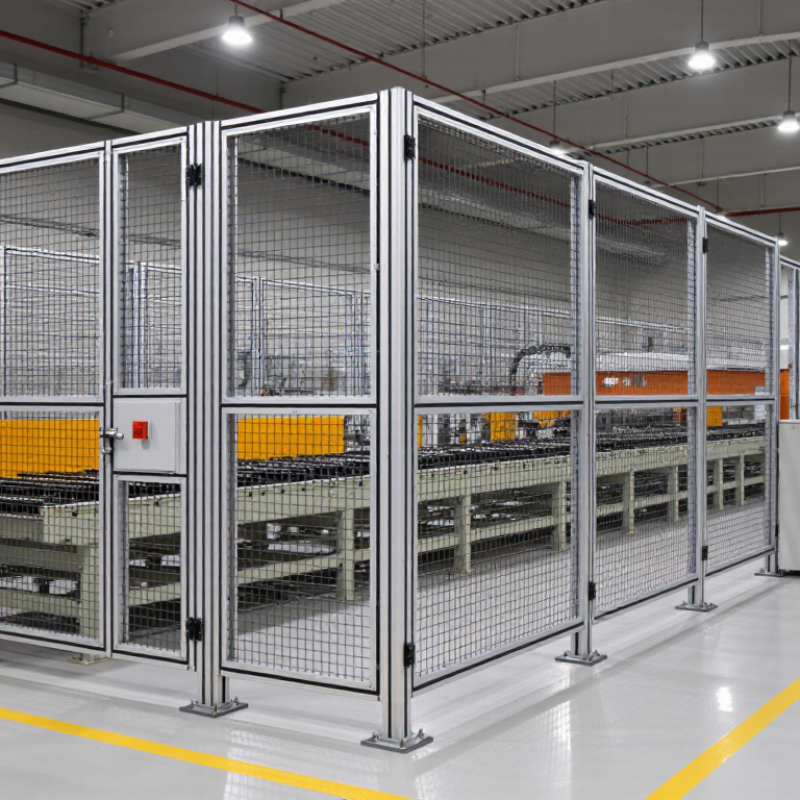
| Primary Purpose | Perimeter guarding for robots, presses, conveyors, machining centers, and automated production cells | Creates a physical barrier that helps prevent unintended access to hazardous moving parts | Areas where a risk assessment identifies access to danger zones as a foreseeable hazard | Use the fence as part of a complete safeguarding system, together with safety-rated doors, interlocks, emergency stops, and safe control functions |
| Fence Panel Material | Welded wire mesh, expanded metal, polycarbonate panels, or solid steel panels | Wire mesh provides visibility and airflow; transparent panels improve observation; solid panels offer greater separation from sparks, chips, or splash | Wire mesh for general automation; transparent panels for processes requiring continuous visual monitoring; solid panels for high-ejection or contamination risks | Confirm resistance to impact, heat, chemicals, corrosion, and process-specific debris |
| Visibility and Ventilation | Open mesh or clear-panel construction selected according to the process | Allows operators to observe equipment status while maintaining airflow and reducing heat buildup around machinery | Factories requiring frequent visual inspection, cooling airflow, or easy identification of machine faults | Ensure openings do not allow a person to reach through or over the barrier into the hazard zone |
| Opening Size and Reach Distance | Opening dimensions and fence location determined using the applicable safety-distance assessment | Reduces the possibility of reaching through, over, under, or around the guard to contact hazardous parts | All machinery with moving components, especially equipment with accessible pinch, shear, crush, cutting, or entanglement points | Apply the current requirements of ISO 13857 or the applicable local regulation; do not select mesh size based only on appearance |
| Fence Height | Common industrial layouts use approximately 1.4 to 2.0 m panels, subject to the hazard assessment | Helps deter climbing and reaching over the barrier while maintaining practical access for maintenance planning | Standard production cells, robotic work areas, and conveyor lines with normal floor-level access | Calculate height and distance together; a taller fence may still be inadequate if the hazard is too close to the barrier |
| Access Control | Hinged gates, sliding gates, lift-off panels, or controlled maintenance access points | Permits authorized entry while limiting routine access to hazardous machinery | Production cells requiring material loading, tool changes, cleaning, inspection, or maintenance | Access gates should be monitored or interlocked when entry could expose personnel to hazardous motion |
| Interlock Compatibility | Mechanical or electronic safety interlocks connected to the machine safety control system | Can initiate a controlled stop when a protected gate is opened, helping prevent operation with the gate unsecured | Machines where stopping the process before access is necessary to control residual or moving energy | Verify stopping time, guard distance, reset location, fault monitoring, and the required safety performance level |
| Impact Protection | Standard panels for normal conditions; reinforced panels or additional barriers for vehicle and material-handling areas | Helps the guard withstand foreseeable contact from parts, tooling, pallets, or industrial vehicles | Factories with forklifts, automated guided vehicles, heavy workpieces, or high-energy processes | Separate pedestrian routes from vehicle routes where possible and assess impact loads before specifying posts and anchors |
| Corrosion and Hygiene | Powder-coated or galvanized steel for general industry; stainless steel or suitable corrosion-resistant finishes for demanding environments | Supports service life and simplifies cleaning when the fence is exposed to moisture, chemicals, dust, or washdown | Food-related, chemical, outdoor, humid, or washdown production areas | Check coating compatibility with cleaning agents, temperature, humidity, and process chemicals |
| Modularity and Expansion | Bolted modular panels with adjustable posts, standard gates, and removable sections | Allows layout changes, line extensions, and maintenance access without replacing the complete guarding system | Factories with frequently reconfigured production lines or planned automation upgrades | Confirm replacement-panel availability, connection strength, floor tolerances, and compatibility with future equipment |
| Installation and Floor Fixing | Anchored posts installed on concrete floors using suitable mechanical or chemical anchors | Provides stability and helps prevent panels from being displaced during normal operation or foreseeable contact | Permanent machine cells and fixed production layouts | Inspect the floor condition, anchor spacing, underground services, panel alignment, and required clearance from the machine |
| Compliance Framework | Risk assessment supported by applicable requirements such as ISO 14120, ISO 13857, ISO 14119, and local workplace-safety regulations | Helps ensure that the guard design addresses construction, reach prevention, access monitoring, and the intended safety function | Factories supplying regulated markets or operating equipment with significant mechanical hazards | Regulatory requirements vary by location; document the risk assessment, validation, inspection, and maintenance procedures |
| Recommended Choice for Most General Automation Cells | Modular welded-mesh panels with controlled-access gates and safety-rated interlocks | Balances visibility, ventilation, maintainability, modularity, and physical separation | Robotic cells, conveyor systems, packaging lines, and automated assembly areas | The final design must still be verified against the machine’s hazards, stopping performance, access requirements, and applicable regulations |