| Rock Classification | Clastic sedimentary rock | Formed from sand-sized mineral, rock, or organic grains that become compacted and cemented over time. | Building stone, paving, walling, monuments, landscaping, and decorative surfaces. | Its performance depends on grain size, cement type, porosity, weathering, and geological origin. |
| Grain Size | Fine- to coarse-grained sandstone | Most sandstone grains are approximately 0.0625 to 2 millimeters in diameter. | Fine-grained varieties are commonly used for detailed carving and smooth finishes; coarser varieties are used for robust masonry and textured surfaces. | Coarser grains may create a rougher surface and can affect cutting, polishing, and abrasion resistance. |
| Mineral Composition | Quartz-rich sandstone | Contains a high proportion of quartz, which is hard and generally contributes to good durability. | Exterior cladding, steps, paving, retaining walls, and heavy-use architectural features. | Quartz-rich stone is not automatically waterproof; pore structure and cementation still control moisture behavior. |
| Mineral Composition | Arkose | A sandstone containing a significant amount of feldspar, commonly with a pink, reddish, or light-colored appearance. | Wall construction, architectural blocks, landscaping, and decorative stonework. | Feldspar can weather more readily than quartz, so local climate and surface exposure should be considered. |
| Mineral Composition | Lithic sandstone | Contains abundant fragments of pre-existing rocks in addition to mineral grains. | General masonry, landscape features, aggregate production, and construction fill when appropriately tested. | Properties can vary widely because the rock fragments may differ in strength and weathering resistance. |
| Cementing Material | Silica-cemented sandstone | Grains are bonded mainly by silica, often producing a hard and durable stone. | Exterior paving, steps, building facades, and areas subject to abrasion. | Hardness may increase cutting difficulty; suitability should be confirmed for the intended finish and installation method. |
| Cementing Material | Calcite-cemented sandstone | Grains are bonded by calcium carbonate, which can react with acids. | Interior flooring, wall panels, decorative masonry, and low-acid-exposure applications. | Acidic cleaners and acidic environments may etch or weaken carbonate-rich surfaces. |
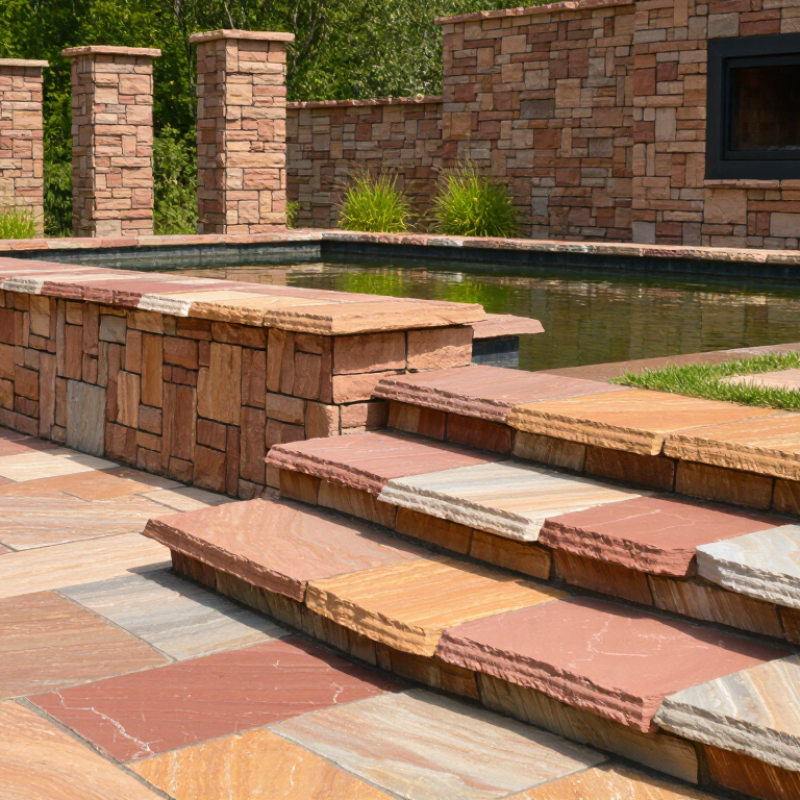
| Cementing Material | Iron-oxide-cemented sandstone | Iron minerals provide yellow, orange, brown, or red coloration and bind some grains together. | Decorative cladding, garden walls, paving, monuments, and landscape architecture. | Color can vary between layers, and prolonged moisture may contribute to staining or surface deterioration. |
| Color | Common colors | White, gray, yellow, tan, brown, red, and orange; color is influenced by minerals and cement. | Facades, fireplaces, garden structures, paths, patios, wall panels, and ornamental work. | Natural variation is normal; samples should be checked because color may differ between blocks or quarry layers. |
| Porosity | Moderate to high in many varieties | Connected pore spaces can allow water absorption and vapor movement. | Suitable for breathable masonry, landscaping, and selected interior applications. | High absorption can increase susceptibility to freeze-thaw damage, staining, salt movement, and biological growth. |
| Permeability | Variable | Water movement depends on pore connectivity, grain size, compaction, and cementation. | Construction and drainage-related applications where tested performance meets project requirements. | Water management, flashing, drainage, sealing, and correct detailing are essential in exposed installations. |
| Strength | Variable compressive strength | Strength ranges widely among sandstone varieties; dense, well-cemented stone is generally stronger than friable stone. | Load-bearing masonry, paving, steps, retaining walls, and structural or semi-structural elements when engineered. | Use project-specific test data rather than assuming all sandstone has the same load-bearing capacity. |
| Workability | Generally easy to cut and shape | Many varieties can be sawn, split, carved, or textured, although hardness varies. | Sculpture, columns, moldings, cladding, fireplaces, benches, and custom architectural details. | Soft or poorly cemented stone may chip, abrade, or shed grains during fabrication and installation. |
| Surface Finish | Natural cleft, sawn, honed, brushed, or textured | Finishes can emphasize grain, bedding planes, color variation, and surface texture. | Flooring, wall panels, patios, walkways, steps, countertops in suitable settings, and decorative features. | Rough finishes improve slip resistance, while smoother finishes are easier to clean but may become slippery when wet. |
| Thermal Behavior | Moderate thermal mass | Sandstone can absorb and slowly release heat, depending on density and moisture content. | Interior walling, fireplaces, solar-exposed masonry, courtyards, and landscape structures. | Thermal performance is not the same as insulation; moisture and temperature cycling should be considered. |
| Weather Resistance | Moderate to high, depending on variety | Dense, well-cemented sandstone generally resists weathering better than porous or friable stone. | Exterior walls, paving, steps, monuments, retaining walls, and garden architecture. | Freeze-thaw cycles, salt, acid rain, persistent dampness, and incorrect cleaning can accelerate deterioration. |
| Typical Applications | Construction and architecture | Used as dimension stone, ashlar, veneer, blocks, slabs, and architectural details. | Building facades, walls, arches, columns, window surrounds, fireplaces, flooring, and staircases. | Stone thickness, anchoring, structural design, water control, and local building requirements must be evaluated. |
| Typical Applications | Landscaping and outdoor design | Natural texture and color make sandstone suitable for outdoor hardscape features. | Patios, garden paths, paving slabs, steps, seating, fountains, edging, rock gardens, and retaining walls. | Select a variety tested for local climate, expected traffic, slip resistance, and water exposure. |
| Typical Applications | Industrial and raw-material uses | Crushed sandstone can provide mineral aggregate, while high-purity sand may serve specialized industrial purposes. | Road base, concrete and asphalt aggregate, fill, filtration media, and selected glass or foundry applications. | Material must meet the relevant grading, cleanliness, strength, and chemical requirements for the application. |
| Maintenance | Regular cleaning and moisture control | Routine care usually involves gentle cleaning, removal of standing water, and inspection of joints and surfaces. | Preserves appearance and service life in floors, facades, paving, walls, and monuments. | Avoid harsh acids, abrasive cleaning, and unsuitable sealers; test cleaning methods on an inconspicuous area first. |