| China Market Performance |
| China wearable-device market | Shipments in Q1 2024 | 33.67 million units | Indicates a large addressable market for smartwatches, smart bands, and related wrist-worn devices. | Publicly reported market data |
| China wearable-device market | Year-over-year shipment growth in Q1 2024 | 38.4% | Strong annual growth increased opportunities for suppliers with flexible production and fast product refresh cycles. | Publicly reported market data |
| Female Android smartwatch segment | Standalone official shipment series | Not separately disclosed | Public market reports generally combine gender, operating-system compatibility, and price segments rather than reporting this niche separately. | Market-data limitation |
| Female Android smartwatch segment | Recommended sales measurement | Track units, average selling price, return rate, active-use rate, and repeat-order rate by SKU. | This provides a more reliable supplier comparison than using unsupported gender-specific market totals. | Recommended measurement framework |
| Supplier Capability Benchmarks |
| Android compatibility | Supported mobile operating systems | Android compatibility should cover current mainstream Android releases, with documented pairing and notification functions. | Reduces connection failures and customer-support costs in Android-heavy markets. | Technical procurement benchmark |
| Wireless connectivity | Bluetooth specification | Bluetooth Low Energy support, preferably Bluetooth 5.0 or later. | Improves power efficiency, connection stability, and compatibility with newer smartphones. | Technical specification benchmark |
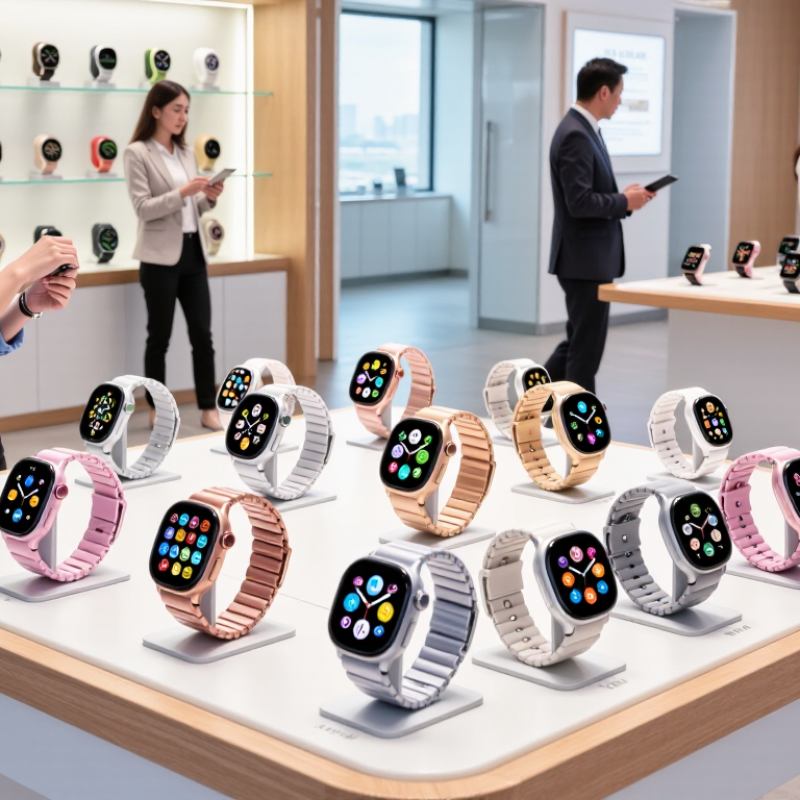
| Display design | Female-oriented case and screen options | Common procurement targets include compact cases, lightweight construction, adjustable straps, and AMOLED or equivalent high-contrast displays. | Supports comfort, readability, and style preferences without relying on any specific brand design. | Product-development benchmark |
| Protection rating | Water and dust resistance | IP67 or IP68 is commonly requested for daily-use models; water-resistance claims must match the supplier’s test documentation. | Helps protect against sweat, rain, and accidental splashes. A rating should not be treated as unlimited swimming protection. | International protection-rating benchmark |
| Health features | Typical monitoring functions | Heart-rate tracking, sleep tracking, step counting, blood-oxygen estimation, and menstrual-cycle recording may be offered. | Health-related functions should be described as wellness features unless the supplier provides legally valid medical certification. | Feature and compliance benchmark |
| Battery performance | Target operating time | A practical procurement target is approximately 5–10 days for basic smartwatch use, depending on display, sensors, GPS, and notification settings. | Battery claims should be verified through a standardized test scenario before mass production. | Typical product benchmark |
| Customization capability | OEM and ODM services | Evaluate case colors, strap materials, watch faces, application interface, packaging, firmware, and language localization. | Higher customization capability allows suppliers to serve specific female lifestyle, fashion, and retail requirements. | Supplier-evaluation benchmark |
| Quality management | Factory documentation | Request quality-management certification, product test reports, incoming-material controls, final inspection records, and traceability procedures. | Documentation helps reduce inconsistent batches and supports import, retail, and after-sales requirements. | Procurement due-diligence benchmark |
| Order flexibility | MOQ and sampling process | Compare sample lead time, minimum order quantity, pilot-batch support, tooling charges, and production lead time. | Suppliers that support smaller pilot orders can lower the risk of testing a new female-focused Android smartwatch SKU. | Commercial evaluation benchmark |
| After-sales readiness | Warranty and technical support | Assess warranty duration, replacement policy, firmware-update process, application maintenance, spare-parts availability, and response time. | Software and connectivity support are especially important because smartwatch ownership depends on both hardware and mobile applications. | Supplier-evaluation benchmark |
| Recommended Supplier-Selection Scorecard |
| Product and technology | Suggested evaluation weight | 30% | Cover Android compatibility, app stability, sensor performance, battery life, display quality, and firmware support. | Recommended purchasing model |
| Quality and compliance | Suggested evaluation weight | 25% | Review test reports, factory controls, protection claims, labeling, documentation, and market-specific compliance. | Recommended purchasing model |
| Customization and design | Suggested evaluation weight | 20% | Compare case size, colors, straps, watch faces, packaging, user interface, and localization capability. | Recommended purchasing model |
| Commercial terms | Suggested evaluation weight | 15% | Consider unit cost, MOQ, tooling, lead time, payment terms, sample fees, and shipping support. | Recommended purchasing model |
| After-sales service | Suggested evaluation weight | 10% | Measure warranty handling, replacement speed, software updates, technical response, and spare-parts support. | Recommended purchasing model |