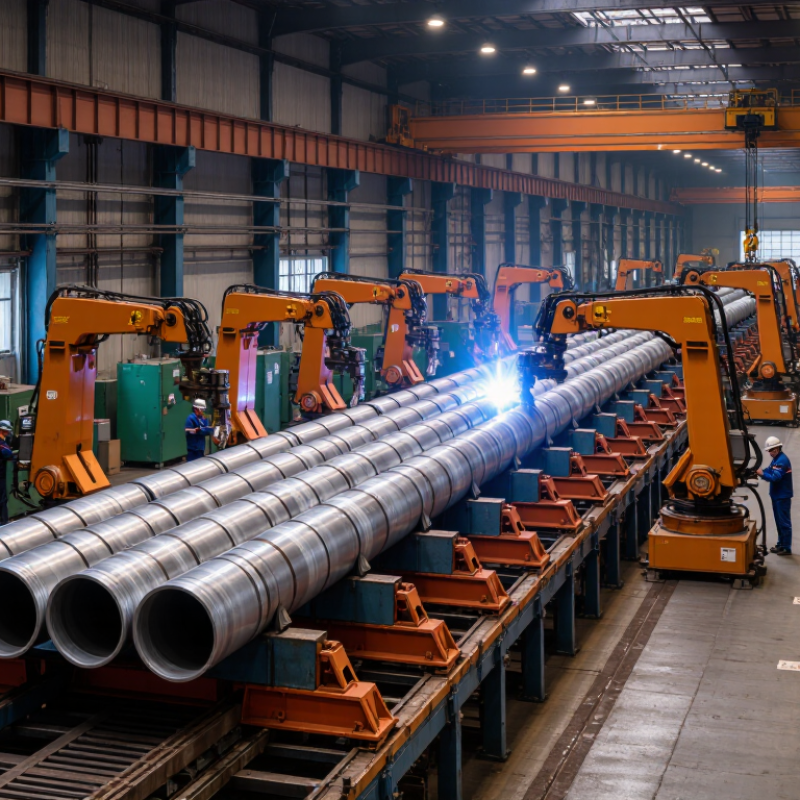
| Manufacturing Processes | Uses the process suited to the pipe specification and application | Common welded-pipe processes include electric resistance welding (ERW), high-frequency welding (HFW), longitudinal submerged arc welding (LSAW), and helical submerged arc welding (SSAW). Process selection should match diameter, wall thickness, grade, and service requirements. |
| Product Standards | Supplies products to recognized domestic and international standards | Relevant standards may include GB/T 3091 for galvanized or uncoated welded steel pipes for low-pressure fluid service, GB/T 9711 for line pipe, ASTM A53 for steel pipe used in mechanical and pressure applications, ASTM A500 for structural tubing, and API 5L for line pipe. |
| Steel Grades | Provides traceable grades with documented chemical and mechanical requirements | Frequently specified grades include Q235B and Q355B under Chinese standards, as well as ASTM A53 Grade B, ASTM A500 Grade B or C, and API 5L grades such as Grade B, X42, X52, and X60. The exact grade must be confirmed against the purchase specification. |
| Dimensional Range | Offers multiple outside diameters, wall thicknesses, and pipe lengths | Welded pipe ranges vary by production line. ERW lines commonly serve small and medium diameters, while LSAW and SSAW lines are used for larger diameters. A credible supplier should publish allowable diameter, wall-thickness, length, ovality, straightness, and end-condition ranges. |
| Welding Quality | Controls weld integrity through process monitoring and inspection | Quality programs commonly include visual and dimensional inspection, weld-process monitoring, hydrostatic testing, and nondestructive examination such as ultrasonic testing, eddy-current testing, or radiographic testing when required by the applicable standard. |
| Mechanical Testing | Verifies performance through documented laboratory testing | Typical tests include tensile testing, yield-strength measurement, elongation testing, flattening or bend testing, and impact testing when required by the grade, standard, temperature, or project specification. |
| Coating and Corrosion Protection | Provides coating systems appropriate for the operating environment | Available protection may include hot-dip galvanizing, three-layer polyethylene, three-layer polypropylene, fusion-bonded epoxy, liquid epoxy, or internal cement mortar lining. Coating thickness, surface preparation, adhesion, and holiday testing should be stated in the technical offer. |
| Quality Management | Maintains a documented and auditable quality-management system | A strong supplier should be able to provide a valid ISO 9001 quality-management certificate, manufacturing procedures, inspection and test plans, calibration records, material certificates, and nonconformance-control procedures where applicable. |
| Material Traceability | Links each pipe to its raw-material heat and production records | Traceability normally includes heat number, steel-mill certificate, chemical composition, mechanical-test results, forming and welding records, inspection results, coating records, and final marking or packing identification. |
| Testing Documentation | Delivers complete inspection documentation with the shipment | Common documents include a mill test certificate, dimensional inspection report, hydrostatic or nondestructive-testing report, coating inspection report, certificate of conformity, packing list, and independent inspection report when specified by the buyer. |
| Production Capacity | Demonstrates capacity that matches the order schedule rather than relying only on stated output | Capacity should be evaluated by applicable pipe process, diameter range, annual production capability, available shifts, confirmed lead time, raw-material availability, and the supplier’s history of completing comparable orders on schedule. |
| Export Readiness | Handles international packaging, documentation, and logistics requirements | Export capability is reflected in seaworthy bundling, end protection, corrosion prevention, container or bulk-vessel loading plans, accurate shipping documents, and familiarity with destination-country inspection and customs requirements. |
| Application Experience | Matches product design and inspection plans to the intended end use | Welded steel pipes are used in water transmission, structural construction, piling, oil and gas transportation, fire-protection systems, industrial utilities, and low-pressure fluid service. Requirements differ significantly among these applications. |
| Commercial Reliability | Provides clear technical and commercial terms before production | A dependable quotation should identify standard, grade, dimensions, tolerance, pipe length, quantity, coating, testing scope, marking, packing, delivery term, payment terms, inspection requirements, and validity period without ambiguous substitutions. |
| Customer Due Diligence | Supports independent verification before order placement | Buyers should verify certificates with the issuing bodies where possible, request recent product samples or inspection records, review factory and production-line evidence, confirm applicable licenses, and use third-party inspection for critical projects. |