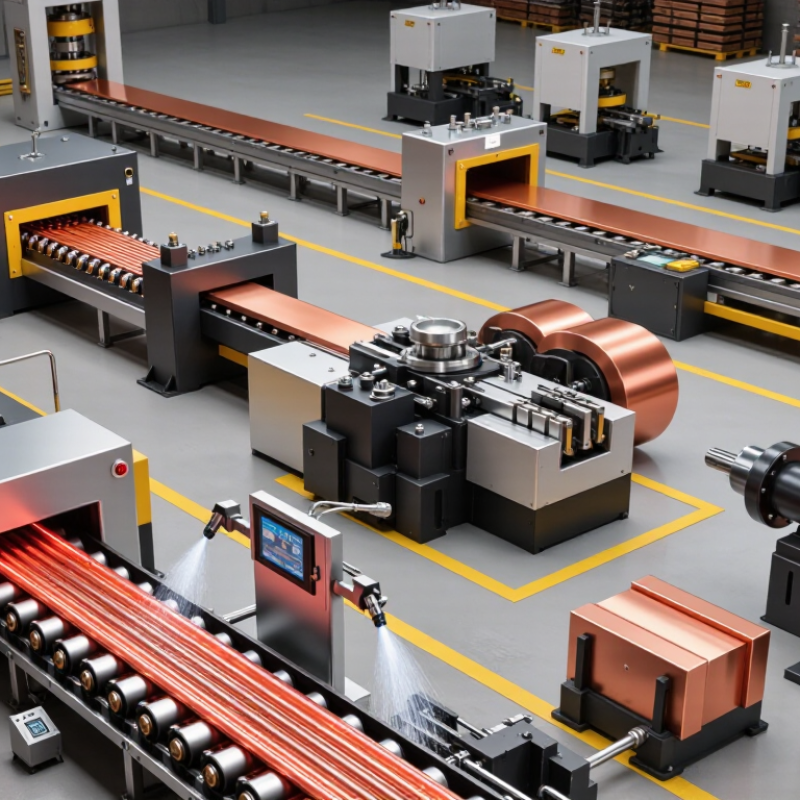
| 1 | Horizontal Direct Extrusion Press | Solid round billets, commonly 100–300 mm diameter | Flat bars approximately 10–150 mm wide and 2–30 mm thick | Electrolytic tough-pitch copper (Cu-ETP), oxygen-free copper (Cu-OF) | 600–850 °C billet heating | A heated billet is pushed directly through a stationary die by a ram. The copper and ram move in the same direction through the die opening. | Flexible tooling, broad product range, and comparatively simple process control | Power distribution bars, switchgear conductors, transformer components |
| 2 | Vertical Direct Extrusion Press | Short copper billets, often 80–250 mm diameter | Short to medium-length busbars and precision profiles up to about 100 mm wide | Cu-ETP, Cu-OF, low-alloy copper | 600–850 °C billet heating | The billet is loaded vertically and forced through a die positioned below or above the container, reducing floor space and supporting controlled alignment. | Compact layout, good guidance of the billet, and reduced bending of heavy tooling | Medium-section busbars, precision copper sections, specialized electrical profiles |
| 3 | Indirect Extrusion Press | Solid billets, generally 100–250 mm diameter | Flat and shaped sections commonly 10–120 mm wide | Cu-ETP, Cu-OF, CuCr1, CuAg alloys | 600–850 °C billet heating | A hollow ram carries the die into the stationary billet. Metal flow is opposite to the movement of the die, which reduces container-wall friction. | Lower friction, more uniform deformation, and improved surface quality on suitable alloys | High-conductivity busbars, intricate profiles, and products requiring close dimensional control |
| 4 | Hydrostatic Extrusion Machine | Rod, billet, or preform surrounded by a pressure-transmitting fluid | Small and medium precision sections, typically below 60 mm in major width | Cu-OF, high-purity copper, selected copper alloys | Usually cold to warm processing | High-pressure fluid applies nearly uniform pressure to the billet and forces it through the die, minimizing direct metal-to-container contact. | Low friction, good surface finish, and suitability for difficult-to-extrude materials | Specialty busbars, fine profiles, and high-precision conductive components |
| 5 | Continuous Copper Extrusion Machine | Continuous copper rod, commonly 8–30 mm diameter | Continuous busbars approximately 5–100 mm wide and 1–20 mm thick | Cu-ETP, Cu-OF, recycled high-conductivity copper | Typically 400–750 °C in the deformation zone | A rotating wheel or tool continuously grips the copper rod and feeds it into a chamber, where frictional work and pressure force the material through a fixed die. | Continuous production, high material utilization, and no billet butt discard | Long-length busbars, electrical conductors, grounding bars, and laminated-bar components |
| 6 | Conform-Type Continuous Extruder | Cast copper rod or prepared copper feed rod | Continuous rectangular or shaped profiles up to roughly 80–120 mm across | Cu-ETP, Cu-OF, selected copper alloys | Approx. 500–750 °C local process temperature | A grooved wheel carries the feedstock into a fixed chamber. Friction generates heat while the wheel supplies the pressure needed to extrude the copper through the die. | Compact continuous line, high productivity, and efficient use of rod feedstock | Power bars, contact profiles, telecommunications conductors, and electrical strip |
| 7 | Multi-Strand or Multi-Outlet Extrusion Machine | One large billet or continuous feed divided through multiple die outlets | Several identical bars produced simultaneously; each outlet commonly 10–80 mm wide | Cu-ETP, Cu-OF | 600–850 °C for hot billet processes | A multi-hole die or parallel die arrangement divides the copper flow into two or more synchronized product streams. | Higher output per press cycle and efficient production of standardized sections | High-volume switchboard bars, standard grounding bars, and repeated conductor profiles |
| 8 | Precision Micro-Extrusion Machine | Small billets, wire, rod, or preformed copper slugs | Sections typically below 20 mm wide, with thin walls or fine grooves | Cu-OF, Cu-ETP, precipitation-hardening copper alloys | Cold to warm; often below 600 °C | Small feedstock is accurately metered into a close-tolerance die, with controlled lubrication, alignment, and cooling to maintain fine dimensions. | Excellent dimensional control, low material consumption, and fine detail capability | Miniature busbars, battery interconnects, electronic power contacts, and compact terminals |
| 9 | Hot Extrusion Line with Online Quenching | Heated copper billets or preforms | Flat bars commonly 20–200 mm wide and 3–40 mm thick | CuCrZr, CuCr1, CuAg, and other heat-treatable copper alloys | 650–900 °C, alloy dependent | The billet is extruded hot and rapidly cooled after die exit. Controlled quenching helps retain a desired balance of conductivity, strength, and hardness. | Suitable for stronger copper alloys and integrated control of post-extrusion properties | High-strength busbars, welding electrodes, rail equipment, and demanding power systems |
| 10 | Tandem Extrusion and Sizing Line | Hot-extruded bar from a primary press or continuous extruder | Long-length bars generally 10–150 mm wide and 2–30 mm thick | Cu-ETP, Cu-OF, CuCr1, CuCrZr | Extrusion temperature followed by controlled cooling | The primary extruder forms the busbar, while downstream sizing rolls or a secondary forming unit correct width, thickness, straightness, and edge geometry. | Improved dimensional consistency, straightness, surface quality, and line productivity | Long precision busbars, switchgear assemblies, transformer bars, and automated cut-to-length production |