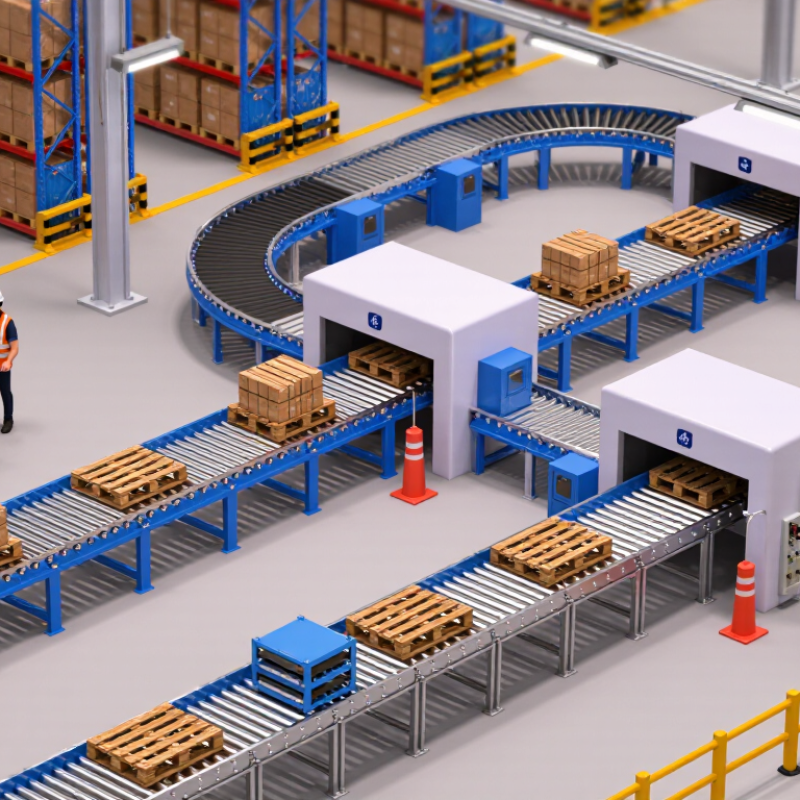
| Powered Roller Conveyor | Continuous horizontal transport of loaded or empty pallets between production, storage, and shipping areas. | Wooden, plastic, or steel pallets with reasonably flat bottom surfaces; standard pallet sizes can be accommodated through conveyor-width selection. | Typically about 500–2,000 kg per pallet, depending on roller diameter, frame construction, drive arrangement, and support spacing. | Motor-driven rollers transfer pallets through direct drive, chain drive, or a line-shaft arrangement. | Drive motor Rollers Chains or belts Frame Sensors Controls | Assembly lines, warehouses, pallet accumulation zones, order fulfillment, and dispatch areas. | Load capacity, pallet underside design, roller pitch, conveyor width, speed, accumulation requirements, and safety guarding. |
| Chain-Driven Roller Conveyor | Move heavy, rigid, or difficult-to-transport pallets with positive traction and reliable starting performance. | Best suited to pallets that provide adequate contact with multiple rollers and have a stable, non-flexing base. | Commonly designed for approximately 1,000–3,000 kg per pallet in heavy-duty installations. | A motor drives a chain loop that rotates each powered roller in the conveying section. | Geared motor Sprockets Drive chain Steel rollers Take-up device Guards | Automotive components, metal products, bulk materials, manufacturing plants, and heavy pallet handling. | Required torque, chain protection, noise level, maintenance access, pallet weight distribution, and duty cycle. |
| Non-Powered Roller Conveyor | Provide economical short-distance movement, manual positioning, or gravity-assisted pallet transfer. | Rigid pallets with a flat and clean underside; pallet movement depends on pushing force or a controlled slope. | Often suitable for approximately 300–1,500 kg per pallet, subject to roller and frame specifications. | Pallets move through manual force or gravity; brake rollers and speed controllers may be used on inclined sections. | Free rollers Support frame Legs Side guides Brake rollers End stops | Workstations, pallet staging, loading docks, inspection areas, and low-volume material handling. | Floor slope, operator ergonomics, pallet condition, stopping control, roller spacing, and required throughput. |
| Chain Transfer Conveyor | Transfer pallets at a right angle between parallel conveyor lines when a conventional curve is unsuitable. | Compatible with pallets whose bottom boards or runners allow safe lifting and support by transfer chains. | Typically about 500–2,000 kg per pallet, depending on the number of chains and lifting mechanism. | Chains raise or support the pallet and move it laterally across the gap between conveyor sections. | Transfer chains Chain sprockets Lift mechanism Drive unit Position sensors Safety interlocks | Cross-docking layouts, production line branching, storage lanes, and pallet sorting systems. | Transfer direction, pallet stability, cycle time, positioning accuracy, available floor space, and lifting height. |
| Pallet Turntable | Change pallet orientation or route pallets between conveyor lines without manually repositioning the load. | Standard and non-standard pallets can be handled if the platform dimensions and load center are correctly specified. | Usually engineered for approximately 500–2,000 kg per pallet. | A rotating platform turns the pallet, commonly through 90 or 180 degrees, before releasing it to the next conveyor. | Rotary platform Drive motor Roller deck Indexing sensors Position locks Control panel | Space-constrained warehouses, packaging lines, pallet labeling, wrapping operations, and conveyor intersections. | Rotation angle, platform size, load center of gravity, indexing accuracy, cycle time, and guarding. |
| Pallet Lift | Raise or lower pallets between different conveyor elevations, floors, or process levels. | Requires a stable pallet and a load that remains secure during vertical movement. | Commonly configured for approximately 500–2,000 kg per pallet, with heavier designs available. | A powered lifting platform positions a roller or chain conveyor deck at the required elevation. | Lift platform Hydraulic or electric actuator Guides Level sensors Safety locks Guarding | Multi-level warehouses, mezzanines, automated storage systems, and transfer points between floors. | Vertical travel, rated load, cycle frequency, platform size, emergency protection, and building clear height. |
| Accumulation Conveyor | Buffer pallets between process stages while allowing upstream and downstream equipment to operate at different rates. | Suitable for uniform pallets with known dimensions and stable loads; accumulation zones should prevent load contact where required. | Often designed for approximately 500–2,000 kg per pallet. | Multiple controlled zones start, stop, or release pallets individually or in groups according to sensor signals. | Zone drives Photoelectric sensors Logic controller Rollers Stop gates Communication network | Packaging, palletizing, warehousing, sorting, production buffering, and shipping preparation. | Zero-pressure or contact accumulation, buffer length, control logic, release pattern, pallet spacing, and throughput. |
| Flexible or Expandable Conveyor | Provide temporary or adjustable pallet movement in changing layouts, loading areas, or seasonal operations. | Usually used with compatible pallet sizes and controlled loads; floor conditions strongly affect performance. | Capacity varies widely; pallet applications generally require a reinforced heavy-duty design. | Conveyor sections extend, retract, or curve to reach different loading and unloading positions. | Telescoping frame Wheels or casters Powered rollers Flexible joints Control pendant End stops | Truck loading, temporary warehouses, container unloading, cross-docking, and short-term logistics projects. | Extended length, floor loading, mobility, docking height, power supply, load stability, and operating environment. |
| Automated Guided Pallet Conveyor Cell | Connect production, storage, and shipping operations with automated pallet routing and minimal manual handling. | Requires defined pallet dimensions, readable identification, consistent load stability, and controlled pallet quality. | System capacity depends on the conveyor modules, vehicle interface, and automation design; many industrial systems handle 500–2,000 kg per pallet. | Conveyors, sensors, programmable controls, and automated vehicles or storage equipment coordinate pallet movement. | Powered conveyors PLC Barcode or RFID readers Safety scanners WMS interface AGV or AMR interface | Smart factories, distribution centers, automated storage and retrieval, and high-volume pallet logistics. | Software integration, routing logic, uptime targets, safety standards, pallet identification, maintainability, and expansion capacity. |