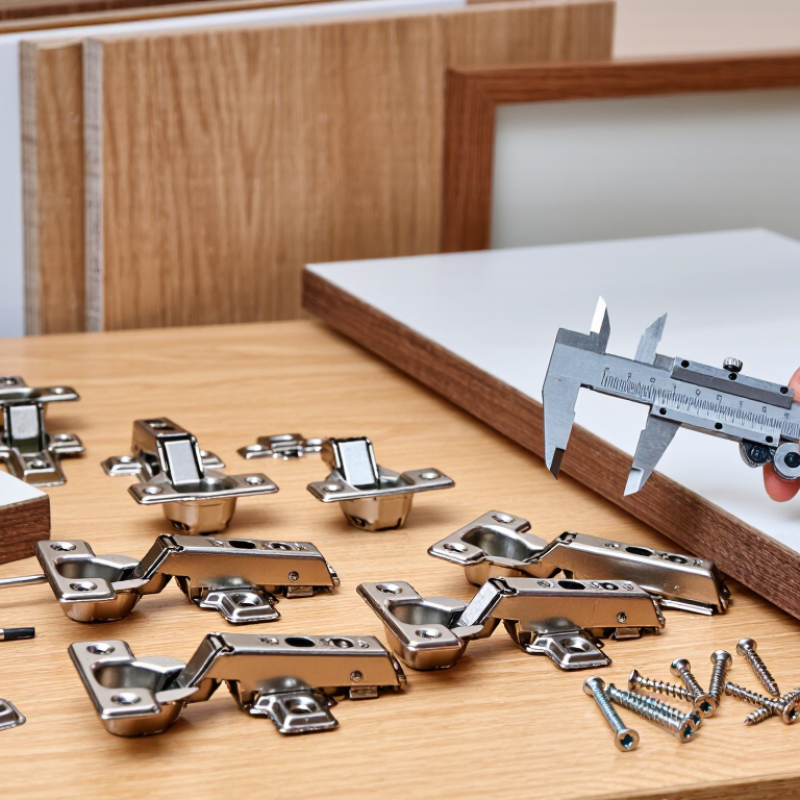
| Concealed European Hinge | Modern frameless or face-frame cabinet doors | Full overlay, half overlay, or inset | Commonly 95°–110°; wide-angle versions may reach approximately 165° | Clean appearance, concealed hardware, three-dimensional adjustment, soft-close options | Match the hinge cup size, mounting plate, overlay, door thickness, and cabinet construction |
| Inset Concealed Hinge | Doors fitted inside the cabinet opening | Full inset | Usually about 95°–110° | Supports a flush, furniture-style front and allows door alignment adjustments | The door, hinge, and mounting plate must provide sufficient clearance inside the cabinet |
| Face-Frame Hinge | Cabinets with a front supporting frame | Overlay or inset, depending on the hinge model | Commonly 95°–110° | Designed to attach to the cabinet face frame without requiring a separate frameless mounting arrangement | Measure the frame width and confirm the required overlay before ordering |
| Full-Overlay Hinge | Doors covering nearly the entire cabinet side or partition | Full overlay | Typically 95°–110° | Creates a continuous cabinet-front appearance with minimal visible gaps | Use the correct overlay value and maintain the manufacturer's recommended door gap |
| Half-Overlay Hinge | Two doors sharing one cabinet partition | Half overlay | Typically 95°–110° | Allows paired doors to use the same central partition while preserving a controlled gap | Check the partition thickness, shared overlay, and clearance between adjacent doors |
| Piano Hinge | Tall, narrow, lightweight doors or continuous-support applications | Surface-mounted along most or all of the door edge | Varies by knuckle and installation clearance | Distributes the load along the full height and can reduce local stress on the door | Select the correct leaf width, material thickness, screw pattern, and door weight capacity |
| Surface-Mount Butt Hinge | Traditional cabinet doors, utility cabinets, and visible-hardware designs | Mounted directly on the door and cabinet surface | Often approximately 90°–180°, depending on the design and stop position | Simple installation, durable construction, and compatibility with many door materials | Confirm screw placement, hinge thickness, door clearance, and whether the visible finish suits the design |
| Pivot Hinge | Lift-up, drop-front, or specialized doors requiring rotation around pivot points | Pivot-mounted at the top and bottom or at designated points | Determined by the pivot geometry and built-in stops | Provides a distinctive movement and can support designs where side hinges are unsuitable | Accurate drilling, balanced door weight, and precise alignment are essential for smooth operation |
| Glass-Door Hinge | Glass cabinet doors and display units | Surface-mounted or clamp-mounted, depending on the glass design | Commonly 90°–110° | Designed to hold glass without standard wood-door cup drilling | Verify glass thickness, edge condition, gasket requirements, and the permitted clamping force |