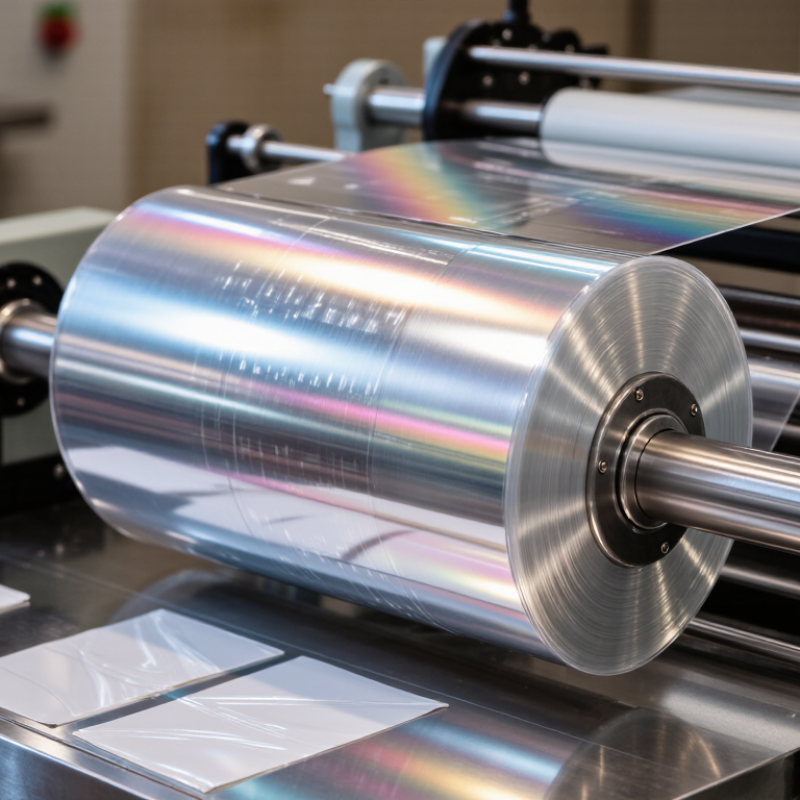
| Machine Definition | Holographic foil machine | A hot-stamping, cold-foiling, or embossing system configured to transfer a diffraction-based foil pattern | Applies a reflective holographic layer to paper, board, plastic film, labels, or other compatible substrates | Determines the available transfer method, production speed, registration accuracy, and substrate compatibility |
| Foil Construction | Carrier film | Usually a thin polyester film, commonly about 12–25 micrometres thick | Supports the coating layers during unwinding and transfer | Film thickness, stiffness, and dimensional stability influence feeding, wrinkling, and registration |
| Foil Construction | Release layer | A controlled low-adhesion coating between the carrier film and decorative layers | Allows the transferred layer to separate from the carrier at the correct temperature and pressure | Poor release balance can cause incomplete transfer, smearing, excessive waste, or premature separation |
| Foil Construction | Holographic image layer | Microstructured diffraction pattern formed by embossing or replication | Diffracts incident light to create changing colors, motion effects, or three-dimensional visual effects | Pattern depth, continuity, and replication accuracy control brightness, sharpness, and viewing-angle effects |
| Foil Construction | Reflective or metallized layer | Often a very thin vacuum-deposited metal layer or another reflective coating | Enhances contrast and reflects light from the holographic microstructure | Uniformity affects brightness, color consistency, opacity, and the visibility of fine details |
| Operating Principle | Unwinding and web control | Foil is fed from a roll through tension-controlled rollers | Maintains a stable foil path and presents the image area to the transfer zone | Incorrect tension can produce wrinkles, lateral movement, stretching, and image misregistration |
| Operating Principle | Heating system | Hot-stamping processes commonly operate approximately within 90–180°C, depending on foil, substrate, and tooling | Softens the adhesive or release system so the decorative layer can bond to the substrate | Too little heat causes weak or incomplete transfer; excessive heat can distort details, damage the substrate, or reduce gloss |
| Operating Principle | Stamping die or embossing cylinder | Engraved or patterned tooling matched to the required image and repeat length | Applies the image to selected areas and may combine transfer with physical embossing | Tool flatness, cleanliness, wear, and alignment affect edge definition, uniformity, and repeat accuracy |
| Operating Principle | Pressure | Set according to tooling area, substrate hardness, foil construction, and machine design; no single pressure value applies to all jobs | Creates intimate contact between the foil, die, adhesive, and substrate | Insufficient pressure causes skips and weak adhesion; excessive pressure can flatten details, mark the substrate, or increase foil waste |
| Operating Principle | Dwell time or contact time | The period during which heated tooling and foil remain in contact with the substrate | Controls heat transfer and adhesive activation during each impression | Short contact may reduce adhesion; long contact can lower productivity and increase thermal distortion |
| Production Performance | Line or sheet speed | Common production speeds range from tens to several hundred metres per minute, depending on process type and equipment | Determines throughput and changes the effective heat and pressure exposure | Higher speed may require optimized temperature, pressure, tension, and adhesive chemistry to maintain complete transfer |
| Substrate Compatibility | Paper and paperboard | Coated, uncoated, laminated, and label-grade materials can be used when surface energy and smoothness are suitable | Provides the receiving surface for the transferred layer | Porosity, coating uniformity, caliper, moisture, and surface roughness strongly affect adhesion and visual brightness |
| Substrate Compatibility | Plastic film and synthetic materials | Requires a foil adhesive system compatible with the polymer surface and any printed or coated layer | Enables holographic decoration on flexible packaging, labels, cards, and films | Surface energy, heat resistance, flexibility, and ink or coating compatibility determine bond strength and durability |
| Registration Control | Web tension and registration marks | Closed-loop or manual alignment systems may be used, depending on machine configuration | Keeps the holographic pattern aligned with printed graphics, die-cut shapes, or security features | Stable tension, accurate sensors, and consistent material dimensions reduce image drift and repeat errors |
| Environmental Conditions | Relative humidity | A controlled production environment is generally preferred; many paper-converting operations target approximately 45–55% relative humidity | Reduces dimensional changes and static-related handling problems | Large humidity changes can cause paper expansion, curl, static attraction, feeding instability, and registration variation |
| Surface Preparation | Ink, coating, varnish, or laminate condition | The receiving surface should be fully cured, clean, dry, and chemically compatible with the foil adhesive | Provides a stable bonding interface | Uncured ink, excess varnish, silicone contamination, or poor surface energy can cause pinholes, peeling, and low adhesion |
| Visual Quality | Brightness and color shift | Depends on reflective-layer uniformity, microstructure, viewing angle, illumination, and substrate color | Creates the characteristic rainbow, motion, depth, or color-changing appearance | Non-uniform replication, scratches, low contrast, and uneven transfer reduce optical impact and visual consistency |
| Durability | Abrasion, rub, moisture, and chemical resistance | Varies with adhesive formulation, protective overprint, laminate, substrate, and curing conditions | Protects the transferred holographic image during converting, transport, and end use | A suitable protective layer can improve resistance, while poor curing or incompatible coatings may cause scuffing and delamination |
| Common Defects | Incomplete transfer or missing areas | Often associated with insufficient heat, pressure, dwell time, surface energy, or adhesive activation | Reduces image coverage and weakens the visual effect | Corrective actions include adjusting process settings, cleaning tooling, improving substrate preparation, and verifying foil compatibility |
| Common Defects | Wrinkles, streaks, and silvering | Usually linked to unstable tension, misalignment, uneven pressure, damaged rollers, or surface contamination | Creates visible defects across the transferred pattern | Reduces saleable yield and may indicate a mechanical or material-handling problem rather than a temperature issue alone |
| Quality Verification | Key inspection checks | Coverage, registration, image sharpness, brightness, rub resistance, adhesion, and defect rate | Confirms that the finished holographic decoration meets functional and visual requirements | Consistent sampling and documented process settings improve repeatability and reduce production variation |
| Process Optimization | Balanced process window | The best result is achieved by balancing temperature, pressure, dwell time, speed, tension, and substrate condition | Creates adequate adhesion and optical performance without damaging the material | Small controlled trials are recommended because the optimum settings vary by foil construction, tooling, substrate, and machine design |