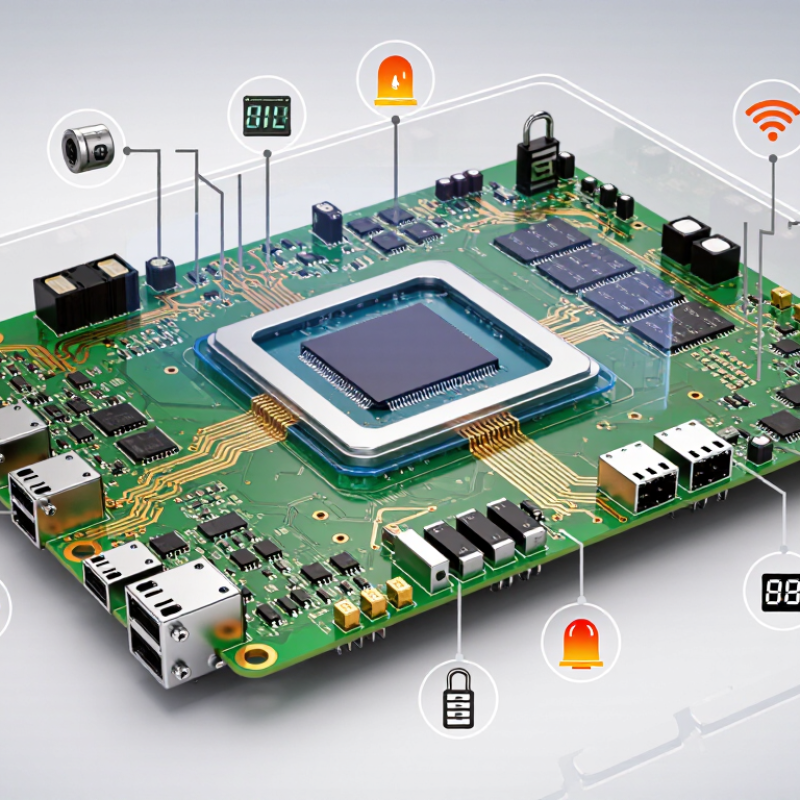
| Central Processing Unit | Executes program instructions | Fetches, decodes, and processes instructions using arithmetic, logic, and control operations. | Usually includes one or more processing cores; performance depends on clock frequency, architecture, and instruction efficiency. | Acts as the main decision-making unit that controls system behavior. |
| Program Memory | Stores firmware and constant data | Retains instructions so the processor can start and run the embedded application after power is applied. | Common technologies include flash memory, read-only memory, and electrically erasable nonvolatile memory. | Holds the operating logic, control algorithms, and startup code. |
| Data Memory | Stores temporary variables and runtime information | Provides fast read and write access while the processor is executing instructions. | Static random-access memory is commonly used for temporary data because it is fast and does not require refresh cycles. | Supports calculations, buffers, task management, and temporary state information. |
| Nonvolatile Data Storage | Preserves settings and data without power | Stores calibration values, configuration parameters, event logs, or user preferences after the system is turned off. | Typically offers lower write endurance than volatile memory and may require special write-management techniques. | Maintains important information across power cycles. |
| Clock and Timing Circuitry | Provides synchronized timing signals | Generates or distributes clock pulses that coordinate processor operations and peripheral activity. | May use an internal oscillator, an external crystal, or a phase-locked loop for frequency control. | Determines operating speed and keeps digital operations synchronized. |
| General-Purpose Input/Output | Connects the chip to external digital signals | Configurable pins read logic levels from sensors or switches and drive external actuators, indicators, or control circuits. | Pins may support input, output, pull-up, pull-down, interrupt, or alternate peripheral functions. | Provides flexible digital interaction with the surrounding hardware. |
| Analog-to-Digital Converter | Converts analog signals into digital values | Samples an input voltage and represents its amplitude as a numerical code for processing by the CPU. | Important specifications include resolution, sampling rate, input range, and conversion accuracy. | Allows the chip to measure physical quantities such as temperature, pressure, light, and voltage. |
| Digital-to-Analog Converter | Generates analog output signals | Transforms digital codes into proportional voltages or currents for external circuits. | Performance is described by resolution, update rate, output range, and linearity. | Supports audio generation, analog control, waveform output, and calibration functions. |
| Timers and Counters | Measure time and generate scheduled events | Count clock pulses to create delays, measure signal periods, or produce periodic interrupts. | Often support input capture, output compare, pulse-width modulation, and event counting. | Controls precise timing, motor speed, signal generation, and periodic tasks. |
| Interrupt Controller | Responds quickly to important events | Pauses normal program execution and directs the processor to a specific service routine when an interrupt occurs. | Can manage external interrupts, timer events, communication events, and internal fault conditions. | Improves responsiveness without requiring the CPU to continuously poll every event. |
| Communication Interfaces | Exchange data with other devices | Use defined electrical and communication protocols to transmit and receive digital information. | Common interfaces include serial peripheral interface, inter-integrated circuit, universal asynchronous receiver-transmitter, controller area network, and universal serial bus. | Connects the embedded chip to sensors, memory devices, displays, controllers, and networks. |
| Pulse-Width Modulation Unit | Controls average power or analog-like output | Adjusts the duty cycle of a digital pulse train to regulate delivered energy or represent a control value. | Key parameters include frequency, duty-cycle resolution, output channels, and synchronization options. | Controls motors, LED brightness, heaters, power converters, and servos. |
| Power Management Circuitry | Regulates and distributes internal power | Converts and controls supply voltage for different internal circuit domains and operating modes. | May include voltage regulators, brownout detection, sleep modes, and power-on reset functions. | Improves reliability, energy efficiency, and safe startup behavior. |
| Reset and Watchdog Timer | Recovers the system from abnormal conditions | Resets the chip when power is unstable, startup conditions are invalid, or software fails to periodically respond. | Watchdog intervals are configurable; reset sources can include external pins, voltage faults, and software commands. | Helps maintain autonomous operation in unattended equipment. |
| Debug and Test Circuitry | Supports software development and hardware diagnosis | Provides controlled access for programming, tracing, breakpoints, register inspection, and production testing. | May use dedicated debug pins or shared communication pins, depending on the chip design. | Reduces development time and helps identify faults during manufacturing and maintenance. |
| Operating Temperature Range | Defines acceptable environmental conditions | Specifies the temperature limits within which electrical performance and reliability are guaranteed. | Ranges vary by device category and application; wider ranges generally support more demanding environments. | Determines whether the chip is suitable for consumer, industrial, automotive, or specialized equipment. |
| Power Consumption | Determines energy usage and heat generation | Depends on clock activity, supply voltage, circuit load, memory access, and active or sleep mode. | Often specified as active, standby, sleep, and leakage current or power values. | Influences battery life, thermal design, enclosure size, and system operating cost. |