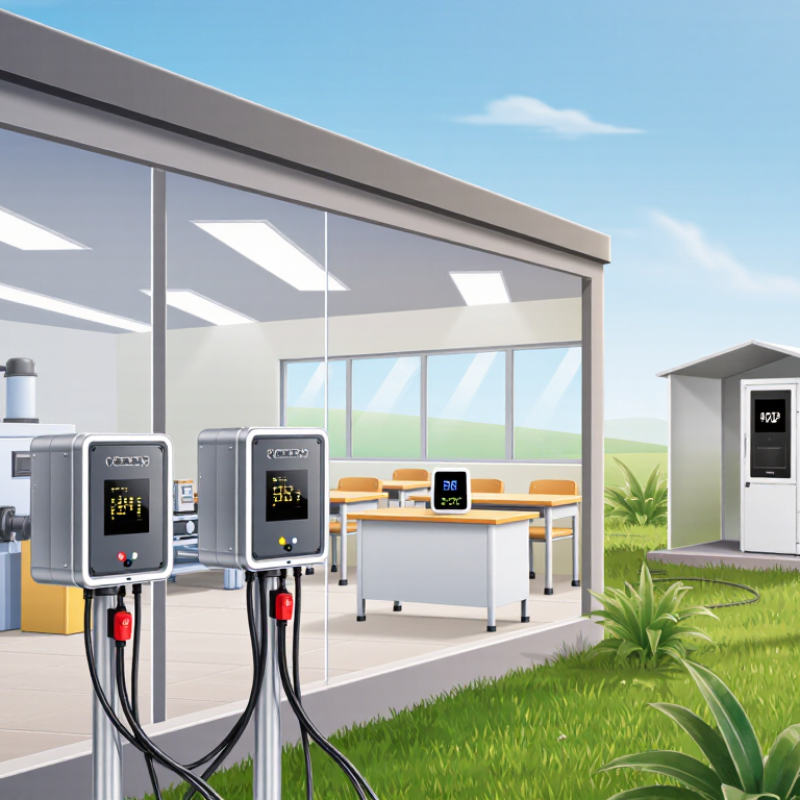
| Offices, classrooms and public buildings | Carbon dioxide, temperature, relative humidity and ventilation performance | Indoor air quality monitor with NDIR CO2 sensor | CO2: commonly 0–5,000 ppm; temperature and relative humidity displayed simultaneously | Continuous, non-dispersive infrared measurement for CO2 | Automatic baseline adjustment, data logging, display visibility, alarm thresholds and stable performance at changing humidity | CO2 is a ventilation indicator, not a complete measure of indoor air quality. Avoid placing the sensor directly beside occupants, doors or supply-air outlets. |
| Urban areas and outdoor ambient-air stations | Particulate matter such as PM1, PM2.5, PM10 and sometimes black carbon | Ambient particulate monitor or optical particle counter | PM2.5 and PM10 are commonly reported in µg/m³; particle counters may report size channels from approximately 0.3 µm upward | Light scattering with controlled airflow; reference-grade systems may use gravimetric or equivalent methods | Size range, inlet design, flow control, weather protection, time resolution and documented performance against an applicable reference or equivalent method | Optical readings can be affected by particle composition, shape and humidity. High humidity may cause hygroscopic particles to appear larger. |
| Industrial workplaces with dust-generating processes | Worker exposure to inhalable, thoracic or respirable dust | Personal aerosol sampling pump with size-selective sampler and filter cassette | Airflow is commonly set within approximately 1–4 L/min, depending on the sampler and analytical method | Time-integrated filter sampling followed by laboratory gravimetric or chemical analysis | Constant-flow control, flow calibration before and after sampling, suitable sampling head, battery life and worker comfort | Results depend on sampling duration, filter handling and laboratory analysis. A direct-reading monitor should not automatically replace a validated personal exposure method. |
| Combustion areas, garages and boiler rooms | Carbon monoxide and, where relevant, nitrogen dioxide or oxygen deficiency | Portable electrochemical gas detector or multi-gas monitor | CO sensors commonly cover 0–500 ppm or higher; oxygen sensors commonly cover 0–25% by volume | Electrochemical sensing with diffusion or pumped sampling | Sensor cross-sensitivity, response time, audible and visual alarms, bump testing, intrinsically safe construction where required and data logging | Electrochemical sensors have finite service lives and may be affected by temperature, humidity and interfering gases. Alarm limits must follow the applicable safety regulation. |
| Chemical production, laboratories and storage areas | Specific toxic gases, solvent vapors or oxygen concentration | Single-gas or multi-gas monitor selected for the target compounds | Varies by gas; common outputs include ppm, % by volume or parts per billion for low-level applications | Electrochemical, photoionization detection, infrared or other compound-specific sensing | Target-gas selectivity, detection limit, measurement range, sensor compatibility, sampling-line materials and alarm management | Photoionization detectors respond to many volatile compounds but do not identify each compound individually. Response factors and humidity effects must be considered. |
| Industrial hygiene surveys for volatile organic compounds | Screening for VOC leaks, process emissions and short-term concentration changes | Portable photoionization detector with data logging | Many instruments cover approximately 0.1–10,000 ppm isobutylene-equivalent, depending on configuration | Ultraviolet photoionization using a lamp selected for the target compounds | Ionization potential of the target chemical, lamp energy, response factor, humidity compensation, pump performance and alarm response | Readings are often displayed as an equivalent concentration rather than a compound-specific result. Confirmatory laboratory sampling may be required. |
| Cleanrooms, pharmaceutical areas and controlled manufacturing spaces | Airborne particle concentration and cleanroom classification verification | Calibrated airborne particle counter with isokinetic or appropriate sampling probe | Common particle channels include 0.3, 0.5, 1.0, 5.0 and 10 µm; results are reported as particles per cubic metre or cubic foot | Laser light-scattering particle counting with defined sample volume | Particle-size calibration, sample-flow accuracy, sample-volume control, tubing cleanliness, probe design and compliance with the applicable cleanroom standard | The instrument measures airborne particles, not biological viability. Sampling technique and instrument cleanliness are critical in low-concentration environments. |
| Outdoor construction sites and environmental impact assessments | Dust concentration, wind conditions and boundary monitoring | Enclosed particulate monitor combined with weather station sensors | Particulate results commonly reported in µg/m³; wind speed, wind direction, temperature and humidity are recorded at defined intervals | Continuous optical particle measurement with meteorological logging | Weatherproof enclosure, heated inlet where necessary, solar or mains power, remote communications, anti-condensation protection and secure mounting | Construction dust composition can differ from the calibration aerosol. Correlation with gravimetric samples improves interpretation and reporting confidence. |
| Stack emissions and process exhaust ducts | Gases, particulate matter, oxygen, flow rate and temperature in exhaust streams | Extractive or in-situ emissions monitoring system with heated sampling components where required | Ranges depend on the process; gas concentrations may be reported in ppm or mg/m³, with results corrected to specified oxygen and reference conditions | Non-dispersive infrared, ultraviolet absorption, paramagnetic oxygen, electrochemical or gravimetric methods | Sampling location, gas conditioning, condensation control, high-temperature compatibility, calibration gases, response time and regulatory method requirements | Wet, hot or corrosive gases can damage sensors and bias results. Sampling and calculation procedures must follow the applicable emissions standard. |
| Mines, tunnels, confined spaces and emergency response | Oxygen deficiency, combustible gases and toxic gases | Portable intrinsically safe four-gas or multi-gas detector with pump option | Typical measurements include oxygen in % by volume, combustible gas as %LEL, and toxic gases in ppm | Electrochemical, catalytic-bead or infrared sensing, selected according to the hazard | Intrinsic safety certification, alarm reliability, pump sampling distance, ruggedness, battery endurance, docking or calibration capability | Catalytic sensors require oxygen to respond to combustible gases and may be poisoned by certain compounds. Perform a bump test and calibration according to the safety program. |
| Biological laboratories, healthcare areas and research facilities | Airborne biological particles, aerosols and contamination-control conditions | Bioaerosol sampler used with a calibrated air pump, often alongside a particle counter | Air volume is selected according to the sampling method; results may be reported as colony-forming units per cubic metre or particles per cubic metre | Impaction, filtration or liquid impingement followed by culture, microscopy or molecular analysis | Collection efficiency, sample volume, preservation method, sterile handling, flow-rate accuracy and laboratory detection capability | Particle counters do not determine whether particles are viable or infectious. Biological results are highly dependent on sampling and analysis procedures. |