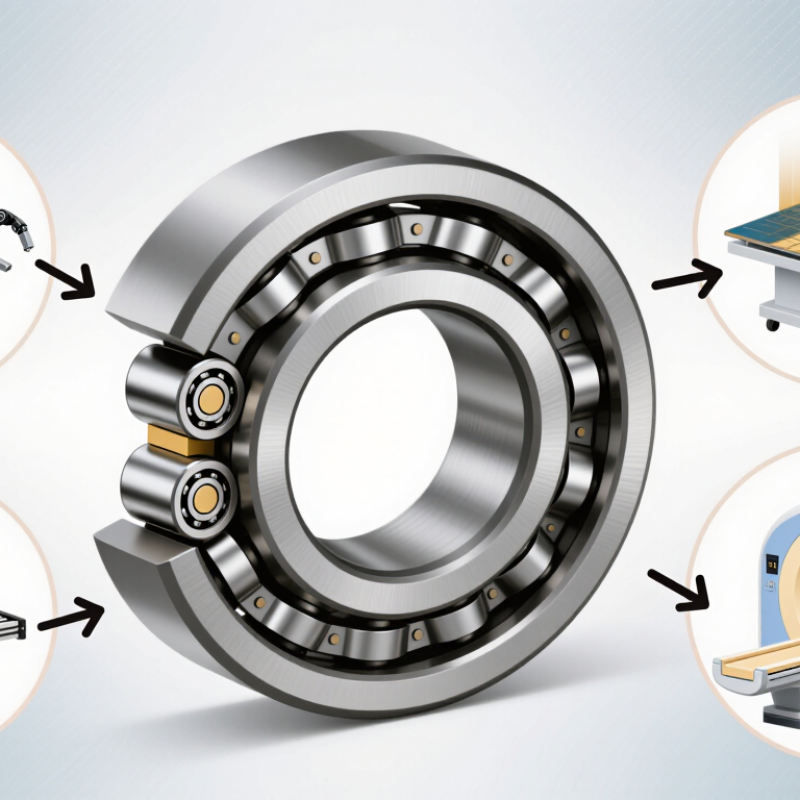
| Crossed Roller Ring Bearing | Two raceways and cylindrical rollers arranged alternately at 90°. | Rotary tables, indexing mechanisms, robotic joints, inspection equipment, and compact rotary axes. | Supports radial, axial, and moment loads simultaneously in a compact envelope. High overturning-moment stiffness is available when the bearing diameter is large relative to the applied moment. | Suitable when low runout, repeatable rotation, and a rigid mounting structure are required. | Preload improves rigidity and reduces clearance, but excessive preload increases friction, heat, and required drive torque. | Check radial load, axial load, overturning moment, mounting flatness, bolt pattern, and calculated L₁₀ life. |
| Crossed Roller Way | Roller cage and raceway pair used for linear motion. | Linear stages, measuring systems, optical equipment, semiconductor machinery, and precision slides. | Provides high linear stiffness and load capacity in a relatively small cross-section. Load distribution depends strongly on rail parallelism and mounting accuracy. | Best for short or medium travel where smooth motion and high repeatability are more important than long travel speed. | Light preload can improve motion quality. Excessive preload may cause stick-slip, higher drive force, and accelerated wear. | Check travel length, stroke frequency, acceleration, load center height, rail parallelism, and contamination control. |
| Split or Separable Crossed Roller Assembly | Separate inner and outer race components assembled around a shaft, housing, or mounting structure. | Applications requiring simplified installation, removable shafts, or special housing geometries. | Can provide high rigidity, but the final performance depends on housing accuracy, clamping, and raceway alignment. | Useful where service access or installation flexibility is important; mounting tolerances must be controlled carefully. | Preload is normally set during assembly. Adjustment should be gradual and verified by torque, runout, and temperature checks. | Verify assembly method, raceway alignment, preload adjustment range, shaft and housing tolerances, and service conditions. |
| Compact Crossed Roller Bearing | Integrated bearing with a small radial section and closely spaced rollers. | Compact rotary actuators, small positioning stages, camera mechanisms, and laboratory instruments. | Provides a favorable stiffness-to-size ratio, but allowable load and moment capacity are lower than those of larger-section bearings. | Appropriate where space is limited and moderate loads must be combined with controlled rotational accuracy. | Requires careful lubrication because the smaller internal volume can be more sensitive to lubricant quantity and contamination. | Check envelope dimensions, static safety factor, operating speed, lubrication interval, and thermal conditions. |
| ISO 281 L₁₀ Life Verification Examples for Generic Roller Bearings |
| Example | Application Condition | C: Dynamic Load Rating | P: Equivalent Dynamic Load | p Value | L₁₀ Basic Rating Life | Approximate Life at Stated Speed |
| A | Moderate rotary load with stable lubrication | 50 kN | 5 kN | 10/3 | (50/5)^(10/3) × 10⁶
≈ 2,154 million revolutions | ≈ 299,167 h at 120 r/min |
| B | High-load rotary axis with a balanced load distribution | 100 kN | 10 kN | 10/3 | (100/10)^(10/3) × 10⁶
≈ 2,154 million revolutions | ≈ 149,583 h at 240 r/min |
| C | Compact bearing with a relatively high applied load | 30 kN | 6 kN | 10/3 | (30/6)^(10/3) × 10⁶
≈ 214 million revolutions | ≈ 59,444 h at 60 r/min |
| D | Linear-stage equivalent load converted to bearing load | 80 kN | 20 kN | 10/3 | (80/20)^(10/3) × 10⁶
≈ 102 million revolutions | ≈ 14,167 h at 120 r/min equivalent speed |
| Practical Selection Criteria |
| Criterion | What to Determine | Recommended Engineering Check | Effect on Bearing Selection |
| Combined Loading | Radial force, axial force, and overturning moment. | Convert the actual load condition into an equivalent dynamic load P using the selected bearing manufacturer's calculation method. | A bearing with a higher C value or larger effective moment arm may be required when combined loads are significant. |
| Static Safety | Shock loads, emergency stops, clamping forces, and standstill loads. | Compare the maximum static equivalent load with the static load rating C₀ and apply an appropriate safety factor. | Static capacity may govern selection even when calculated L₁₀ life is adequate. |
| Rigidity | Required deflection under operating load and moment. | Evaluate bearing stiffness, preload, mounting structure, and raceway deformation together. | Higher preload and larger bearing geometry generally improve rigidity but may increase friction and heat. |
| Speed and Motion | Rotational speed, stroke frequency, acceleration, and duty cycle. | Check permissible speed, lubrication method, cage behavior, and temperature rise. | High acceleration or frequent reversing may require a suitable cage design, lubricant, and preload level. |
| Mounting Accuracy | Housing roundness, flatness, parallelism, shaft fit, and bolt tightening sequence. | Follow the applicable precision bearing installation tolerances and measure runout after mounting. | Poor mounting accuracy can reduce load sharing, increase friction, and shorten practical life even when the ISO 281 calculation is acceptable. |
| Environment | Dust, moisture, vacuum, temperature, chemicals, and cleaning agents. | Select seals, lubricant, corrosion protection, and maintenance intervals for the actual environment. | Contamination and inadequate lubrication can make actual service life substantially lower than calculated basic rating life. |