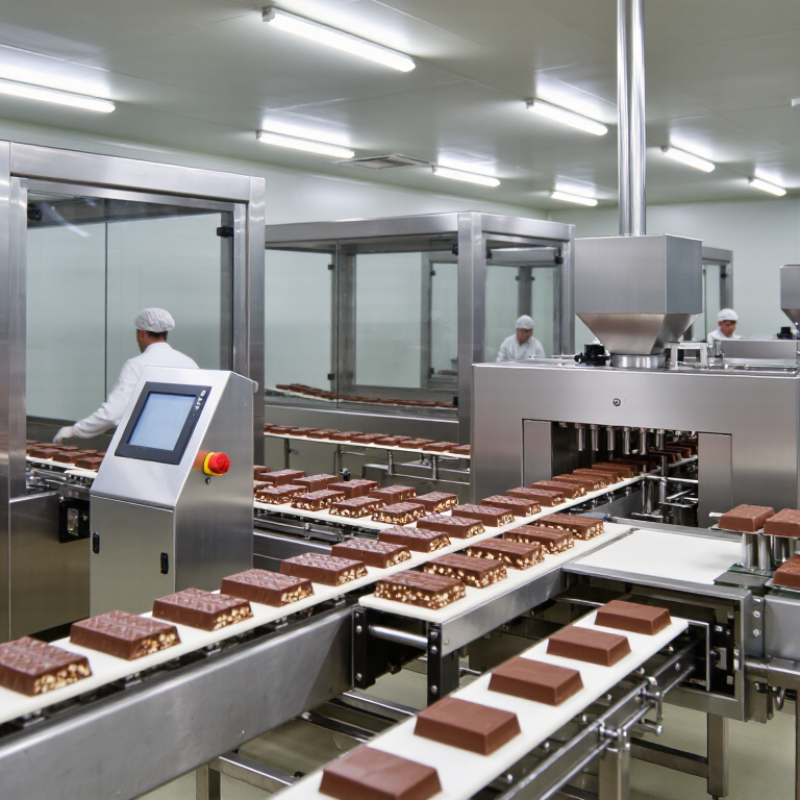
| 1. Ingredient Preparation | Prepare cocoa mass, cocoa butter, sugar, milk powder, emulsifiers, and flavor ingredients for consistent dosing and processing. | Ingredient temperature commonly maintained above the fat-melting point.
Typical cocoa butter melting range: approximately 32–35°C. | Load cells, dust-controlled feeding, ingredient filters, heated tanks, and recipe-based dosing controls. | Accurate ingredient weighing, stable material temperature, low foreign-matter risk, and repeatable recipes. | Batch size Recipe flexibility Dust control | Dosing errors, ingredient clumping, moisture pickup, and contamination. |
| 2. Mixing | Distribute dry and liquid ingredients evenly and create a uniform chocolate paste before particle-size reduction. | Common mixing temperature: approximately 40–50°C, depending on formulation.
Mixing time often ranges from 10–30 minutes. | Heated jacket, robust agitator, controlled scraper action, hygienic discharge, and variable-speed drive. | Uniform color, consistent fat distribution, no visible dry pockets, and stable feed to the refiner. | Agitator design Working volume Heating control | Uneven blending, excessive aeration, overheating, and incomplete discharge. |
| 3. Refining | Reduce sugar and cocoa particles to improve smoothness and prevent a gritty mouthfeel. | Finished particle size is commonly targeted around 18–25 micrometers for smooth chocolate products.
Exact targets depend on recipe and sensory requirements. | Five-roll refiner or equivalent system, adjustable roll pressure, cooling control, and gap monitoring. | Particle-size distribution, smoothness, throughput stability, and absence of excessive metal wear particles. | Target particle size Throughput Roll cooling | Over-refining, coarse particles, roll overheating, and unstable feed consistency. |
| 4. Conching | Develop flavor, reduce undesirable volatile compounds, improve coating of particles with fat, and adjust rheology. | Typical conching temperatures:
Milk chocolate: approximately 45–60°C.
Dark chocolate: approximately 50–80°C.
Time may range from 2–24 hours depending on recipe and equipment. | Heated vessel, high-shear or kneading action, controlled ventilation, variable-speed drive, and accurate temperature measurement. | Balanced aroma, reduced acidity, smooth texture, target viscosity, and consistent moisture level. | Flavor profile Energy use Batch or continuous | Flavor loss, excessive oxidation, moisture variation, and inconsistent viscosity. |
| 5. Holding and Filtration | Keep finished chocolate fluid and remove agglomerates or foreign particles before tempering and molding. | Holding temperature is commonly maintained approximately 2–5°C above the chocolate’s working temperature, according to formulation. | Insulated or heated tank, slow agitator, sanitary pump, inline filter, and level control. | Stable viscosity, uniform temperature, clean product flow, and minimal residence-time variation. | Tank capacity Filter rating Pump shear | Fat separation, blocked filters, temperature stratification, and prolonged residence time. |
| 6. Tempering | Form stable cocoa-butter crystals to produce a glossy surface, clean snap, and resistance to fat bloom. | Typical dark chocolate cycle: heat to about 45–50°C, cool to about 27–28°C, then rewarm to about 31–32°C.
Milk and white chocolate generally use lower final working temperatures. | Multi-zone heat exchanger, automatic temperature control, continuous agitation, bypass loop, and temper index monitoring. | Gloss, snap, contraction from molds, stable viscosity, and correct crystal formation. | Chocolate type Flow rate Control accuracy | Fat bloom, dull appearance, poor demolding, thickening, and unstable temper. |
| 7. Molding and Depositing | Deposit a precise quantity of tempered chocolate into bar molds and create the required shape and weight. | Depositing temperature is normally close to the selected working temperature of the tempered chocolate.
Weight tolerance should be defined by product specification. | Servo-controlled depositor, interchangeable molds, vibration table, automatic mold transport, and recipe storage. | Bar weight, fill level, surface definition, dimensional accuracy, and absence of air pockets. | Bar geometry Mold changeover Deposit accuracy | Underfilling, overfilling, trapped air, incomplete mold coverage, and product leakage. |
| 8. Cooling and Demolding | Solidify the chocolate evenly and release finished bars without distortion or surface defects. | Cooling tunnel conditions commonly use controlled air temperature and humidity.
Product temperature must be reduced gradually enough to limit condensation and thermal stress. | Multi-zone cooling tunnel, insulated enclosure, adjustable airflow, humidity monitoring, and automated demolding. | Complete solidification, clean edges, stable dimensions, glossy surface, and easy release from molds. | Tunnel length Cooling capacity Humidity control | Condensation, cracking, warping, sticking, and uneven cooling. |
| 9. Inspection and Packaging | Verify finished-product compliance and protect bars from moisture, oxygen, light, odor transfer, and physical damage. | Inspection may include weight, appearance, seal integrity, metal detection, and code verification.
Storage should be cool, dry, and protected from temperature fluctuations. | Checkweigher, metal detector, vision inspection, date coder, flow wrapper, and case packer. | Correct weight, intact packaging, readable coding, clean appearance, and conformity with specifications. | Pack format Line speed Traceability | Seal failure, incorrect coding, package contamination, and temperature-related bloom. |