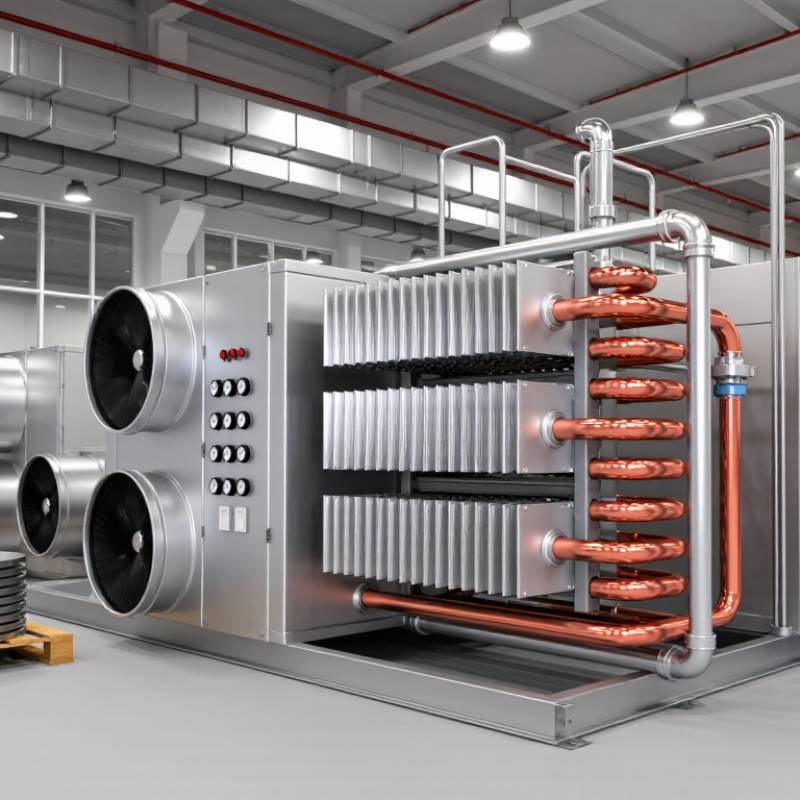
| Heat-Transfer Materials | Fins and tubes must match the thermal load, operating temperature, humidity, and fluid chemistry. | Aluminum alloys such as 3003 or 3102 are commonly used for fins. Copper or copper alloys may be selected for high thermal conductivity. Stainless steel grades such as 304L or 316L are suitable when corrosion resistance is more important. | Material certificates, grade specifications, chemical composition reports, and corrosion-resistance documentation where applicable. | 15% | Reject suppliers that cannot provide traceable material identification for production batches. |
| Design and Thermal Performance | The exchanger must meet the required air volume, inlet and outlet temperatures, pressure drop, and heat-transfer duty. | Require a design calculation based on defined air velocity, fluid flow rate, fouling assumptions, ambient conditions, and allowable pressure drop. Performance should be verified against the applicable coil or heat-exchanger specification. | Thermal selection sheet, performance curves, pressure-drop calculations, design assumptions, and tolerance information. | 18% | Compare suppliers using identical operating conditions rather than relying only on nominal capacity. |
| Applicable Manufacturing Standards | Production processes should be controlled under recognized quality and fabrication systems. | ISO 9001 quality management certification is a useful baseline. ISO 3834 may be relevant for fusion-welded components. Pressure-bearing designs may require compliance with applicable pressure-vessel codes, such as ASME Section VIII or EN 13445, depending on jurisdiction and service conditions. | Current certificates, scope of certification, controlled procedures, welding qualifications, and code-compliance statements. | 12% | Verify that the certificate scope covers the actual manufacturing site and product type. |
| Tube-to-Fin and Joint Integrity | Mechanical expansion, brazing, soldering, or welding must provide durable thermal contact and leak resistance. | The supplier should define process parameters, joint-clearance controls, expansion methods, filler-metal selection, and inspection requirements. Joint design must account for thermal cycling and differential expansion. | Process qualification records, work instructions, joint inspection results, filler-metal certificates, and sample cross-sections when required. | 12% | Give preference to suppliers that can demonstrate repeatable joint quality through documented process controls. |
| Leak and Pressure Testing | All fluid circuits must be tested before shipment. | Require a documented pressure or leak-test method appropriate to the design pressure and fluid. Common methods include hydrostatic testing, pneumatic testing with suitable safety controls, pressure-decay testing, or tracer-gas testing for high-sensitivity applications. | Approved test procedure, test pressure and duration, calibrated-gauge records, leak-rate limits, and signed test reports linked to serial or batch numbers. | 15% | Do not accept a generic “100% tested” statement without test parameters and traceable results. |
| Dimensional and Visual Inspection | Coil dimensions, connections, fin spacing, frame alignment, and surface condition must conform to the approved drawing. | Use controlled drawings with defined tolerances. Inspect tube-end condition, fin damage, brazed or welded joints, coating coverage, drain-pan slope, and connection orientation before packing. | Inspection and test plan, dimensional inspection report, approved drawings, photographs, and nonconformance records. | 10% | Require first-article approval for new designs and documented corrective action for deviations. |
| Corrosion Protection | Materials and finishes must suit the installation environment, including condensation, salt exposure, chemicals, and outdoor service. | Specify bare metal, anodizing, epoxy or other coating systems only after defining the exposure category. Dissimilar-metal joints should be assessed for galvanic corrosion, especially in wet environments. | Coating specification, surface-preparation method, coating-thickness records, salt-spray or environmental test data when applicable. | 8% | Evaluate the complete assembly, not only the fin material; frames, fasteners, headers, and drain pans also affect service life. |
| Traceability and Quality Records | Materials, processes, inspections, and shipment information must be traceable to each unit or production batch. | A robust system should link raw-material heat or batch numbers, production records, operator or equipment identification, inspection results, and final serial numbers. | Traceability matrix, batch records, calibration certificates, inspection logs, release certificate, and retention-period policy. | 8% | Prefer suppliers that can retrieve complete quality records quickly and consistently during an audit. |