| Geotextile | Separation, filtration, drainage, reinforcement, or erosion control | Road subgrades, railway foundations, drainage trenches, retaining structures, coastal works, and erosion-control systems | Mass per unit area, tensile strength, elongation, puncture resistance, apparent opening size, permittivity, and transmissivity | Use a nonwoven geotextile when filtration and drainage are dominant; use a woven geotextile when higher tensile strength and separation are required. Filter opening size must be compatible with the surrounding soil. | ASTM D4595 or ISO 10319 for tensile properties; ASTM D4751 for apparent opening size; ASTM D4491 for permittivity; ASTM D4716 for transmissivity | Clogging, installation damage, ultraviolet exposure before covering, chemical degradation, and loss of drainage capacity under compression | Confirm soil gradation, hydraulic conditions, survivability requirements, and required filtration criteria. |
| Geogrid | Soil reinforcement and load distribution | Mechanically stabilized earth walls, reinforced slopes, pavement base reinforcement, working platforms, and embankments over weak soil | Junction strength, tensile strength, tensile stiffness, aperture geometry, resistance to installation damage, and interaction with aggregate or soil | Performance depends on aggregate interlock, confinement, loading direction, and strain level; short-term tensile strength alone is not sufficient for design. | ASTM D6637 or ISO 10319 for tensile properties; ASTM D7737 for junction strength; project-specific installation-damage and pullout testing where required | Installation damage, creep under sustained load, stress cracking, chemical exposure, and inadequate anchorage or pullout resistance | Verify design tensile stiffness, connection or junction strength, pullout resistance, and reduction factors for creep and damage. |
| Geomembrane | Liquid or gas barrier and containment | Landfill liners and covers, mining leach pads, wastewater ponds, irrigation reservoirs, secondary containment, and hazardous-liquid storage | Thickness, tensile strength, elongation, tear resistance, puncture resistance, seam strength, stress-crack resistance, and permeability | Typical polymer options include HDPE, LLDPE, PVC, and flexible polypropylene. Material selection must match chemical exposure, temperature, subgrade conditions, and required service life. | ASTM D6693 or ISO 527 for tensile properties; ASTM D1004 for tear resistance; ASTM D4833 for puncture resistance; ASTM D6392 or ISO 15221 for seam strength; ASTM D5885 for stress-crack resistance | Seam defects, puncture, differential settlement, thermal expansion and contraction, oxidation, stress cracking, and prolonged ultraviolet exposure | Require a documented welding plan, trial seams, non-destructive seam testing, destructive sampling, and final leak detection where applicable. |
| Geosynthetic Clay Liner (GCL) | Low-permeability hydraulic barrier | Landfill caps and liners, canals, ponds, secondary containment, and composite liner systems | Bentonite mass per unit area, swell index, fluid loss, hydraulic conductivity, peel strength, and internal shear strength | Hydraulic conductivity is commonly designed at approximately 1 × 10⁻¹¹ m/s or lower when properly hydrated and confined; actual performance depends strongly on the permeant and installation conditions. | ASTM D5887 for hydraulic conductivity; ASTM D5890 for swell index; ASTM D5891 for fluid loss; ASTM D6496 for peel strength | Premature hydration, desiccation, bentonite compatibility with saline or contaminated liquids, wrinkles, overlap displacement, and poor confinement | Protect from rain and uncontrolled hydration, confirm chemical compatibility, and provide adequate overlap and confinement. |
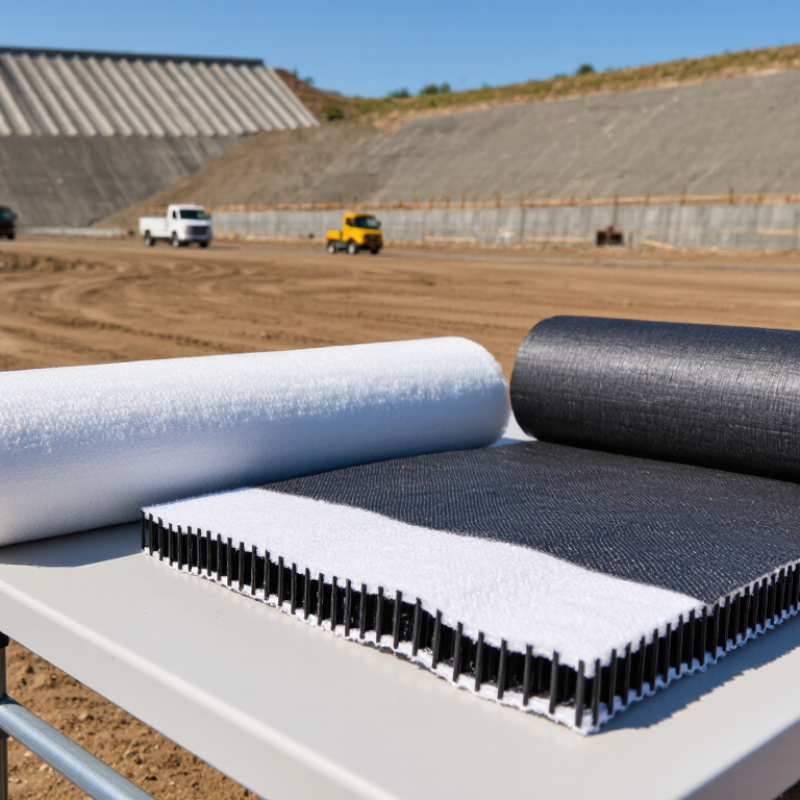
| Geocomposite Drainage Layer | In-plane drainage and fluid conveyance | Landfill covers, retaining walls, foundation drainage, road drainage, tunnel waterproofing protection, and vertical drainage systems | Transmissivity, compressive resistance, interface friction, filter compatibility, core thickness, and resistance to installation damage | Drainage capacity must be checked at the design normal stress, hydraulic gradient, temperature, and anticipated reduction over the service life. | ASTM D4716 for transmissivity; ASTM D1621 or project-specific compression testing; ASTM D5321 for interface shear; ASTM D4751 for filter opening size where a geotextile filter is included | Crushing or creep of the drainage core, filter clogging, blocked outlets, inadequate slope, and reduced flow under long-term compression | Calculate flow capacity using site-specific compressive stress and include an appropriate reduction factor for clogging and creep. |
| Geocell | Lateral confinement, load distribution, and erosion control | Unpaved roads, slope protection, channel lining, access roads, embankment reinforcement, and low-volume traffic areas | Cell depth, cell size, strip tensile strength, seam strength, aperture stability, anchorage, and infill compatibility | Performance is governed by cell confinement, infill quality, anchorage, and surface drainage. It is not a substitute for proper subgrade preparation or structural drainage. | ASTM D4883 for geocell seam or strip strength where applicable; ASTM D6637 for polymeric tensile properties; project-specific pullout and load-spreading tests | Seam failure, ultraviolet degradation before cover, infill migration, inadequate anchorage, and erosion at unprotected transitions | Verify cell geometry, seam strength, anchorage pattern, infill gradation, and surface-water management. |
| Erosion-Control Geosynthetic | Surface erosion protection and vegetation establishment | Channels, cut slopes, embankments, drainage swales, riverbanks, and temporary construction slopes | Open area, tensile strength, shear resistance, UV stability, permissible shear stress, anchorage, and vegetation compatibility | Temporary blankets are selected for the expected establishment period; permanent systems must be checked against design flow velocity, shear stress, and exposure duration. | ASTM D6818 for tensile properties of rolled erosion-control products; ASTM D6460 for large-scale rainfall or channel performance; manufacturer-independent project testing where needed | Uplift, undercutting, UV degradation, poor soil contact, insufficient anchorage, and damage from concentrated flow | Match the system to calculated hydraulic shear stress and install anchors, overlaps, and termination details exactly as designed. |
| Paving Fabric or Asphalt-Reinforcement Geosynthetic | Interlayer separation, crack reduction, and moisture control in pavement rehabilitation | Asphalt overlays, pavement rehabilitation, reflective-crack mitigation, and waterproofing beneath asphalt layers | Tensile strength, asphalt retention, melting or softening behavior, adhesion, puncture resistance, and installation temperature compatibility | Results depend on pavement condition, crack movement, surface preparation, tack coat, overlay thickness, and drainage. It cannot correct structural failures caused by unstable subgrade. | ASTM D6637 for tensile properties; ASTM D6140 for asphalt retention; project-specific interlayer bonding and reflective-crack testing | Debonding, wrinkling, inadequate tack coat, construction damage, moisture trapped beneath the overlay, and excessive crack movement | Repair failed pavement areas first, confirm surface dryness and bond requirements, and control paving temperature and placement. |
| Fiberglass or Polymer Geocomposite Reinforcement | Tensile reinforcement and crack-control support | Asphalt overlays, bridge approaches, industrial pavements, and localized structural rehabilitation | Longitudinal and transverse tensile strength, stiffness, bond strength, creep, alkali resistance where relevant, and installation survivability | Use design strains and loading cycles rather than nominal tensile strength alone. Reinforcement must be fully bonded and placed at the specified elevation within the pavement system. | ASTM D6637 or ISO 10319 for tensile properties; ASTM D5321 for interface shear; project-specific fatigue and reflective-crack testing | Insufficient bond, construction wrinkles, creep, chemical attack, poor overlap detailing, and reinforcement placed outside the effective tensile zone | Verify interface bond, overlap, strain compatibility, fatigue behavior, and construction tolerances. |