Best Trailer Wiring Harness Manufacturer in China?
Choosing the best Trailer wiring harness manufacturer in China requires more than comparing prices or glossy product photos. A dependable supplier should demonstrate practical experience, controlled production, and traceable quality records. The harness must fit the vehicle’s connector, circuit layout, and towing requirements precisely. Small errors can cause brake-light failures, poor grounding, or intermittent trailer signals.
W. Edwards Deming, a respected manufacturing-quality expert, said, “Quality comes not from inspection, but from the improvement of the production process.” This principle matters here. A capable Chinese manufacturer should control copper-strand quality, insulation thickness, terminal crimping, and connector sealing. Ask for material certificates, pin-out drawings, sample inspection reports, and documented test procedures. Look for testing under vibration, moisture, heat, and repeated bending. Real details matter. A sealed connector should remain secure after installation, not only inside a showroom.
No supplier is perfect. We may overvalue factory size and overlook engineering communication. A smaller manufacturer might provide better customization, faster feedback, and clearer technical support. However, those advantages need evidence. Review production samples, inspect crimp consistency, and confirm whether the team understands OEM specifications. The best Trailer wiring harness manufacturer in China should explain its process without vague promises. It should also identify limitations honestly. That transparency builds trust. A reliable partnership develops through accurate drawings, controlled revisions, responsive service, and consistent batch performance. Price matters, but failure on the road costs more.
What Is a Trailer Wiring Harness and Why Does It Matter?
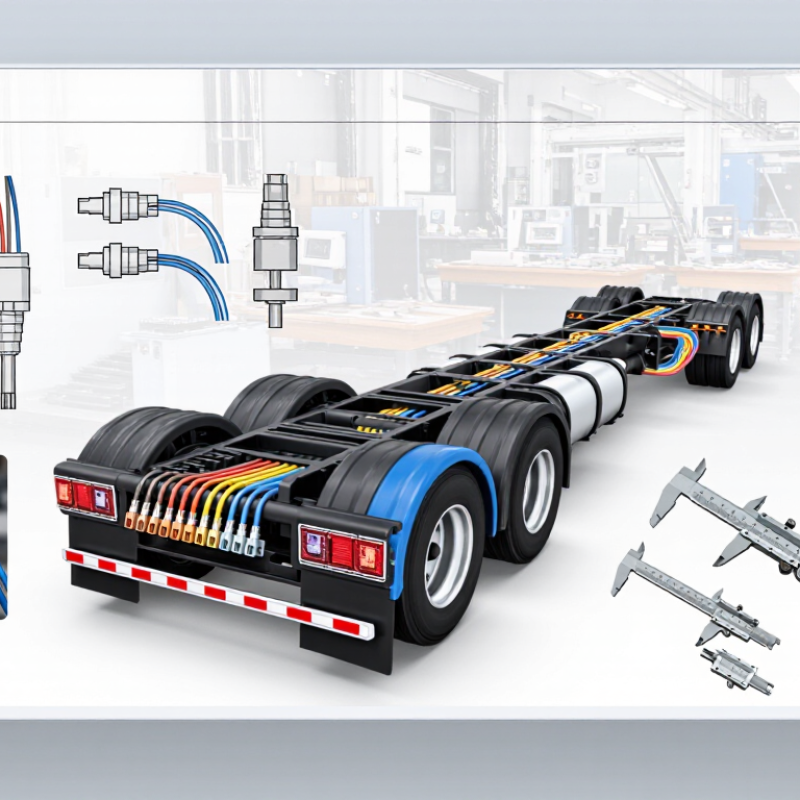
A trailer wiring harness is the electrical pathway between a towing vehicle and its trailer. It carries power for brake lamps, turn signals, marker lights, and sometimes electric brakes or reverse lamps. The harness includes insulated wires, connectors, terminals, and protective coverings. Every part must withstand vibration, road spray, heat, and repeated bending.
The connection matters because lighting faults can reduce a trailer’s visibility at night or during sudden braking. SAE J560, a widely used industry standard, specifies the seven-way trailer connector layout used for several essential circuits. Market research also shows strong demand for reliable wiring. Grand View Research valued the global automotive wiring harness market at more than USD 50 billion in 2023, with continued growth expected through the decade. That figure covers more than trailers, but it reflects the rising importance of dependable vehicle electrical systems.
Good harness design starts with correct wire gauges, sealed terminals, strain relief, and clear circuit identification. In practical inspections, corrosion often begins where water enters a connector, not where the wire appears damaged. A clean-looking plug can still fail under vibration. That is easy to underestimate. Choosing a manufacturer requires more than comparing prices; production testing, traceability, material consistency, and compliance with relevant standards deserve equal attention. Even experienced buyers should review connector fit and sealing performance under real towing conditions. Specs can look perfect on paper, yet field performance may tell a different story.
Best Trailer Wiring Harness Manufacturer in China? - What Is a Trailer Wiring Harness and Why Does It Matter?
| Harness Configuration | Common Trailer Application | Typical Circuits | Main Functions | Typical Connector | Common Wire Guidance | Key Selection Consideration |
| 4-Circuit Harness | Basic utility trailers and small cargo trailers | 4 | Ground, left stop/turn lamp, right stop/turn lamp, and tail/marker lamps | 4-way flat connector | Often 16–18 AWG for lighting circuits; confirm vehicle and trailer requirements | Suitable when no electric brakes, reverse lamps, or auxiliary power are required |
| 5-Circuit Harness | Trailers requiring a reverse-light or auxiliary signal | 5 | All 4 basic lighting circuits plus a reverse-lamp or auxiliary circuit | 5-way flat connector | Lighting circuits are commonly 16–18 AWG; auxiliary circuit size depends on load | Confirm whether the fifth pin is assigned to reverse lights, a lockout solenoid, or another auxiliary function |
| 6-Circuit Harness | Trailers with additional braking or auxiliary requirements | 6 | Basic lighting plus combinations of electric-brake output, reverse signal, or auxiliary power | 6-way round or 6-way square connector | Brake and power circuits generally require larger conductors than lighting circuits | Pin assignments are not universal; verify the wiring diagram before installation |
| 7-Circuit Harness | Travel trailers, boat trailers, equipment trailers, and larger utility trailers | 7 | Ground, tail/marker lamps, left and right stop/turn lamps, electric brakes, reverse lamps, and 12 V auxiliary power | 7-way RV blade connector | Lighting wires are often 14–16 AWG; brake and auxiliary-power wires may require 10–12 AWG | Check brake-controller compatibility, charging requirements, fuse protection, and total cable length |
| Vehicle-Specific Plug-and-Play Harness | Vehicles with factory connectors or multiplexed lighting systems | Vehicle-dependent | Transfers lighting and, where supported, braking or auxiliary signals to the trailer | Vehicle-specific connectors with a trailer-side 4-, 5-, 6-, or 7-way plug | Use the conductor sizes and protection specified for the vehicle system | Vehicle year, trim, lighting architecture, and factory tow package must be confirmed |
Why it matters: A trailer wiring harness carries lighting, braking, grounding, and auxiliary-power signals between the tow vehicle and trailer. Correct circuit selection, conductor sizing, connector compatibility, sealing, strain relief, and fuse protection help improve electrical reliability and road safety.
Important note: Wire size, circuit capacity, connector pin assignments, and required protection vary by vehicle, trailer length, load, and applicable regulations. Always verify the manufacturer’s wiring diagram and test every circuit before use.
How to Evaluate Chinese Trailer Wiring Harness Manufacturers
Best Trailer Wiring Harness Manufacturer in China?
Choosing a Chinese trailer wiring harness manufacturer requires evidence, not polished promises. Grand View Research valued the global automotive wiring harness market at about USD 82.7 billion in 2023. That scale increases competition, but it does not confirm trailer-specific capability. Ask for recent production records, inspection plans, and traceability from copper terminals to packed harnesses.
Inspect the samples closely. Check conductor size, terminal crimp height, connector locking force, and seal compression. A reliable supplier should provide continuity results, pull-test data, heat-aging records, and salt-spray methods. Do not accept “passed” without test conditions. Standards such as SAE J1128 and SAE J560 can help define wire and connector expectations, but the actual trailer design still needs application testing. Request a first-article sample before approving mass production.
Factory visits are useful, yet they can mislead. A clean showroom proves little. Review calibration certificates, incoming-material records, and nonconforming-product procedures. Ask operators to demonstrate crimp-height checks on the production line. Then compare the result with the inspection report. One uncomfortable lesson from supplier audits is that documentation may look stronger than process control. I would also order an independent sample test, especially for water sealing and repeated flexing. Small omissions matter. A missing strain-relief check can become a field failure after months of vibration. Evaluate communication, correction speed, and honest disclosure of limitations, not only the quoted price.
Which Manufacturing Standards and Certifications Should You Check?
Best Trailer Wiring Harness Manufacturer in China?
When evaluating a trailer wiring harness manufacturer in China, check the quality system before comparing prices. ISO 9001 shows controlled production processes and documented corrective actions. IATF 16949 is more relevant when the supplier serves automotive programs. It indicates stronger controls for traceability, risk management, and process approval.
Ask for current certificates, issuing bodies, and covered production sites. Do not accept a certificate for another factory. Paper is not performance. Request sample inspection records, crimp-pull test results, conductor resistance data, and water-ingress testing. The supplier should explain how terminals, seals, wires, and connectors are identified by batch. A clear lot code should lead back to materials, operators, and inspection records. Ask for evidence.
Compliance also depends on the destination market. Check RoHS and REACH declarations for restricted substances. For specific vehicle markets, verify applicable SAE, GB/T, or UNECE requirements with the supplier. Do not assume CE marking applies to every trailer harness. A responsible manufacturer will confirm the correct standard for your application. It should also provide PPAP or equivalent production documentation when required.
I have found that factory audits reveal details certificates cannot show. Watch the crimping machines, wire storage, labeling, and final electrical tests. A certificate is useful, but it is not proof of every batch. I still treat a clean audit as a starting point, not a guarantee. Even small issues, such as loose seals or mixed terminals, can cause field failures. Ask how the factory handles these uncomfortable findings.
How to Compare Product Quality, Customization, and Pricing
Best Trailer Wiring Harness Manufacturer in China?
When comparing a trailer wiring harness manufacturer in China, inspect more than photographs. Check conductor material, insulation thickness, connector fit, and terminal crimp quality. Copper conductors should meet the stated specification, not merely look bright. Ask for test records covering continuity, pull strength, water resistance, and temperature cycling. A sample should survive repeated bending near the plug and trailer frame. That detail reveals weak strain relief quickly.
Customization deserves a practical review. Confirm pin layouts, wire lengths, connector shapes, labels, protective sleeves, and packaging requirements. Request a drawing before production begins. A reliable engineering team should explain voltage drop and fuse protection clearly. It should also identify design risks instead of accepting every request blindly. I once underestimated sleeve length on a tight chassis route. The harness worked, but installation became unnecessarily difficult.
Pricing comparisons need more than a unit quote. Separate tooling, samples, testing, packaging, shipping, and possible order minimums. Ask whether the quoted terminals and insulation match the approved sample. A cheaper harness can become expensive after rework or field failures. Compare landed cost and replacement risk. Small differences matter. Before choosing, order pilot units and inspect ten connectors from different cartons. This may feel slow, but it exposes inconsistent crimping and labeling. No supplier gets every detail perfect; clear records and responsive corrections matter more than polished promises.
How to Compare Trailer Wiring Harness Manufacturers in China
Product quality receives the highest evaluation weight because trailer wiring harnesses must provide reliable conductivity, weather resistance, secure connections, and long service life. Customization covers connector options, wire length, circuit design, labeling, packaging, and compatibility with different trailer models. Pricing remains important, but it should be evaluated together with materials, testing, warranty coverage, and production consistency.