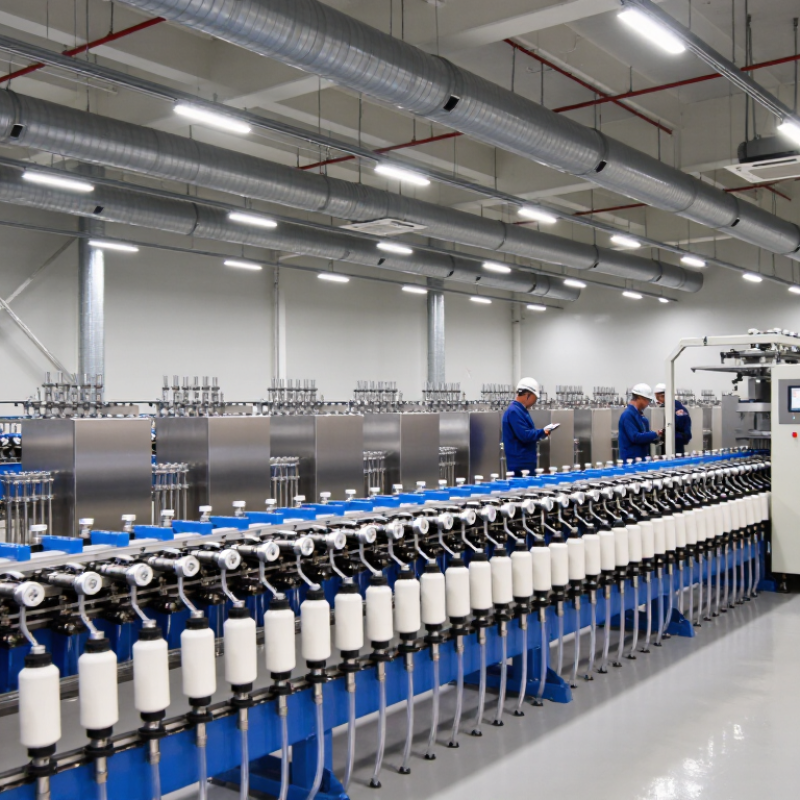
| POY Spinning Line Process |
| Raw Material | Polyester chips | Usually polyethylene terephthalate (PET); intrinsic viscosity commonly selected according to the required yarn application | Provides the polymer that is melted, filtered, extruded, cooled, and drawn into partially oriented yarn | Chip moisture, viscosity, melting behavior, contamination level, and consistency affect yarn quality |
| Preparation | Crystallization and drying | Drying temperature and residence time depend on chip grade and equipment design; moisture control is essential before melting | Removes moisture and reduces hydrolytic degradation during high-temperature extrusion | Use stable temperature control, adequate air circulation, and dew-point monitoring |
| Melting | Extruder and melt-pump system | Converts dried PET chips into a homogeneous polymer melt; melt pressure and temperature are continuously monitored | Delivers a steady, metered polymer flow to the spinning assembly | Important factors include screw design, energy efficiency, pressure stability, and maintenance access |
| Filtration | Melt filter or polymer filtration unit | Removes solid impurities and unmelted particles from the polymer melt | Protects spinnerets and improves filament uniformity and spinning stability | Filter area, automatic changeover capability, pressure-drop monitoring, and cleaning method |
| Extrusion | Spinning beam and spinneret | Produces multiple continuous filaments through precision capillary holes | Determines filament count, cross-sectional profile, and initial yarn formation | Spinneret material, hole geometry, hole count, beam temperature uniformity, and replacement cost |
| Cooling | Quench-air cabinet | Controlled cross-flow or radial cooling air is applied below the spinneret | Solidifies the extruded filaments and helps control denier and orientation uniformity | Air temperature, humidity, velocity uniformity, cabinet sealing, and filtration quality |
| Finishing | Finish-oil application system | Applies a controlled amount of spin finish to the filament bundle | Reduces friction and static electricity while improving downstream processing performance | Metering accuracy, finish uniformity, pump stability, and compatibility with the target end use |
| Orientation | Godet rollers and interlace unit | Controls yarn tension, speed, and filament cohesion; interlacing commonly uses compressed air | Provides partial molecular orientation and keeps filaments together during winding | Roller surface quality, speed synchronization, tension control, air consumption, and interlace consistency |
| Winding | Automatic winder | Forms packages at controlled winding speed and tension; package size depends on the line design | Produces transportable POY packages for texturing, knitting, weaving, or other downstream processes | Package density, doffing time, tension variation, yarn-break handling, and automation level |
| Typical POY Line Performance Parameters |
| Product Type | Polyester POY | Partially oriented yarn made from thermoplastic polyester filaments | Used as an intermediate yarn, especially for false-twist texturing and selected textile applications | Confirm compatibility with the intended texturing, knitting, weaving, or dyeing process |
| Common Yarn Range | Total yarn linear density | Often supplied across approximately 30–300 denier, with the exact range determined by spinneret configuration and line design | Defines the mass per unit length of the yarn | Higher denier generally requires suitable polymer throughput, cooling capacity, and winding configuration |
| Filament Configuration | Filament count | Selected according to yarn specification; examples include fine-filament and multi-filament constructions | Influences handle, covering power, luster, strength, and downstream process behavior | Choose spinneret hole count and cross-sectional geometry according to the final fabric requirements |
| Winding Speed | Line speed | Modern systems may operate at several thousand meters per minute; actual speed depends on yarn type and machine configuration | Determines production rate and contributes to filament orientation | Evaluate yarn quality at the target speed rather than relying only on the maximum mechanical speed |
| Production Capacity | Annual output | Depends on positions, ends per position, denier, operating hours, start-up efficiency, and product mix | Measures the practical output of the complete line | Use realistic operating efficiency, planned maintenance, waste, and product changeover time in calculations |
| Energy Demand | Electricity, compressed air, and cooling utilities | Varies with polymer throughput, extruder efficiency, cooling system, winder speed, and plant layout | Supports melting, extrusion, cooling, interlacing, winding, and environmental control | Request a utility balance covering connected load, normal load, chilled water, compressed air, and ventilation |
| Indicative Equipment Investment Factors |
| Equipment Price | Complete POY spinning line | Indicative project quotations can range from approximately USD 1 million to more than USD 10 million, depending on capacity, automation, specifications, and scope | Covers some or all of the systems required to convert PET chips into wound POY packages | Compare the same scope: main machinery, auxiliaries, installation, commissioning, training, spare parts, and taxes |
| Price Driver | Number of spinning positions | More positions generally increase output, building requirements, controls, utilities, and installation complexity | Determines the number of simultaneous yarn production streams | Balance target output with available floor space, labor, utility capacity, and expansion plans |
| Price Driver | Automation level | Options may include automatic doffing, centralized process control, online monitoring, and production data recording | Improves consistency, labor efficiency, traceability, and operating visibility | Assess payback, local technical support, software integration, and operator training requirements |
| Price Driver | Auxiliary systems | May include chip conveying, drying, chilled water, compressed air, waste handling, air conditioning, and electrical systems | Provides the utility and material-handling infrastructure needed for continuous operation | Clarify whether utilities are included in the quotation or supplied by the buyer |
| Installation | Commissioning and start-up | Requires equipment alignment, piping and cabling, process calibration, trial production, and operator training | Brings the line from mechanical completion to stable commercial production | Include installation supervision, acceptance criteria, spare parts, and warranty terms in the contract |
| Operating Cost | Major cost components | PET chips, electricity, labor, maintenance, finish oil, packaging materials, compressed air, and water treatment | Determines the cost per kilogram of POY produced | Calculate cost using local energy prices, realistic utilization, waste rate, and maintenance intervals |
| Manufacturer Evaluation Checklist |
| Technical Capability | Proven process performance | Review documented output, denier range, yarn quality data, energy balance, and successful trial results | Confirms that the proposed line can meet the required product specifications | Request objective test reports rather than evaluating equipment by purchase price alone |
| Quality Control | Yarn testing and monitoring | Typical checks include denier, breaking strength, elongation, oil content, interlace, evenness, and package quality | Detects process variation and verifies production consistency | Confirm the available online sensors, laboratory instruments, calibration method, and data records |
| After-Sales Support | Service and spare parts | May include remote support, on-site commissioning, preventive maintenance guidance, and critical spare-parts planning | Reduces downtime and supports stable operation after installation | Check response time, local service resources, documentation, training, and long-term parts availability |
| Commercial Terms | Quotation and delivery scope | Price depends on technical configuration, delivery terms, payment schedule, lead time, and included services | Defines the actual project cost and responsibilities of each party | Request a line-by-line quotation with exclusions, performance guarantees, warranty, and acceptance conditions |