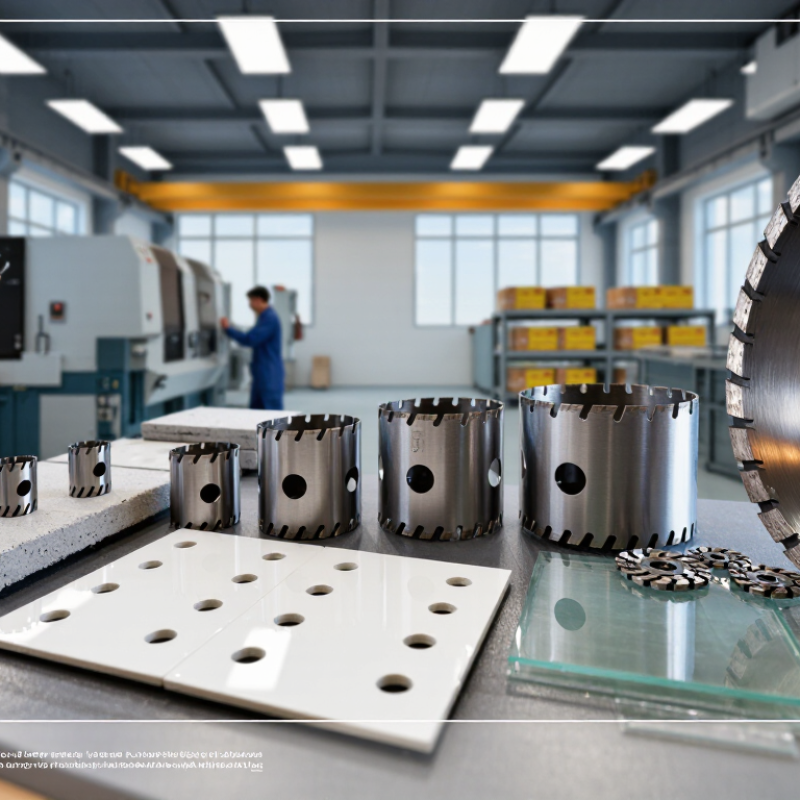
| Product Range | Common diameters from approximately 5 mm to 150 mm, with metric and imperial options | A broad size range supports tile, glass, masonry, and installation projects without requiring multiple sources. | Request a current size chart, dimensional tolerances, and samples from several diameter groups. |
| Diamond Working Layer | Uniformly distributed diamond particles with a consistent electroplated or bonded working layer | Even diamond distribution helps maintain cutting speed, hole quality, and tool life. | Inspect the cutting edge under magnification and compare performance across repeated samples. |
| Suitable Materials | Clear application guidance for ceramic tile, porcelain, glass, marble, granite, and other brittle materials | Different materials require different cutting speeds, cooling methods, and diamond specifications. | Ask for a material-to-tool selection guide and test the tool on the actual workpiece. |
| Shank Compatibility | Options such as hex, round, SDS-compatible, and threaded connections, depending on the product type | Correct shank design improves tool fit, operating stability, and user safety. | Confirm shank dimensions, thread specifications, and compatibility with the intended drill or grinder. |
| Cooling Requirements | Clear instructions for wet cutting, dry cutting, or intermittent cooling; water is commonly used for tile and glass | Cooling reduces heat buildup, helps control dust, and can extend the working life of the diamond layer. | Review operating instructions and conduct a controlled test using the recommended cooling method. |
| Cutting Accuracy | Stable diameter, low edge chipping, and a clean entry and exit during practical testing | Accuracy affects fitting quality, installation time, and the risk of damaging expensive surfaces. | Measure finished holes with calibrated equipment and record chipping, roundness, and total drilling time. |
| Tool Life | Published life data based on a specified material, hole diameter, machine, speed, and cooling method | Tool-life claims are meaningful only when the test conditions are clearly defined. | Request test conditions, inspect used tools, and compare the number of acceptable holes produced. |
| Manufacturing Consistency | Stable dimensions, repeatable diamond-layer placement, and documented process controls | Consistency is essential for repeat orders and reduces variation between production batches. | Review quality-control procedures, batch records, inspection reports, and pre-shipment samples. |
| Quality Management | Traceable inspection procedures aligned with a recognized quality-management system, such as ISO 9001 | Documented quality processes make defects easier to identify, correct, and prevent. | Verify certificate validity, scope, issuing body, and whether the certificate covers the relevant manufacturing site. |
| Safety Information | Clear maximum-speed guidance, PPE recommendations, cooling instructions, and warnings against unsuitable use | Diamond hole saws can generate heat, dust, fragments, and rotating hazards if used incorrectly. | Check packaging, labels, manuals, and product documentation before purchase. |
| Customization Capability | Ability to discuss diameter, length, shank, diamond specification, packaging, and application-specific requirements | Customization can improve compatibility with specialized equipment and installation conditions. | Request a written specification sheet, prototype approval process, and change-control procedure. |
| Lead Time and Capacity | Clearly stated sample, production, and replenishment lead times with capacity matched to order volume | Reliable delivery reduces project delays and inventory pressure. | Obtain a production schedule, capacity statement, and delivery history for comparable orders. |
| Packaging and Export Readiness | Protective packaging, accurate product labels, carton specifications, and export documentation | Good packaging helps prevent edge damage, corrosion, and identification errors during transport. | Review packaging samples, barcode or label requirements, packing lists, and shipping documents. |
| Technical Support | Responsive guidance on material selection, cutting parameters, troubleshooting, and after-sales claims | Technical support helps users achieve the expected performance rather than judging the tool only by price. | Send practical application questions and evaluate the clarity and speed of the technical response. |
| Total Cost of Ownership | Compare purchase price, usable hole output, labor time, breakage rate, shipping, and replacement cost | The lowest unit price may not be the lowest cost per finished hole. | Calculate cost per acceptable hole using identical test conditions and documented results. |