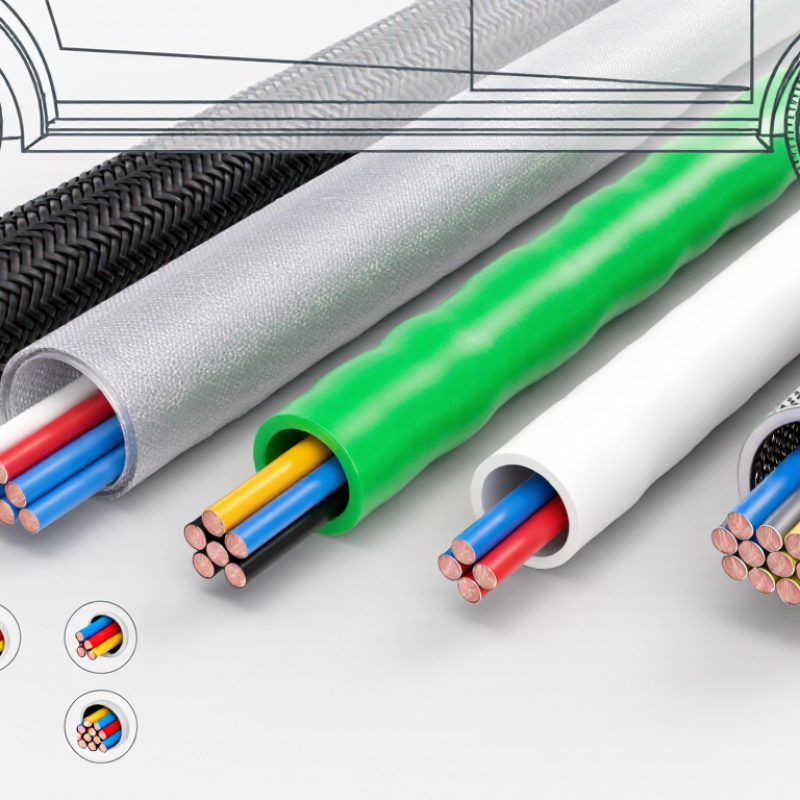
| Expandable Braided Sleeve | Woven polyethylene terephthalate (PET) monofilaments or multifilaments | The open braid expands to fit bundles and contracts around irregular shapes, creating a flexible protective layer. | Abrasion, scuffing, light UV exposure, and cable bundling | Approximately −50°C to 150°C | Automotive wiring, computer cables, control panels, robotics, and general cable management | Slides over cable bundles; ends should be secured with clips, heat-shrink tubing, tape, or cable ties to prevent fraying. | Lightweight and flexible, but the open weave does not provide a liquid-tight or fully dust-tight seal. |
| Expandable Flame-Retardant Sleeve | Flame-retardant polyester or other halogen-free braided fibers | The braided structure surrounds the cable while allowing movement, ventilation, and bundle expansion. | Abrasion, flame spread reduction, and limited heat exposure | Often approximately −40°C to 125°C | Industrial control cabinets, transportation equipment, electrical machinery, and low-voltage wiring | Installed by feeding the cable through the sleeve; the braid can normally be cut to length with a hot knife. | Verify the specific flame rating and smoke or halogen requirements before use in safety-critical installations. |
| Fiberglass Braided Sleeve | Braided fiberglass yarn, commonly with a silicone or acrylic coating | Heat-resistant fibers form a flexible barrier that isolates cables from radiant heat and occasional molten-metal splashes. | High-temperature exposure, abrasion, and thermal shielding | Commonly approximately −60°C to 260°C; higher ratings may apply to specialized constructions | Engine compartments, furnaces, welding equipment, glass processing, and high-temperature machinery | Slides over individual cables or bundles and is secured at the ends; the sleeve may become less flexible after prolonged heat exposure. | Temperature ratings depend strongly on the coating and exposure time. It is not automatically flameproof or liquid-tight. |
| Silicone-Coated Fiberglass Sleeve | Fiberglass braid coated with silicone rubber | The fiberglass carries the thermal load while the silicone coating adds flexibility, electrical insulation, and splash resistance. | Heat, abrasion, electrical contact, oils, and occasional fluid splashes | Typically approximately −60°C to 260°C | Motors, generators, welding leads, industrial heaters, and high-temperature electrical assemblies | Can be pushed over cables or installed around selected sections; end termination is required for reliable service. | Continuous exposure to harsh chemicals, sharp edges, or direct flame requires confirmation against the product specification. |
| Split Braided Sleeve | Braided textile sleeve with a longitudinal slit or overlapping closure | The split allows existing cables with connectors to be enclosed without disconnecting or re-routing them. | Abrasion, light impact, cable bundling, and maintenance protection | Often approximately −40°C to 125°C | Retrofitting vehicles, server rooms, machinery, and assembled electrical harnesses | Wraps around an installed cable bundle; installation is faster than threading a closed sleeve over a connector. | The opening can reduce mechanical protection and may require clips or hook-and-loop retention to remain closed. |
| Split Corrugated Conduit | Slit flexible corrugated plastic tubing, commonly made from polyethylene or polyamide | Corrugations provide bend flexibility while the surrounding tube separates cables from abrasion, impact, and contamination. | Mechanical abrasion, light impact, dirt, and organized routing | Commonly approximately −40°C to 120°C | Automotive harnesses, machinery, control cabinets, and equipment wiring | Cables can be inserted through the longitudinal slit without removing terminals; retaining clips may be used. | Provides stronger mechanical protection than an open braid, but the split design is generally not watertight. |
| Closed Corrugated Conduit | Continuous corrugated plastic tube made from polyethylene, polypropylene, or polyamide | The tube creates a structured enclosure that bends along its corrugations and keeps cables separated from surrounding hazards. | Abrasion, impact, dirt, routing movement, and moderate crush forces | Often approximately −40°C to 150°C, depending on material | Industrial automation, machine wiring, electrical cabinets, and vehicle installations | Usually installed before connectors are fitted or by pushing cables through the tube; conduit fittings can secure the ends. | It may need additional sealing fittings for water or dust protection. Bend radius must be respected. |
| Spiral Wrap | Helically cut polyethylene, polypropylene, or flexible elastomer strip | The spiral winds around cables and holds them together while allowing branch-outs and repeated access at any point. | Abrasion, bundling, light impact, and cable organization | Typically approximately −40°C to 90°C | Office equipment, control panels, laboratory equipment, and retrofit cable management | Wraps around installed cables without disconnecting them; branches can exit between spiral turns. | Easy to install and reuse, but it generally offers less complete coverage and strain protection than a closed conduit. |
| Heat-Shrink Tubing | Cross-linked polyolefin, fluoropolymer, elastomer, or other shrinkable polymer | When heated, the tubing contracts around the cable, forming a close-fitting layer that insulates and seals the covered area. | Electrical insulation, moisture sealing, strain relief, abrasion, and corrosion prevention | Commonly approximately −55°C to 135°C for polyolefin | Wire splices, terminal transitions, cable ends, harness branches, and connector backshell areas | Must be placed over the cable before the end connector is installed, unless a split or repairable version is used. | Requires a compatible heat source and correctly selected shrink ratio; overheating can damage the tubing or cable insulation. |
| Adhesive-Lined Heat-Shrink Tubing | Heat-shrinkable polymer with an internal hot-melt adhesive layer | Heating shrinks the outer layer while the adhesive melts and fills gaps, producing a more secure moisture-resistant seal. | Moisture, corrosion, electrical insulation, strain relief, and environmental sealing | Often approximately −55°C to 110°C | Outdoor wiring, marine connections, automotive harnesses, underground cable transitions, and repair joints | Requires controlled heating and sufficient overlap beyond the joint or cable transition. | Not a substitute for a certified waterproof connector or pressure-rated cable gland when immersion or pressure sealing is required. |
| Metal Braided Sleeve | Interwoven stainless-steel, tinned-copper, or other metal wires | The metal braid forms a strong flexible shield around the cable and can also provide electromagnetic shielding when properly terminated. | Severe abrasion, mechanical impact, heat, and electromagnetic interference shielding | Material-dependent; stainless steel commonly tolerates several hundred degrees Celsius | Industrial machinery, aerospace systems, high-temperature equipment, and EMI-sensitive cable assemblies | Installed over the cable or harness and terminated with suitable metal fittings or clamps. | Metal braid can be electrically conductive, heavier, less flexible, and more difficult to terminate than textile sleeves. |
| Hook-and-Loop Cable Sleeve | Woven fabric or polymer-coated textile with a hook-and-loop closure | The reclosable closure wraps around cables and permits frequent access, inspection, and cable additions. | Abrasion, bundling, light contamination, and maintenance protection | Commonly approximately −30°C to 105°C | Data centers, audio-video systems, test equipment, office installations, and temporary setups | Wraps around existing cables without disconnecting connectors; it can be opened and reused repeatedly. | Convenient for maintenance, but the closure may collect debris and usually provides less heat and liquid protection than sealed tubing. |
| Braided Sleeve with Foil or Drain Wire | Textile or conductive braid combined with a foil layer and, in some designs, a drain wire | The conductive layer surrounds signal cables and provides a controlled path for electromagnetic noise when connected to ground correctly. | Electromagnetic interference, radio-frequency interference, abrasion, and cable bundling | Often approximately −40°C to 125°C | Industrial sensors, instrumentation, communication wiring, audio systems, and control equipment | Requires correct overlap, termination, and grounding practices to maintain shielding continuity. | A sleeve alone does not guarantee shielding performance; connector design, grounding, and installation geometry are also important. |