| Court Length | 13.40 m for a full badminton court | Use the full-court distance to assess deep-clear consistency and baseline recovery. | Intermediate to advanced | Count shuttles landing within the target rear-court zone. |
| Singles Court Width | 5.18 m | Supports straight-line footwork, singles defense, and side-to-side movement drills. | Beginner to advanced | Measure successful returns inside the singles sideline area. |
| Doubles Court Width | 6.10 m | Useful for wider defensive coverage, doubles drive practice, and transition drills. | Intermediate to advanced | Record recovery time and return accuracy across both service boxes. |
| Net Height | 1.524 m at the center and 1.55 m at the posts | Provides a fixed reference for net kills, tumbling net shots, and controlled lifts. | All levels | Track shots that cross the net safely and land in the intended target area. |
| Shuttle Weight | 4.74–5.50 g for a feather shuttle | Select a consistent shuttle weight when comparing repetition quality and endurance results. | All levels | Use the same shuttle specification throughout a test session. |
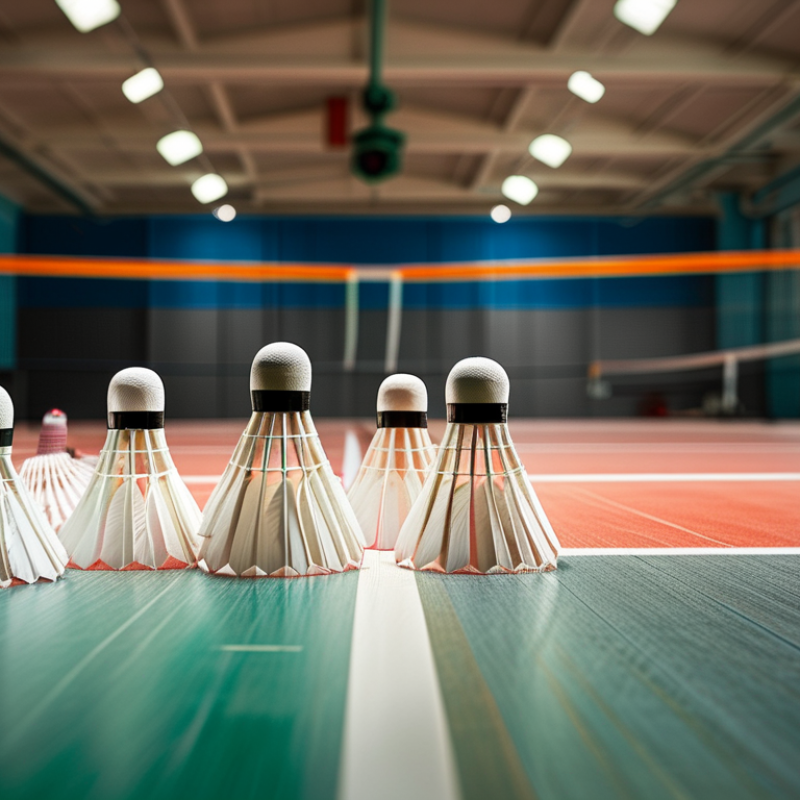
| Feather Count | 16 feathers per standard feather shuttle | Maintains consistent flight characteristics for repeated feeding and multi-shuttle drills. | Intermediate to advanced | Replace visibly damaged shuttles to reduce flight variation. |
| Shuttle Length | 62–70 mm | Helps maintain consistent trajectory during clears, drives, drops, and defensive lifts. | All levels | Compare landing distribution across repeated batches of shuttles. |
| Racket Length Limit | Maximum 680 mm under international equipment rules | Allows training plans to remain compatible with standard competitive equipment. | All levels | Confirm that the racket used in training matches competition equipment. |
| Basic Stroke Repetition | Clear, drop, drive, lift, smash, and net shot | Automated feeding can isolate one stroke before combining multiple shot types. | Beginner to intermediate | Measure consecutive successful contacts and target accuracy. |
| Footwork Pattern | Six primary court movement directions | Covers front-left, front-right, mid-left, mid-right, rear-left, and rear-right movement. | Beginner to advanced | Record movement completion time, balance, and return-to-base quality. |
| Multi-Shuttle Training | Continuous feeding with repeatable intervals | Supports reaction speed, stroke endurance, and consistent preparation under fatigue. | Intermediate to advanced | Track successful contacts per set and technical errors near the end of the set. |
| Beginner Practice Goal | Stable grip, contact point, and basic court positioning | Use predictable feeds and moderate repetition volume to build reliable movement habits. | Beginner | Evaluate clean contact rate and ability to return to a ready position. |
| Intermediate Practice Goal | Directional control and transition between strokes | Combine front-, mid-, and rear-court feeds with alternating target zones. | Intermediate | Measure target accuracy and recovery consistency over repeated sequences. |
| Advanced Practice Goal | Pressure tolerance, deception response, and tactical placement | Use randomized or programmed sequences to challenge anticipation and decision-making. | Advanced | Compare response time, shot quality, and error rate under higher workload. |
| Training Record | Repetitions, successful contacts, target accuracy, and recovery time | A consistent data structure makes progress easier to compare across sessions and players. | All levels | Store results by date, drill type, duration, and player level. |