| U-bolt wire-rope clip | Usually forged or malleable iron or steel; finishes may include plain, hot-dip galvanized, or other specified coatings. | Forming an eye or securing a wire-rope end in applications permitted by the product instructions. | No universal rating. Use only the specified rope diameter, clip quantity, spacing, orientation, and installation torque from the applicable instructions. | Install the U-bolt over the dead end and the saddle on the live end, as directed by the manufacturer. Recheck fasteners after initial loading when required by the instructions. | Confirm rope-diameter range, material grade, coating, dimensional compatibility, traceability, and applicable conformity documentation. |
| Fist-grip wire-rope clip | Commonly forged steel with a protective finish selected for the service environment. | Wire-rope terminations where the clip design and manufacturer’s instructions are suitable for the rope and application. | Capacity and termination efficiency are product-specific. Do not infer working load from clip size alone. | Follow the specified assembly sequence and tightening requirements. Inspect for movement, deformation, corrosion, and damaged rope strands. | Check whether the supplier provides installation instructions, test information, compatible rope constructions, and clearly stated limitations. |
| Duplex wire-rope clip | Typically steel, with finish and corrosion resistance varying by specification. | Wire-rope loop or end connections where the duplex design is specified and suitable for the intended service. | Use the manufacturer’s rated information for the complete assembly. Ratings are not interchangeable between designs or suppliers. | Verify correct rope seating and fastener tightness. Do not use a damaged, altered, or visibly corroded clip in a load-bearing connection. | Compare dimensions, compatible rope diameter, fastener arrangement, finish, and documented service limits. |
| Stainless-steel wire-rope clip | Stainless-steel body and fasteners; grade should be specified by the supplier. Stainless steel is not immune to corrosion in every environment. | Outdoor, marine, or wash-down environments when the selected alloy and design are suitable for exposure conditions. | Obtain the exact product rating and compatible rope specification. Do not assume a stainless version has the same capacity as a similarly sized steel version. | Inspect for corrosion, galling, cracking, and loosening. Consider dissimilar-metal contact and the actual chemical or marine environment. | Request the stainless grade, fastener grade, corrosion guidance, and written rating for the complete assembly. |
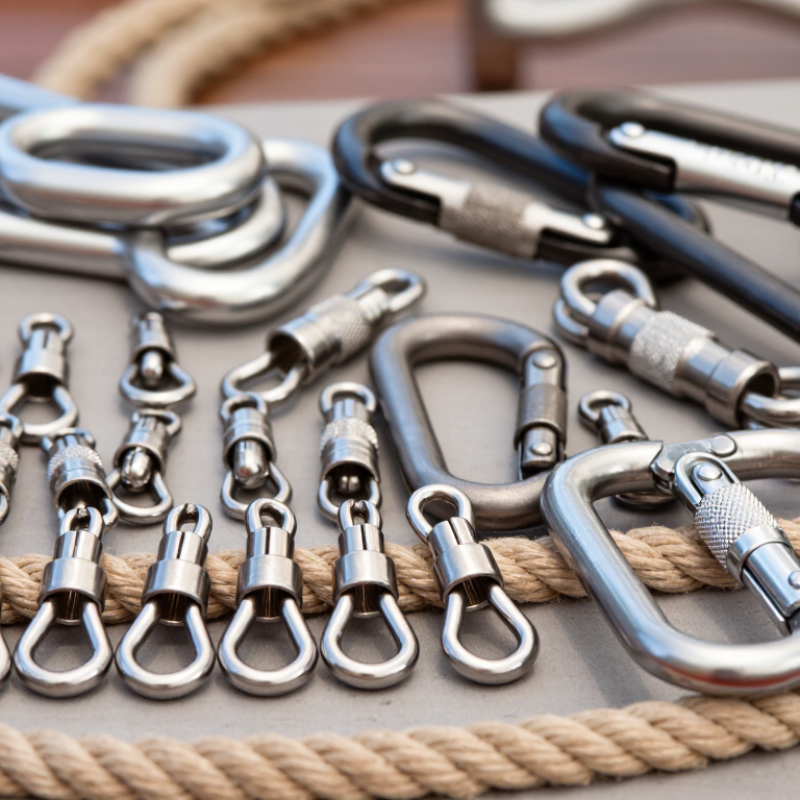
| Wire-rope clip with safety latch or locking feature | Material depends on product type; connector bodies may be steel or stainless steel, with a spring-loaded gate or other closure mechanism. | Connecting a rope assembly to compatible attachment points, where the connector is explicitly rated for the intended use. | A latch is not a load rating. Check the marked working load limit and whether the rating applies to the connector, rope termination, or complete assembly. | Confirm the gate closes and locks fully; avoid side loading and loading across the gate unless the product instructions explicitly permit it. | Verify gate clearance, locking action, load direction, markings, and whether the item is intended for lifting, restraint, or non-load-bearing use. |
| Plastic or polymer rope clip | Molded polymer, sometimes with metal hardware; UV, temperature, and chemical resistance vary by material. | Light-duty rope management, bundling, or non-critical securing, subject to the product’s stated purpose. | Do not assume suitability for lifting or life-safety applications. Use only a documented rating appropriate to the application and exposure conditions. | Check for UV aging, cracking, temperature limits, chemical exposure, and deformation before use. | Confirm polymer type, environmental limits, intended duty, and explicit restrictions on load-bearing use. |