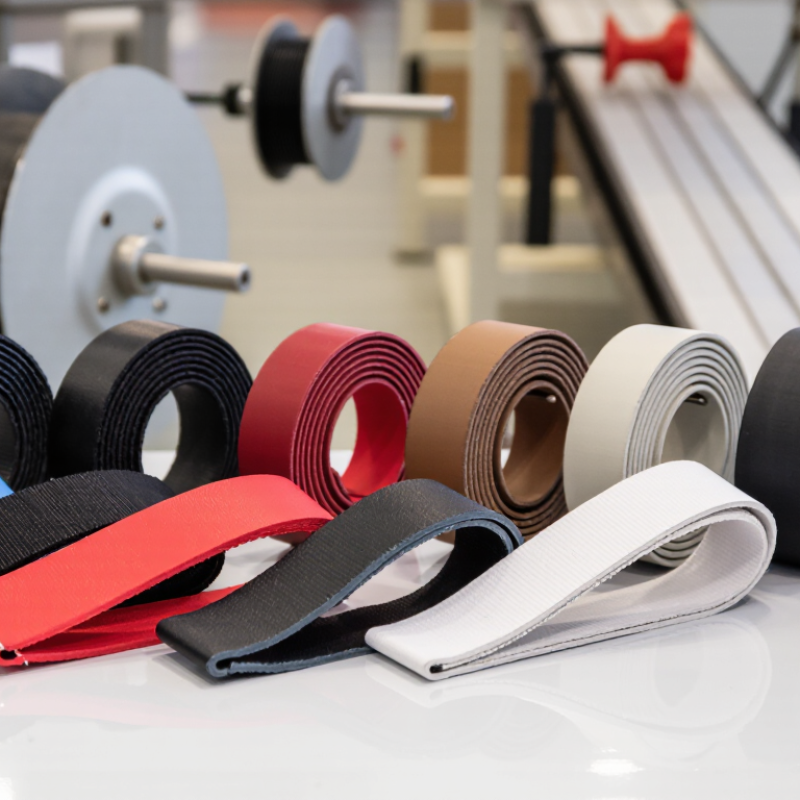
| Nylon Core with Leather Covering | High-speed spindles, textile machinery, machine tools, and legacy line-shaft systems | 25–300 mm | 2.5–6.0 mm | High tensile strength, good flexibility, and effective grip when correctly tensioned | Check leather bonding, splice uniformity, width tolerance, surface cracks, and tensile test records | Keep clean and dry; inspect splice and adjust tension after initial running-in | Best for traditional machinery |
| Nylon Core with Rubber Covering | General power transmission, conveyors, packaging equipment, and workshop machinery | 20–500 mm | 2.0–8.0 mm | Good abrasion resistance, shock absorption, and reliable traction over a broad temperature range | Verify rubber-to-nylon adhesion, cover hardness, edge condition, dimensional accuracy, and flex cracking | Prevent oil contamination unless the compound is oil-resistant; monitor tracking and tension | Best all-purpose option |
| Nylon Core with Urethane Covering | Clean production areas, food-related equipment, printing, and precision conveying applications | 10–300 mm | 1.5–5.0 mm | Low elongation, strong resistance to abrasion, and a smooth surface that is easy to clean | Check cover uniformity, hardness, dimensional stability, splice finish, and compliance with the required regulations | Use compatible cleaners; avoid sharp tools, excessive heat, and over-tensioning | Best for clean environments |
| Nylon Flat Belt with High-Friction Surface | Inclined conveyors, carton handling, material transfer, and applications requiring positive grip | 25–1,000 mm | 2.0–10.0 mm | Improved load transfer and reduced slip on appropriately sized pulleys | Measure surface coefficient consistency, inspect coating adhesion, check edge squareness, and confirm belt flatness | Remove dust and product residue; check for glazing, uneven wear, and lateral movement | Best for grip-critical duties |
| Low-Stretch Nylon Flat Belt | Precision drives, indexing equipment, textile machines, and long-center-distance installations | 20–500 mm | 1.5–6.0 mm | Stable speed ratio, reduced retensioning, and better dimensional control during continuous operation | Review elongation data, measure belt length and width, inspect laminated layers, and verify splice alignment | Set correct initial tension; avoid sudden overloads and inspect for permanent stretch | Best for precision drives |
| Heat-Resistant Nylon Flat Belt | Hot-process machinery, dryers, ovens, foundry handling, and applications near elevated temperatures | 25–600 mm | 2.0–8.0 mm | Maintains useful mechanical performance better than standard belt constructions in elevated heat | Confirm stated temperature range, inspect thermal aging samples, check cover bonding, and test flexibility after heating | Operate within the supplier’s temperature limit; inspect hardening, brittleness, and edge deformation | Best for heated zones |
| Antistatic Nylon Flat Belt | Electronics handling, clean manufacturing, dust-sensitive equipment, and areas with electrostatic-control requirements | 20–500 mm | 1.5–6.0 mm | Helps dissipate electrostatic charge when correctly grounded and installed in the machine | Measure surface resistance using an applicable test method, verify continuity, inspect coating integrity, and review grounding instructions | Keep the belt surface clean; verify grounding periodically and replace belts with damaged conductive layers | Best for ESD-controlled systems |