| Applicable market standard | EN 12811-1 is widely used for temporary works equipment and scaffold performance requirements. Other markets may require OSHA 29 CFR 1926 Subpart L, CSA requirements, AS/NZS requirements or local regulations. | Confirm the destination-country standard, conformity route, test method and required documentation before ordering. | A product suitable for one jurisdiction may not automatically satisfy another jurisdiction’s legal or project requirements. |
| Scaffold load class | EN 12811-1 service load classes range from 1 to 6, with uniformly distributed loads of approximately 0.75, 1.50, 2.00, 3.00, 4.50 and 6.00 kN/m² respectively. | Request the declared load class, allowable span, support spacing and any restrictions on point loads or impact loads. | Load capacity depends on span, support conditions, plank orientation, connections and the actual type of loading. |
| Material and grade | Common metal options include galvanized steel and aluminum alloys. The exact alloy or steel grade, temper, coating and material properties should be declared by the supplier. | Check material certificates, nominal thickness, alloy or steel grade, weldability and compatibility with the intended environment. | Material selection affects strength, weight, corrosion resistance, durability and repairability. |
| Dimensions and tolerances | Important data includes overall length, width, height, working surface width, end-hook dimensions, profile geometry and dimensional tolerances. | Compare certified drawings with the scaffold system’s bay width, ledger spacing, transom arrangement and storage limitations. | Even small dimensional differences can cause unstable seating, excessive gaps or incompatibility with existing scaffold components. |
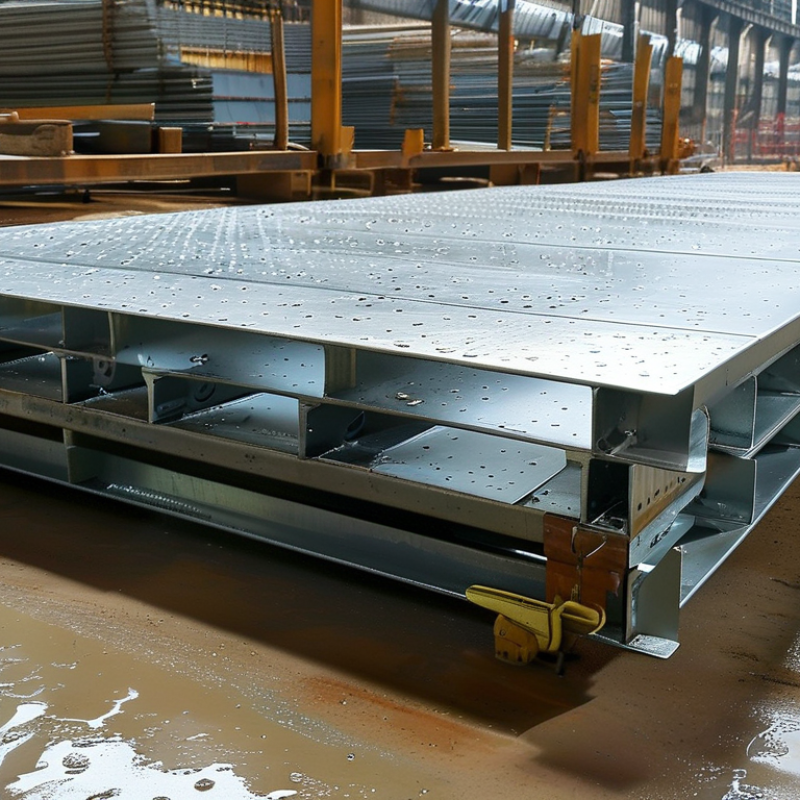
| Slip resistance | The walking surface should use an engineered anti-slip pattern, such as perforation, embossing or raised ribs, suitable for the expected wet and dirty conditions. | Request wet-condition slip testing or documented surface-performance data where required by the project. | Construction dust, water, mud and oil can reduce traction and increase fall risk. |
| End hooks and retention | Planks should have secure end hooks, stops or retention features designed for the compatible scaffold transoms and intended direction of loading. | Verify hook engagement depth, throat opening, anti-lift design, lateral restraint and compatibility with the support members. | Inadequate retention can allow movement, uplift or accidental dislodgement during use. |
| Structural testing | Testing should address bending strength, deflection, local failure, connection performance and, where applicable, repeated or impact loading. | Obtain test reports identifying the exact plank model, span, support arrangement, loading method, test date and acceptance criteria. | A generic material test or unrelated product report does not prove the performance of the complete plank assembly. |
| Deflection control | The supplier should state the maximum service deflection under the declared load and span conditions. The applicable project standard may define limiting criteria. | Check deflection calculations for the actual support spacing rather than relying only on ultimate breaking-load values. | Excessive deflection may create trip hazards, instability or loss of confidence even when the plank has not fractured. |
| Corrosion protection | Typical protection includes hot-dip galvanizing, electro-galvanizing, protective coatings or corrosion-resistant aluminum alloys. Performance depends on exposure and handling. | Verify coating type, coating thickness or mass where specified, salt-spray or corrosion data, drainage design and repair procedures. | Corrosion can reduce section thickness, weaken hooks and create sharp or unstable damaged areas. |
| Edges and surface finish | Planks should have rounded, folded or otherwise protected edges, with no exposed burrs, sharp weld spatter or dangerous protrusions. | Inspect samples and production parts for burr removal, weld quality, edge continuity and safe handling points. | Poor finishing can cause hand injuries, damaged protective equipment and snagging hazards. |
| Drainage and contamination control | Perforated or ribbed surfaces should allow water and debris to clear without creating openings that introduce unacceptable foot or tool hazards. | Review opening size, drainage behavior, cleaning requirements and suitability for tools, footwear and the work environment. | Standing water and accumulated debris reduce traction and may increase corrosion or trip hazards. |
| Inspection and rejection criteria | A documented inspection system should identify unacceptable bending, cracks, damaged hooks, severe corrosion, holes, distortion and unauthorized modifications. | Request inspection instructions, user manuals, repair limits, quarantine procedures and traceability markings. | Reusable scaffold planks can be damaged during transport, assembly, dismantling and overloaded use. |
| Identification and traceability | Permanent or durable markings should identify the product type, length or model, manufacturer lot or batch, rated capacity and relevant compliance information where required. | Confirm that markings remain legible after outdoor exposure and correspond to the supplied drawings and test documents. | Traceability helps prevent mixing of different capacities and supports recalls, inspections and incident investigations. |
| Weight and handling | The declared unit weight should include the complete plank with hooks, end fittings and permanent components. | Check manual-handling limits, lifting points, packaging weight, stacking method and whether mechanical handling is required. | Lower weight can improve installation efficiency, but it must not be used as a substitute for verified structural capacity. |
| Documentation package | A complete package may include technical drawings, declarations, calculations, material certificates, test reports, installation instructions and inspection guidance. | Require documents in the project language and verify that every document references the exact supplied configuration. | Clear documentation supports regulatory approval, safe assembly and consistent quality control across international supply chains. |