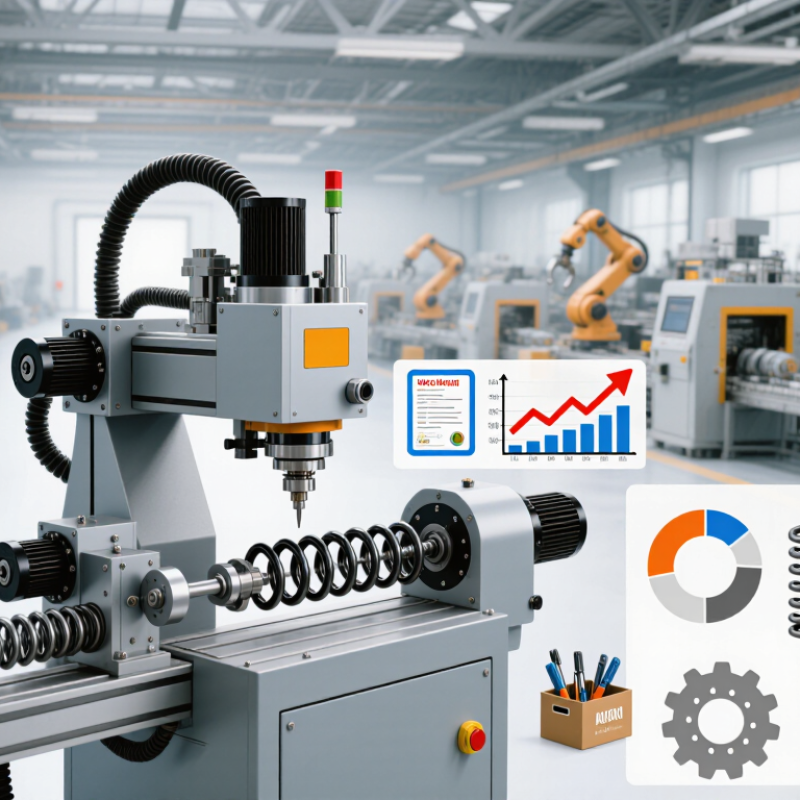
| Machine Definition | Computer numerical control equipment for forming wire into springs and other three-dimensional wire shapes. | Digital programs coordinate wire feeding, rotation, bending, cutting, and optional coiling operations. | Compression springs, extension springs, torsion springs, wire forms, and small custom components. |
| Common CNC Axes | Approximately 3 to 8 controlled axes, depending on the machine configuration and tooling arrangement. | Additional axes allow more independent control of feed, tooling, rotation, pitch, and forming movements. | Three-axis systems for standard springs; multi-axis systems for complex wire forms and mixed production. |
| Typical Wire Diameter | Common equipment covers about 0.15–8 mm wire, while specialized machines may support smaller or larger diameters. | The supported range depends on the feeding unit, straightening system, forming tools, motor torque, and material strength. | Fine wire springs, medium-duty industrial springs, automotive components, and general hardware. |
| Wire Materials | Carbon steel, stainless steel, music wire, oil-tempered wire, alloy steel, copper alloy, and other spring wires. | Material selection affects forming force, tool wear, springback, heat treatment requirements, and dimensional accuracy. | Corrosion-resistant, high-fatigue, electrical-contact, and general mechanical applications. |
| Wire Feeding System | Servo-driven rollers or feed wheels with programmable feed length and speed. | The feeding mechanism delivers a precise amount of wire to the forming zone while maintaining controlled tension. | Repeatable coil diameter, pitch, leg length, and overall spring height. |
| Forming Method | Programmable forming tools, slides, rollers, coiling pins, cutters, and bending attachments. | Tools move according to programmed coordinates to create coils, hooks, legs, bends, and free-form sections. | Compression, extension, torsion, double-torsion, conical, barrel, and irregular wire forms. |
| Control System | Industrial CNC controller with a programmable interface, recipe storage, parameter adjustment, and alarm monitoring. | Operators enter geometry and process parameters, then the controller synchronizes the machine axes. | Fast setup changes, repeat orders, multi-size production, and automated process control. |
| Production Speed | Highly variable; many machines operate at several dozen to several hundred forming cycles per minute, depending on part geometry. | Short, simple springs can run faster than complex parts with multiple bends, long legs, or tight dimensional tolerances. | High-volume production when the part design is stable and tooling is properly adjusted. |
| Dimensional Repeatability | Generally higher and more consistent than manual or mechanically cam-driven forming when the machine is correctly calibrated. | Servo control, stored programs, stable feeding, and regular tool maintenance reduce variation between production cycles. | Precision springs requiring consistent free length, coil diameter, pitch, angle, and leg position. |
| Changeover Method | Digital program changes combined with mechanical adjustment or replacement of forming tools. | Software reduces setup time, but wire size, part geometry, and tooling design still determine the actual changeover effort. | Manufacturers producing multiple spring sizes or frequent small and medium production batches. |
| Quality Inspection | Dimensional gauges, optical inspection, spring load testing, torque testing, and surface inspection. | Inspection verifies geometry and functional performance, including force, rate, torque, and fatigue-related requirements. | Safety-critical, automotive, medical, electronics, and precision industrial components. |
| Post-Processing | Stress relieving, heat treatment, shot peening, surface coating, grinding, or end closing may be required. | CNC forming creates the shape, but subsequent treatments can improve strength, surface quality, fatigue life, or end geometry. | High-load, high-cycle, corrosive-environment, and tightly specified spring applications. |
| Automation Options | Automatic wire loading, in-line cutting, conveyors, vision inspection, data collection, and robotic handling. | Automation reduces manual handling and can connect forming with inspection and packaging processes. | Continuous production lines and facilities seeking lower labor input and consistent throughput. |
| Energy and Air Requirements | Electrical power is required for servo motors and controls; compressed air may be needed for cutters, clamps, or auxiliary devices. | Actual consumption depends on motor capacity, production speed, auxiliary equipment, and operating schedule. | Factories planning utilities, machine layout, operating costs, and production-line integration. |
| Key Selection Criteria | Wire range, number of axes, forming envelope, control functions, tooling support, accuracy, service, and total cost. | The most suitable machine is not necessarily the largest model; it should match the material, geometry, tolerance, volume, and future product range. | New production lines, capacity expansion, contract manufacturing, and replacement of manual forming equipment. |
| Practical Definition of “Best” | Best fit means stable forming quality, adequate capacity, simple programming, reliable support, available spare parts, and acceptable operating cost. | A machine should be evaluated using actual sample wire, drawings, target tolerances, cycle-time requirements, and test-production results. | Businesses comparing CNC spring machine options without relying solely on advertised speed or maximum wire diameter. |