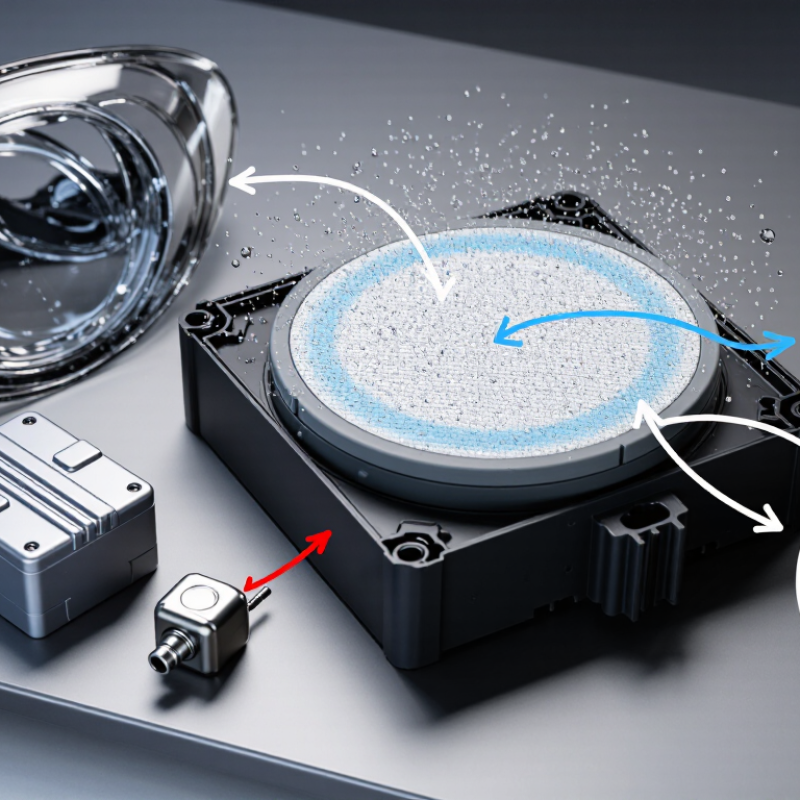
| Purpose | A vent membrane lets air pass between an enclosure and the surrounding environment while helping limit the entry of liquid water and particles. | Assess airflow, liquid-water resistance, and particle protection against the enclosure’s design requirements. | Commonly used on sealed vehicle electronics housings, lamps, sensors, and other enclosures subject to pressure or temperature changes. |
| Pressure equalization | Air exchange can reduce pressure differences that develop as an enclosure heats, cools, or changes altitude. | Measure airflow at specified pressure differences and monitor enclosure pressure during temperature cycling. | Required airflow depends on enclosure volume, leakage, temperature-change rate, and the application’s pressure limits. |
| Water and dust protection | Many vent membranes use a microporous structure that allows gas flow while resisting liquid water under specified conditions. | Use application-relevant water-ingress and dust-ingress tests. ISO 20653 describes degrees of protection for road-vehicle electrical equipment; the complete assembly must be tested for an enclosure rating. | Protection depends on the membrane, seal, mounting surface, and assembly. A membrane alone does not establish an enclosure’s IP or IP6K rating. |
| Air permeability | Airflow capacity affects how quickly the vent can respond to pressure changes. | Record airflow at defined pressure differences, using consistent sample area, conditioning, and test setup. | Compare results only when test conditions are equivalent. Contamination, compression, or blocked vent openings can reduce airflow. |
| Liquid-entry resistance | The membrane’s resistance to water depends on its material, pore structure, surface treatment, and exposure conditions. | Apply water pressure or spray exposure appropriate to the design, then check for liquid ingress and changes in airflow. | Oil, detergents, salts, and other low-surface-tension fluids may affect some membrane materials differently from clean water. |
| Temperature and aging | Heat, cold, humidity, UV exposure, and thermal cycling can affect membrane materials, adhesives, and seals. | Condition samples through application-specific environmental aging, then recheck airflow, adhesion, and water resistance. | Use the vehicle or component supplier’s specified operating and storage limits; performance can vary by construction. |
| Chemical compatibility | Contact with oils, cleaners, fuels, road fluids, or process chemicals can alter a membrane or its bonding materials. | Expose assembled parts to relevant fluids using defined concentration, temperature, and duration, then inspect and retest. | Confirm compatibility for the actual fluid and exposure scenario rather than assuming all hydrophobic membranes behave alike. |
| Mechanical durability | Vibration, impact, abrasion, and handling may damage the membrane or its perimeter bond. | Test the installed assembly under the applicable vibration, impact, and handling conditions; inspect for tears, lifting, or leakage. | Protect the vent from sharp edges and direct mechanical damage, and follow the specified installation method. |
| Installation and sealing | A correctly specified membrane can still fail if its adhesive, gasket, opening, or mounting surface is defective. | Inspect alignment, bond coverage, surface condition, and the finished assembly; perform leak or ingress checks as required. | Keep the bonding area clean and dry, avoid wrinkles or trapped debris, and do not cover the active vent area with paint or sealant. |
| Maintenance | Routine care focuses on keeping the vent opening unobstructed and checking for visible damage or loss of adhesion. | Follow the component service instructions; inspect during scheduled checks or after damage, contamination, or enclosure opening. | Do not pierce, scrape, or aggressively wash the membrane. Replace damaged parts with a compatible specified component rather than attempting an unapproved repair. |