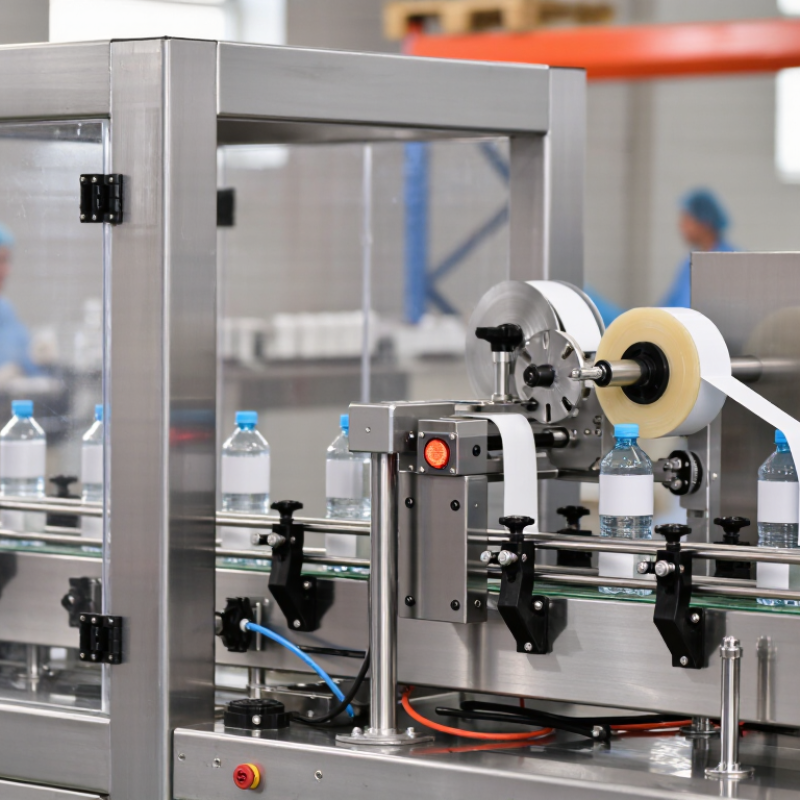
| Machine Frame and Guards | Supports the machine modules and protects operators from moving parts. | Common construction: stainless steel or powder-coated steel; typical working height: approximately 750–950 mm. | Maintains alignment between the conveyor, label dispenser, sensors, and applicator while safety guards limit access during operation. |
| Conveyor and Product Guides | Moves products through the labeling station at a controlled speed and position. | Typical line speed: about 10–40 m/min; guide width is adjustable to suit the product. | The conveyor presents each product consistently so the label can be applied at the programmed location. |
| Label Roll Holder | Holds the reel of pressure-sensitive labels and allows it to unwind smoothly. | Typical roll capacity: approximately 250–400 mm outside diameter, depending on the machine design. | The label web is fed from the roll into the tension and dispensing system without damaging the liner or labels. |
| Web Tension and Unwinding System | Controls the movement and tension of the label backing material. | Uses dancer arms, friction control, magnetic braking, or motorized unwinding; tension must remain stable to prevent web drift. | Regulates label-web release so labels arrive at the peel plate at a consistent pitch and speed. |
| Drive Roller and Nip Roller | Pulls the label web through the machine and maintains traction. | Usually driven by a servo motor or stepper motor; speed is electronically adjustable. | The rollers meter the web length required for each label and synchronize label delivery with product movement. |
| Peel Plate or Dispensing Edge | Separates the pressure-sensitive label from its backing liner. | Uses a sharp, smooth edge with a controlled bend radius; the angle depends on label material and adhesive. | As the liner bends around the edge, the label continues forward while the liner changes direction and returns to the waste path. |
| Applicator Roller, Brush, or Air Tamp | Transfers and presses the label onto the product surface. | Applicator choice depends on product geometry; contact rollers suit flat or cylindrical surfaces, while air systems suit irregular surfaces. | It removes air pockets and improves adhesion after the label has been dispensed onto the product. |
| Product Detection Sensor | Detects when a product reaches the labeling position. | Common sensor types: photoelectric, diffuse-reflective, through-beam, or ultrasonic sensors. | Sends a trigger signal to the controller, which calculates the correct delay before label dispensing begins. |
| Label Gap or Registration Sensor | Detects the gap between labels or a printed registration mark. | Typically uses optical sensing; transparent labels may require specialized ultrasonic or capacitive detection. | Confirms the position of each label so the machine can stop or advance the web accurately at the peel point. |
| Encoder | Measures conveyor or product movement to maintain speed synchronization. | Provides pulses proportional to conveyor travel; resolution varies by encoder and application. | Allows the controller to adjust label dispensing when conveyor speed changes, reducing position errors. |
| PLC or Motion Controller | Coordinates sensors, motors, timing, alarms, and machine sequences. | Controls product delay, label length, dispensing speed, acceleration, and fault logic. | Processes input signals and sends commands to the drive motor and applicator in the correct sequence. |
| HMI Control Panel | Provides an interface for setup, operation, diagnostics, and parameter adjustment. | Common settings include label position, product delay, conveyor speed, and label-count limits. | Operators select a product recipe, adjust operating parameters, and view warnings or maintenance messages. |
| Waste Liner Rewinder | Collects the used backing liner after labels have been dispensed. | Usually uses a motorized take-up reel with adjustable torque or speed control. | Keeps the waste liner organized and prevents loose material from interfering with the conveyor or labeling head. |
| Safety Interlocks and Emergency Stop | Stops hazardous motion and supports safe access for operators and maintenance personnel. | Typical devices include guarded-door switches, emergency-stop buttons, and motor overload protection. | Interrupts machine operation when a guard is opened, an emergency stop is pressed, or a critical fault is detected. |