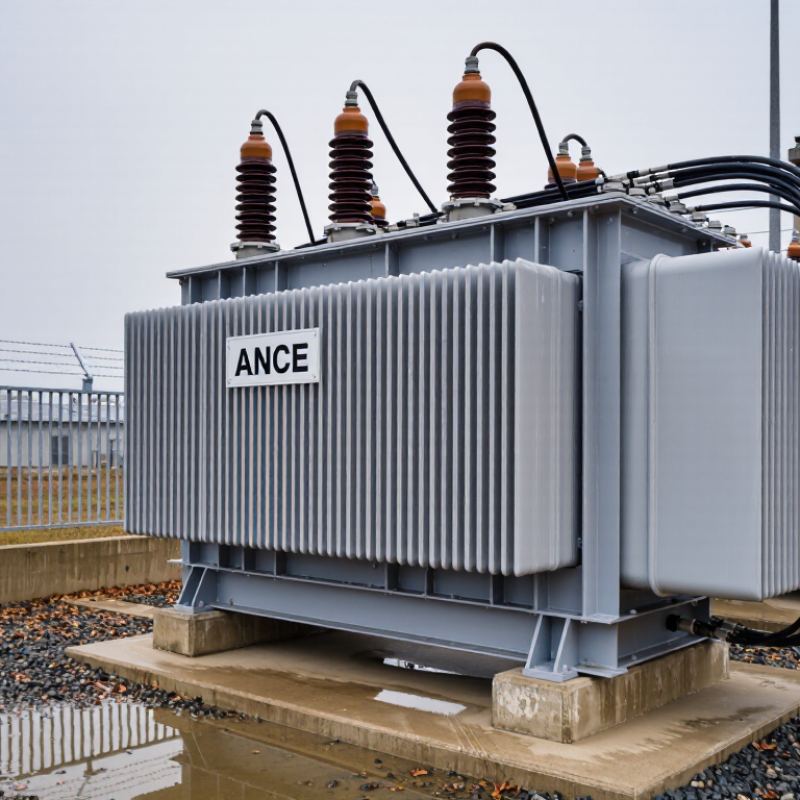
| Transformer Type | Three-phase, liquid-immersed power or distribution transformer | Three primary windings and three secondary windings are magnetically coupled through a common three-phase core. | Three-phase construction normally provides a compact, efficient solution for industrial, utility, and commercial power systems. |
| ANSI/IEEE Rating Basis | Commonly specified using applicable ANSI/IEEE transformer requirements | Typical references include ANSI/IEEE C57.12.00 for general requirements, C57.12.90 for test procedures, and C57.91 for loading guidance. | The exact standard set depends on voltage class, transformer type, installation location, and the purchaser's specification. |
| Frequency | Typically 50 Hz or 60 Hz | The transformer is designed for a specified operating frequency, which affects core flux, losses, and heating. | Operating at a frequency different from the nameplate rating can increase excitation current or core saturation. |
| Common Voltage Range | Application-dependent; from low-voltage distribution systems to high-voltage utility networks | Primary and secondary voltages are selected according to the electrical system, insulation level, and required load service. | Actual ratings must be taken from the transformer nameplate and project specification rather than assumed from a general category. |
| Rated Capacity | Specified in kVA or MVA; distribution units are often rated in kVA | The rating represents the apparent power the transformer can deliver continuously under defined temperature and cooling conditions. | Continuous loading should consider ambient temperature, altitude, cooling mode, harmonics, and the applicable loading guide. |
| Insulating Liquid | Mineral insulating oil or an approved alternative liquid | The liquid provides electrical insulation between energized parts and transfers heat from the windings and core to the tank and radiators. | Liquid quality must be monitored for moisture, dielectric breakdown strength, acidity, oxidation, and dissolved gases. |
| Oil Insulation Function | Dielectric insulation and heat-transfer medium | Oil fills spaces around conductors and solid insulation, reducing the risk of internal electrical discharge while carrying heat away from active parts. | Water contamination and paper insulation aging can significantly reduce dielectric strength and service life. |
| Solid Insulation | Cellulosic paper, pressboard, or other approved insulating materials | Solid insulation separates windings and other energized components while providing mechanical support during short-circuit events. | Thermal aging of paper insulation is a major factor in transformer life expectancy. |
| Cooling Class: ONAN | Oil Natural, Air Natural | Internal oil circulation and external air circulation occur naturally through temperature-driven convection. | This is a simple and reliable cooling method, but its capacity is limited by radiator size and ambient conditions. |
| Cooling Class: ONAF | Oil Natural, Air Forced | Oil circulates naturally while fans force air across radiators or coolers to increase heat dissipation. | Fan controls, fan motors, alarms, and backup arrangements should be included in maintenance planning. |
| Cooling Class: OFAF | Oil Forced, Air Forced | Pumps circulate oil through heat exchangers while fans force air over the cooler surfaces. | This arrangement supports higher capacity but requires dependable pump, fan, control, and protection systems. |
| Temperature Rise | Common designs use approximately 55 °C or 65 °C winding temperature rise, subject to specification | Temperature rise is the increase above the specified reference ambient temperature when the transformer operates at rated conditions. | Lower temperature rise can reduce thermal stress, while the selected value affects size, cost, and capacity. |
| Tap Changer | De-energized tap changer or on-load tap changer | A tap changer adjusts the effective turns ratio to compensate for system voltage variation. | A de-energized tap changer requires the transformer to be disconnected before adjustment; an on-load type requires additional controls and maintenance. |
| Main Safety Protection | Pressure relief device, liquid-level indicator, temperature indicators, and protective relays | These devices detect abnormal pressure, low liquid level, excessive temperature, gas accumulation, or internal faults. | Alarm and trip settings must be coordinated with the protection system and validated during commissioning. |
| Pressure Relief Device | Spring-loaded or diaphragm-type pressure relief device | The device releases excessive internal tank pressure that may result from a severe internal fault or rapid gas generation. | It is not a substitute for electrical protection, correct grounding, or safe working procedures. |
| Conservator or Sealed Tank | Conservator-equipped or sealed-tank construction | A conservator allows liquid expansion into a separate vessel, while a sealed tank limits contact between the insulating liquid and atmospheric air. | A conservator may use a breather or bladder system; sealed designs require correct pressure and liquid-level monitoring. |
| Grounding | Grounded tank and defined winding neutral connection where applicable | The metallic tank is bonded to the facility grounding system, and the transformer winding connection is selected according to the system grounding design. | Grounding and bonding must comply with the applicable electrical code and site fault-current requirements. |
| Routine Condition Monitoring | Visual inspection, oil testing, temperature review, and electrical testing | Condition assessment may include dissolved gas analysis, moisture testing, dielectric breakdown testing, power factor testing, and winding resistance measurement. | Test intervals should be based on transformer importance, operating conditions, age, loading history, and observed trends. |
| Environmental and Fire Considerations | Oil containment, fire separation, ventilation, and spill-control provisions | Liquid-immersed transformers require installation measures that address leakage, combustible-liquid exposure, and access to energized equipment. | Site requirements should be reviewed against local electrical, fire, environmental, and occupational-safety regulations. |
| Typical Advantages | High efficiency, strong overload capability, and effective heat removal | Oil and solid insulation allow active parts to operate within controlled thermal and dielectric limits. | The transformer still requires correct installation, periodic inspection, protection coordination, and safe isolation before maintenance. |