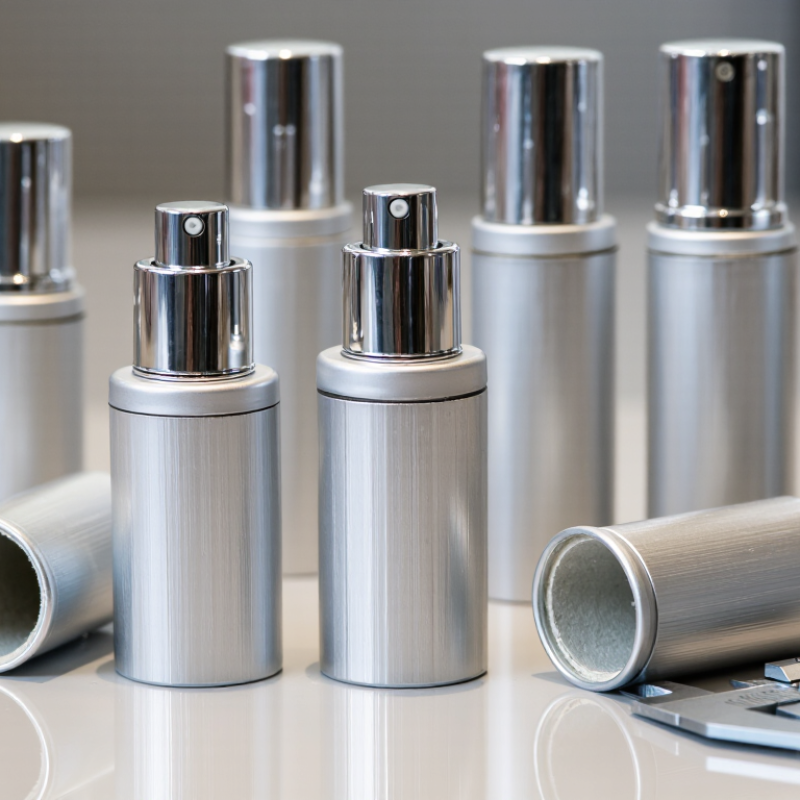
| Bottle Material | Aluminum or aluminum alloy body, commonly selected for its low weight, corrosion resistance, and opaque barrier properties. | Fine fragrance, perfume oils, travel sprays, refillable atomizers, and promotional packaging. | Confirm alloy designation, surface uniformity, dent resistance, and compatibility with the fragrance formula. | Request material declarations and documentation required by the destination market. |
| Common Fill Capacities | Approximately 10 ml, 15 ml, 30 ml, 50 ml, 75 ml, and 100 ml; custom sizes may also be available. | Travel-size products, standard retail fragrances, gift sets, and private-label collections. | Verify nominal volume, overflow capacity, usable fill volume, and dimensional tolerances. | Packaging dimensions and filled-product weight should be checked before freight quotations. |
| Wall Thickness | Often produced within a light-gauge range of approximately 0.3–1.0 mm, depending on forming method and bottle design. | Lightweight retail packaging and more robust reusable containers. | Measure wall consistency, base strength, thread area, and resistance to deformation. | Thickness should be validated with production samples rather than assumed from drawings alone. |
| Surface Finishes | Brushed, anodized, matte, polished, colored, or coated finishes are commonly used. | Premium appearance, color-coded product lines, minimalist packaging, and brand customization. | Check color consistency, coating adhesion, scratch resistance, gloss level, and visible surface defects. | Color approval should use a physical production sample or an agreed color standard. |
| Printing and Decoration | Screen printing, digital printing, hot stamping, laser marking, and label application may be used. | Logos, fragrance names, regulatory text, batch codes, and decorative graphics. | Inspect registration accuracy, ink adhesion, legibility, abrasion resistance, and barcode readability. | Artwork must account for curved surfaces, minimum text size, and language requirements. |
| Neck and Closure Compatibility | Crimp-on, screw-on, and threaded neck formats may be supplied, depending on the atomizer system. | Fine-fragrance pumps, screw atomizers, refillable sprays, and custom closure assemblies. | Check neck dimensions, thread fit, crimp integrity, actuator alignment, and leakage performance. | Closure and pump components should be tested as a complete packaging system. |
| Internal Protection | Interior coatings or liners may be used when the fragrance formula requires additional product-contact protection. | Alcohol-based perfumes, fragrance oils, essential-oil blends, and formulas with reactive ingredients. | Conduct compatibility, odor-transfer, discoloration, and storage-stability testing. | Obtain coating composition and food-contact status only where relevant; perfume compatibility remains formula-specific. |
| Leakage and Performance Testing | Typical checks include pressure, inversion, vibration, drop, spray-output, and accelerated storage tests. | International shipping, air freight, retail distribution, and reusable packaging programs. | Test filled samples under expected transport and temperature conditions. | Dangerous-goods transport rules may apply to alcohol-containing perfumes, even when the bottle itself is non-hazardous. |
| Sustainability Profile | Aluminum is lightweight, durable, and widely recyclable when separated from incompatible components. | Refillable packaging, lightweight logistics, premium sustainable packaging, and circular-design projects. | Review recycled-content claims, component separability, coating type, and recycling instructions. | Environmental claims should be supported by documented material and chain-of-custody evidence. |
| Order Development Process | Typical sequence: technical drawing, prototype, decoration sample, compatibility test, pilot run, and mass production. | New product launches, custom molds, seasonal collections, and contract manufacturing programs. | Approve a signed golden sample and define acceptable quality limits before production. | Confirm tooling ownership, inspection standards, packaging method, lead time, and Incoterms in the purchase agreement. |
| Quality Documentation | Common documents include product specifications, inspection reports, material declarations, and batch traceability records. | International procurement, regulated-market launches, and retailer onboarding. | Match documents to the actual production batch and retain samples for reference. | Documentation requirements vary by destination, product formula, decoration process, and transport method. |
| Recommended Buyer Evaluation | Compare technical capability, customization support, sample quality, communication, capacity, and total landed cost. | Shortlisting and auditing aluminum perfume bottle supply partners worldwide. | Use the same specification sheet, sample test plan, and quotation basis for every candidate. | Evaluate freight, duties, packaging waste, inspection costs, and compliance work—not only unit price. |