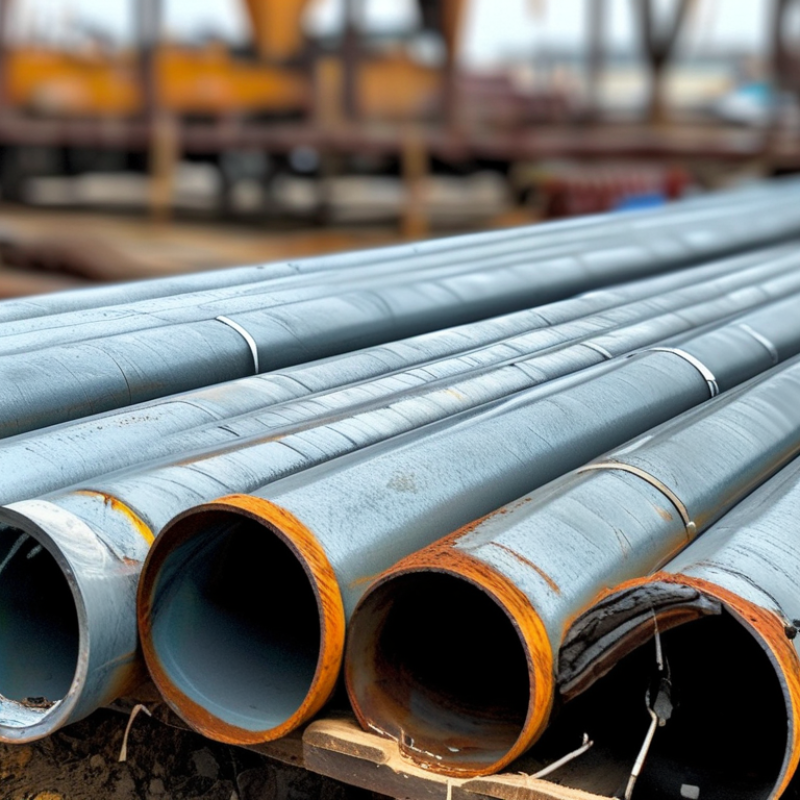
| Hot-dip galvanized welded round pipe | Circular hollow section made from a longitudinally welded steel strip or plate. | Steel is formed into a tube, longitudinally welded, sized, and then galvanized after fabrication. | The complete pipe is immersed in molten zinc, producing an external coating and internal coverage where the process permits. | ASTM A53/A53M, EN 10255, ISO 1461 for hot-dip galvanized coating requirements, or an applicable national equivalent. | Uniform round geometry, good resistance to external compression, and a visible weld seam that may influence local inspection or finishing. | Water service, fire-protection piping, scaffolding, handrails, agricultural structures, and general construction. | Confirm pressure rating, pipe schedule or wall thickness, weld quality, zinc-coating mass or thickness, and threaded-end requirements. |
| Pre-galvanized ERW round pipe | Round hollow section formed from zinc-coated steel strip and closed with a longitudinal electric-resistance weld. | Galvanized coil is slit, roll-formed, electrically welded, sized, and cut to length; the weld area is commonly repaired with zinc-rich material. | Continuous galvanizing is performed before tube formation, generally using a thinner and more controlled coating than post-fabrication hot-dip galvanizing. | Applicable cold-formed structural or mechanical tubing specifications, EN 10346 coating grades, and project-specific requirements. | Clean surface, tight dimensional control, and a longitudinal seam; cut ends and the weld zone may require additional corrosion protection. | Light framing, furniture, fencing, cable supports, greenhouse structures, and indoor or mildly corrosive environments. | Usually economical and visually consistent; verify coating repair at the seam, exposed cut ends, minimum coating mass, and suitability for outdoor exposure. |
| Hot-dip galvanized seamless pipe | Circular hollow section produced without a longitudinal weld. | A solid billet is heated, pierced, elongated, and finished by hot or cold working before galvanizing. | Finished seamless pipe is hot-dip galvanized when corrosion protection is required. | ASTM A106/A106M for seamless carbon-steel pipe at elevated temperatures, ASTM A53/A53M where applicable, and project-specific coating standards. | No longitudinal weld seam and good resistance to internal pressure when correctly specified; dimensional tolerances and wall-thickness variation must be controlled. | High-pressure or high-temperature service, process piping, mechanical components, and applications requiring seamless construction. | Higher material and processing cost is common; confirm actual pressure-temperature rating, chemistry, heat treatment, nondestructive testing, and coating feasibility. |
| Galvanized square hollow section | Four-sided closed structural section with equal or near-equal outside dimensions. | Steel strip is roll-formed and welded into a square tube, then either hot-dip galvanized or supplied pre-galvanized. | Post-fabrication hot-dip galvanizing provides broad surface coverage; pre-galvanizing provides a thinner factory coating before forming. | EN 10219, EN 10210, ASTM A500/A500M, and ISO 1461 or another specified coating standard. | High torsional rigidity and efficient resistance to bending about two principal axes; flat faces simplify connections and cladding installation. | Steel frames, gates, guardrails, solar-support structures, machinery bases, and architectural fabrications. | Specify outside dimensions, wall thickness, corner radius, steel grade, straightness, weld location, and coating treatment on cut or drilled areas. |
| Galvanized rectangular hollow section | Closed four-sided section with different width and height dimensions. | Cold-forming or hot-finishing of steel strip into a rectangular welded section, followed by hot-dip galvanizing or pre-galvanizing. | The selected coating route depends on section size, required durability, dimensional tolerance, and surface appearance. | EN 10219, EN 10210, ASTM A500/A500M, and project-specific zinc-coating requirements. | Strong directional bending efficiency, useful flat mounting faces, and a high strength-to-weight ratio for many frame designs. | Columns, beams, vehicle bodies, conveyors, agricultural equipment, building frames, and support structures. | The stronger axis and weaker axis differ significantly; engineers should check local buckling, corner radius, connection design, and corrosion at fabrication marks. |
| Galvanized mechanical tubing | Round, square, rectangular, or specialty hollow section manufactured to controlled mechanical and dimensional requirements. | Usually produced by electric-resistance welding or cold drawing; galvanizing may be applied before or after tube production. | Continuous zinc coating for pre-galvanized products or batch hot-dip galvanizing for completed tubing. | ASTM A513/A513M, EN 10305 for precision tubes where applicable, and the purchaser's coating specification. | Tight dimensional tolerances and controlled surface quality; pressure-service performance should not be assumed unless specifically certified. | Automotive components, frames, rollers, equipment, furniture, displays, and fabricated assemblies. | Prioritize dimensional tolerance, surface finish, straightness, weld quality, and forming performance rather than relying only on nominal outside diameter. |
| Galvanized scaffolding and structural pipe | Heavy-duty circular tube intended for temporary or permanent load-bearing assemblies. | Typically welded carbon-steel tube, manufactured to controlled outside diameter and wall thickness, then hot-dip galvanized. | Batch hot-dip galvanizing is common because it offers durable protection on exposed external surfaces. | EN 39 for steel tubes used in scaffolding, EN 10255 or an equivalent specification where applicable, plus the relevant scaffolding system requirements. | Round, clamp-compatible geometry with high bending and axial-load capacity when used within a designed system; connection behavior is critical. | Scaffolding, temporary platforms, shoring, access towers, temporary fencing, and construction supports. | Verify outside diameter, wall thickness, yield strength, mass per unit length, straightness, end condition, coating adhesion, and applicable safety regulations. |
| Galvanized line or water-service pipe | Circular pipe designed for conveying fluids, commonly supplied with plain, threaded, or grooved ends. | Welded or seamless carbon-steel pipe is dimensioned according to nominal pipe size and wall class before or after galvanizing. | Hot-dip galvanizing is commonly selected for corrosion protection; internal coating continuity depends on pipe size and processing method. | ASTM A53/A53M, EN 10255, ISO 1461 for coating, and applicable potable-water, fire, or local installation requirements. | Pressure-containing circular wall; hydraulic capacity is determined by internal diameter, roughness, fittings, and the specified pressure class. | Non-potable water, fire-protection systems, compressed-air systems, irrigation, and general utility piping where approved. | Do not use a structural-tube specification for pressure service; confirm fluid compatibility, potable-water approval, pressure rating, thread standard, and joining method. |
| Galvanized pipe nipple and threaded fitting stock | Short threaded sections or fittings used to connect larger pipe runs and equipment. | Cut from galvanized pipe or manufactured as galvanized malleable-iron or steel fittings, then threaded and inspected. | Galvanizing may be applied before threading for pipe or after casting and finishing for fittings; threaded areas may need protective treatment. | ASME B1.20.1 for NPT threads where applicable, ASTM A733 for welded and seamless steel pipe nipples, and relevant fitting standards. | Compact pressure-connection component with reduced wall at threads; sealing depends on thread form, sealant, engagement, and installation torque. | Plumbing, irrigation, fire-protection branches, compressed-air connections, and equipment hookups. | Match nominal size, thread standard, end-to-end length, pressure class, coating condition, and compatibility with adjoining valves or fittings. |