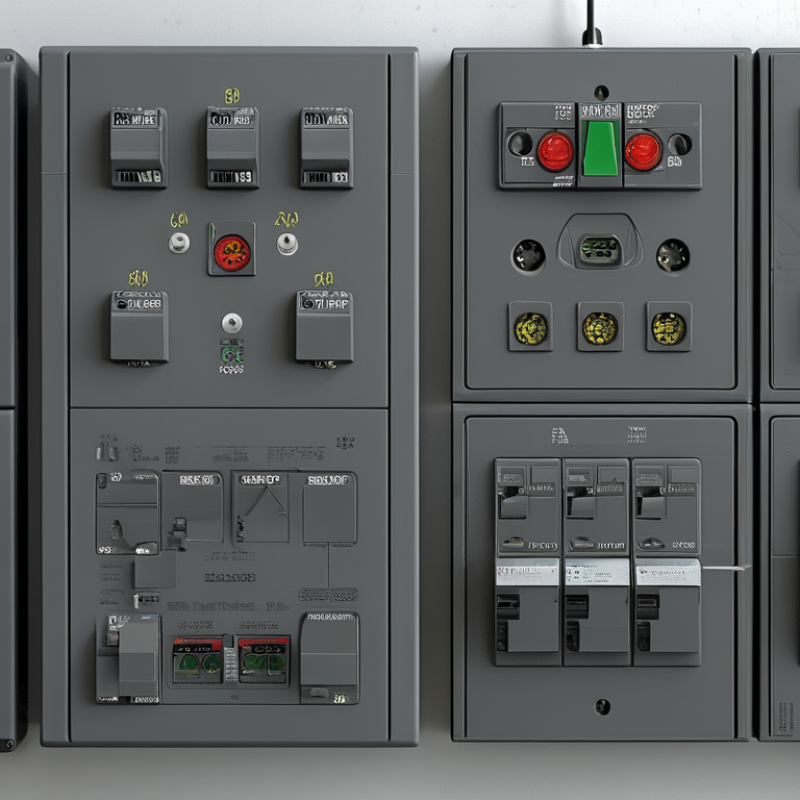
| Miniature Circuit Breaker (MCB) Branch-circuit protection | Protects final circuits from overload and short-circuit damage by automatically disconnecting the circuit. | Residential consumer units, commercial distribution boards, lighting panels, and small control panels. | Commonly 0.5–63 A; some product families extend to approximately 125 A. | Usually low-voltage AC systems up to 230/400 V AC; DC ratings depend on the specific design. | Thermal overload protection and magnetic short-circuit protection. Common trip curves include B, C, and D. | Common ratings include 4.5 kA, 6 kA, and 10 kA, depending on the product and applicable standard. | Lighting, socket outlets, small appliances, office circuits, and general building services. | Verify pole configuration, trip curve, rated current, short-circuit rating, terminal capacity, mounting system, and local certification requirements. |
| Molded-Case Circuit Breaker (MCCB) Higher-current protection | Provides adjustable or fixed overload and short-circuit protection for larger feeders and equipment. | Main distribution boards, industrial panels, commercial buildings, generators, and motor-control assemblies. | Commonly about 16–1,600 A; larger frames are available for specialized systems. | Commonly used in low-voltage systems up to 690 V AC; exact AC and DC limits are design-specific. | Thermal-magnetic or electronic trip units, adjustable long-time and short-time settings, instantaneous protection, and optional earth-fault protection. | Often approximately 18–100 kA at the rated voltage, with the exact value varying by frame size and configuration. | Feeders, large HVAC systems, pumps, industrial machinery, data-center distribution, and generator outputs. | Check interrupting rating at the actual system voltage, coordination settings, busbar compatibility, accessories, enclosure heat rise, and maintenance requirements. |
| Air Circuit Breaker (ACB) Main incomer protection | Protects and switches high-current low-voltage circuits, often with advanced selectivity and communication functions. | Main switchboards, service entrances, generator paralleling systems, and large industrial distribution sections. | Typically 630–6,300 A, depending on the frame and application. | Commonly used on low-voltage AC systems up to 690 V AC. | Electronic protection with long-time, short-time, instantaneous, and ground-fault functions; may support zone-selective interlocking and measurement. | Commonly 42–150 kA at low-voltage ratings, subject to the tested configuration and system voltage. | Utility incomers, bus couplers, large generators, industrial plants, hospitals, airports, and high-load commercial facilities. | Evaluate withdrawable or fixed construction, service continuity, short-circuit withstand, arc-flash strategy, protection coordination, control voltage, and communication protocol. |
| Residual Current Circuit Breaker (RCCB/RCD) Earth-leakage protection | Disconnects the supply when residual current indicates leakage to earth, helping reduce electric-shock and fire risks. | Residential, commercial, construction, outdoor, wet-area, and temporary power distribution boards. | Commonly 16–125 A; residual operating-current settings often include 10, 30, 100, and 300 mA. | Usually 230/400 V AC in low-voltage distribution systems. | Residual-current protection only; it does not normally provide overload or short-circuit protection and must be paired with suitable overcurrent protection. | Short-circuit capability is commonly limited by the associated backup protective device; verify the tested combination. | Socket circuits, bathrooms, kitchens, outdoor circuits, construction equipment, and fire-risk areas. | Choose the correct residual-current type, such as AC, A, F, or B, based on the connected loads. Confirm sensitivity, time delay, number of poles, test function, and local installation rules. |
| Residual Current Breaker with Overcurrent Protection (RCBO) Combined circuit protection | Combines overload, short-circuit, and residual-current protection in one device. | Modern residential consumer units, commercial final-circuit boards, and applications requiring individual circuit monitoring. | Commonly 6–40 A for final circuits; broader ranges exist depending on the design. | Commonly 230 V AC for single-phase circuits; two-, three-, and four-pole versions may support 400 V AC systems. | Thermal-magnetic overcurrent protection plus residual-current protection. Type A is widely used for circuits containing electronic loads. | Common ratings include 4.5 kA, 6 kA, and 10 kA, depending on the device and standard. | Residential socket and lighting circuits, electric vehicle auxiliaries, appliances, offices, and circuits where nuisance tripping should be localized. | Check neutral-pole switching, residual-current sensitivity, trip curve, breaking capacity, busbar format, leakage-current compatibility, and board space. |
| DC Circuit Breaker Direct-current protection | Interrupts overload and short-circuit currents in direct-current systems where the arc does not naturally extinguish at a current zero. | Photovoltaic combiner boxes, battery storage systems, telecom power systems, electric vehicles, and DC control panels. | Commonly 1–630 A; specialized battery and industrial designs can be higher. | Typical ratings range from 48 V DC to 1,500 V DC, depending on the application and pole arrangement. | Thermal-magnetic or electronic overcurrent protection; some designs include polarity-sensitive operation, auxiliary contacts, and remote trip functions. | Highly dependent on DC voltage, current, time constant, and circuit configuration; do not substitute an AC-only rating. | Solar PV strings and arrays, battery racks, UPS systems, telecom rectifiers, and DC motor circuits. | Confirm the certified DC voltage, current direction, number of poles, maximum prospective fault current, isolation requirement, creepage and clearance, and energy-storage fault behavior. |
| Motor Protection Circuit Breaker (MPCB) Motor feeder protection | Protects motor circuits against overload, phase loss, and short circuit while providing manual motor isolation. | Motor-control centers, machine control panels, pump panels, compressors, and conveyor systems. | Commonly approximately 0.1–100 A, with the adjustable range determined by the motor frame and device design. | Commonly used in low-voltage AC motor circuits up to 400/690 V AC. | Adjustable thermal overload protection and instantaneous short-circuit protection; phase-failure sensitivity is available in many designs. | Often in the range of 10–100 kA at the rated voltage, subject to the tested combination and backup protection. | Three-phase induction motors, pumps, fans, compressors, machine tools, and small industrial automation systems. | Set the overload dial to the motor nameplate current, verify the motor starting current, coordinate with contactors and overload relays, and check enclosure temperature derating. |
| Automatic Transfer Circuit Breaker Assembly Power-source transfer | Transfers a load between normal and alternate power sources while providing switching and protective functions. | Emergency distribution boards, standby-generator systems, data centers, healthcare facilities, and critical infrastructure. | Commonly 40–4,000 A, depending on the transfer architecture and switchgear design. | Commonly low-voltage systems up to 400/480 V AC; higher-voltage designs require dedicated equipment. | Source monitoring, undervoltage and phase-loss detection, adjustable transfer delay, return delay, interlocking, and optional overcurrent protection. | Determined by the integrated switching or breaker devices and the tested transfer assembly. | Backup generators, dual utility supplies, emergency lighting, fire pumps, medical loads, and uninterrupted power strategies. | Review open-transition or closed-transition operation, neutral switching, short-circuit rating, bypass-isolation capability, generator compatibility, control logic, and maintenance bypass requirements. |