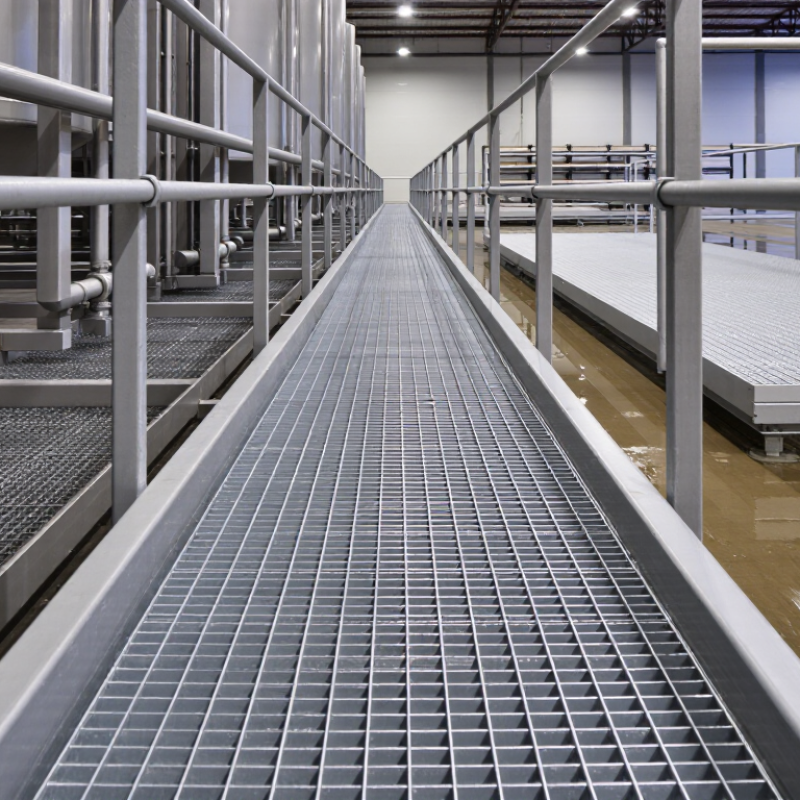
| Welded Steel Bar Grating | Carbon steel; hot-dip galvanized steel; painted steel | High strength and stiffness. Load capacity depends on bearing-bar size, spacing, span, and support conditions. Suitable for medium- to heavy-duty platforms. | Open construction provides effective drainage and ventilation. Serrated bearing bars can improve traction in wet or oily areas. | Plain carbon steel requires a protective coating. Hot-dip galvanizing provides substantially better atmospheric corrosion resistance. Steel is non-combustible. | Industrial platforms, walkways, stair treads, machine areas, wastewater plants, and service floors | Strong, rigid, widely available, easy to fabricate, and generally economical for heavy-duty service. | Heavier than aluminum or FRP. Unprotected steel can rust. Confirm the design load, deflection limit, bearing-bar direction, and coating specification. |
| Press-Locked Steel Grating | Carbon steel; stainless steel; aluminum | Cross bars are mechanically locked into bearing bars. Offers a clean, flush appearance and good two-directional visual uniformity, but capacity must be checked against the selected bar profile and span. | Good open-area drainage. Smooth or serrated surfaces are available; serrated versions are preferable where additional slip resistance is needed. | Material performance depends on the selected metal. Stainless steel provides strong corrosion resistance; carbon steel requires protection. | Architectural floors, platforms, ceiling access panels, ventilation covers, and moderate-duty walkways | Neat appearance, close-fitting intersections, and flexible panel patterns. Can be manufactured in different mesh configurations. | Not automatically stronger than welded grating. Avoid assuming load capacity from appearance; require published span and load tables for the exact construction. |
| Swage-Locked Aluminum Grating | Aluminum alloys commonly used for structural extrusions | Lightweight with good strength-to-weight performance. Usually selected for light- to medium-duty platforms; allowable loads depend on alloy, bar dimensions, span, and support. | Open area drains water efficiently. Serrated surfaces can improve slip resistance, although aluminum may become slippery when contaminated with oil or ice. | Aluminum forms a protective oxide layer and generally resists atmospheric corrosion. It has a lower melting point than steel and should not be used where severe fire exposure is expected without engineering review. | Marine accessways, offshore support areas, rooftop equipment platforms, pedestrian bridges, and corrosion-sensitive facilities | Approximately one-third the density of steel, easy to handle, naturally corrosion resistant, and suitable where installation weight matters. | Higher material cost than ordinary carbon steel. Lower stiffness can result in greater deflection. Check galvanic compatibility when connected to dissimilar metals. |
| Stainless Steel Grating | Austenitic stainless steel, such as 304 or 316 grades | High strength and good durability. Load performance is determined by bar dimensions, span, and grade; engineered design is required for heavy loads or long spans. | Open grid supports drainage. Serrated or abrasive-top surfaces may be specified for improved traction in wet process areas. | Excellent resistance to many corrosive environments. Grade selection is critical: 316 is generally preferred over 304 for chloride-rich or marine exposure. Stainless steel is non-combustible. | Food and beverage plants, chemical processing, pharmaceutical facilities, marine environments, and hygienic areas | Long service life, cleanable surface, strong corrosion resistance, and good appearance with minimal coating maintenance. | Higher purchase cost. Chlorides, acids, crevices, and contamination can still cause localized corrosion. Specify grade, finish, welding quality, and cleaning requirements. |
| Molded FRP Grating | Fiberglass-reinforced polymer with resin systems such as polyester, vinyl ester, or phenolic | Good strength-to-weight ratio, but lower stiffness than steel. Load capacity and deflection are strongly affected by panel thickness, mesh size, resin, span, and temperature. | Excellent open-area drainage. Gritted or molded-in abrasive surfaces provide strong slip resistance, including in many wet and chemically contaminated conditions. | Highly resistant to many chemicals and moisture. Fire performance varies by resin and formulation; request flame-spread, smoke, and fire-test documentation where required. | Chemical plants, water and wastewater facilities, cooling towers, offshore areas, and corrosive maintenance platforms | Non-conductive, corrosion resistant, lightweight, and often lower-maintenance than coated steel in aggressive chemical environments. | Can be affected by ultraviolet exposure, temperature, impact, and resin compatibility. It may creep under sustained load; use product-specific structural data. |
| Pultruded FRP Grating | Pultruded fiberglass profiles with polyester or vinyl ester resin systems | Continuous structural profiles provide high directional strength and stiffness. Efficient for longer spans, but performance is anisotropic and must be checked in the load direction. | Open profiles provide drainage. Gritted top surfaces are commonly used for enhanced pedestrian traction. | Strong resistance to moisture and many chemicals. Fire and smoke characteristics vary by resin and additives; verify the required classification. | Long-span walkways, stair systems, trench covers, platforms, and areas requiring low electrical conductivity | Lightweight, corrosion resistant, non-conductive, and often easier to install than metal grating because of reduced handling weight. | Cross-directional capacity may be lower than longitudinal capacity. Cutting can expose fibers, and connection details require compatible clips and corrosion-resistant fasteners. |
| Expanded Metal Grating | Carbon steel, galvanized steel, stainless steel, or aluminum sheet | One-piece mesh structure with no separate welded intersections. Useful for light- to medium-duty access surfaces; load capacity depends on strand size, mesh geometry, and support spacing. | Provides drainage and ventilation while offering a relatively continuous walking surface. Raised or flattened patterns have different traction and stiffness characteristics. | Corrosion performance follows the base material and coating. Steel is non-combustible; aluminum and stainless steel also require application-specific fire review. | Walkways, guards, ventilation screens, mezzanine infill, equipment platforms, and pedestrian access areas | Low waste production, good airflow, light weight, and no loose welded cross bars. Can be formed and cut to many shapes. | Edges can be sharp after cutting. Mesh geometry may not suit small wheels or narrow footwear. Verify opening dimensions, deflection, and edge treatment. |
| Heavy-Duty Trench and Drain Grating | Ductile iron, cast iron, galvanized steel, stainless steel, or engineered composite materials | Designed for concentrated wheel loads and traffic-rated applications. Selection should follow the applicable loading class, support frame design, and installation conditions. | Drainage slots or openings remove surface water. Opening size and orientation should consider pedestrian safety, bicycle wheels, heels, and accessibility requirements. | Ductile or cast iron is non-combustible but may corrode without suitable protection. Stainless steel and composite options provide different corrosion and maintenance profiles. | Roadside drains, factory floors, loading zones, parking areas, utility corridors, and stormwater channels | Can accommodate substantial wheel loads and protects drainage channels in demanding service environments. | Usually heavier and more expensive to install than ordinary walkway grating. Confirm load class, frame compatibility, anti-rocking design, corrosion exposure, and local standards. |