| Single-sided carton flow rack | Wall-side picking, small parts storage, and low-to-medium SKU operations. | Usually 2–6 picking levels; approximately 300–1,200 mm lane depth; commonly designed for carton loads up to about 50–150 kg per lane, subject to engineering approval. | Efficient use of wall space; simple replenishment; clear product visibility. | Confirm access aisle width, shelf load rating, carton dimensions, and whether replenishment can be performed without interrupting picking. |
| Double-sided carton flow rack | High-throughput distribution centers where replenishment and picking occur on opposite sides. | Typically 4–8 levels; commonly 600–1,200 mm usable depth per side; total unit depth often approximately 1,300–2,600 mm, depending on frame and lane design. | Supports continuous FIFO flow; separates replenishment from order picking; increases operator productivity. | Requires sufficient aisle space on both sides and careful coordination of replenishment rates, lane capacity, and fire-protection clearances. |
| Pallet-supported carton flow | Large warehouses combining pallet reserve stock with carton-level picking. | Carton flow lanes installed within or below pallet-rack structures; pallet-beam loads must be calculated separately from carton-flow loads. | Combines reserve storage and forward picking; can reduce travel distance and replenishment frequency. | Obtain a complete structural design for uprights, beams, decking, lane supports, seismic conditions, and local rack-safety requirements. |
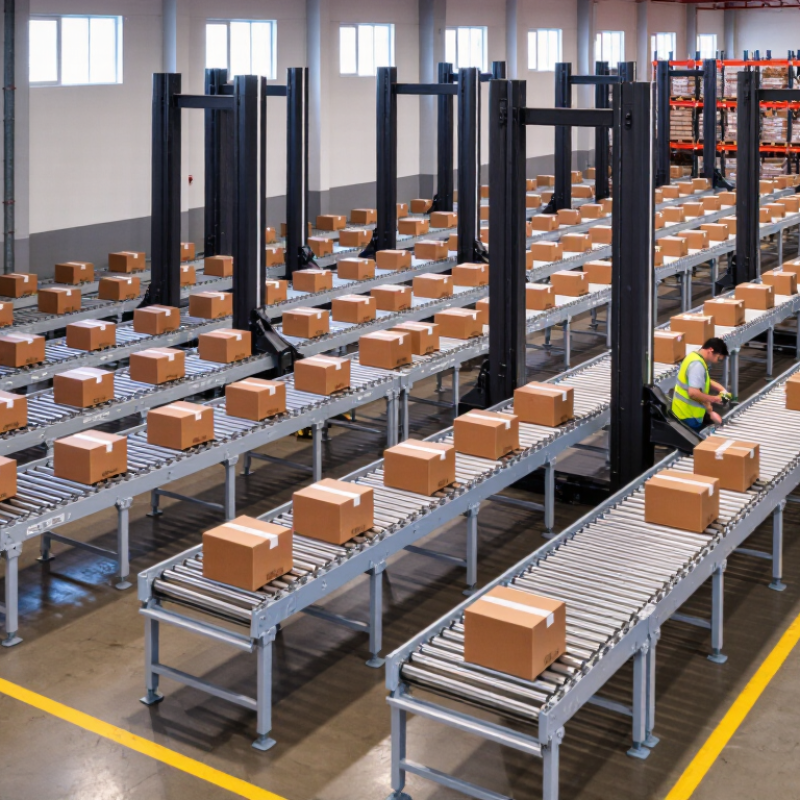
| Gravity roller carton flow | Medium and heavy cartons with relatively flat, rigid bases. | Uses steel or polymer rollers; lane pitch and roller spacing are selected according to carton footprint and weight; lanes are commonly installed with an incline of about 3–5%, subject to product testing. | Lower rolling resistance for heavier loads; durable construction; consistent FIFO movement when correctly configured. | Test the smallest and largest cartons, check base rigidity, and specify braking or speed-control features where carton momentum may be high. |
| Wheel-bed carton flow | Light-to-medium cartons, totes, trays, and containers with smooth, stable bases. | Uses multiple wheel tracks; best suited to loads that contact enough wheels at all times; lane capacity depends on wheel type, track spacing, and support spacing. | Low friction; flexible lane adjustment; often economical for small cartons and totes. | Avoid unstable or soft-bottom cartons; verify wheel-track alignment, carton overhang, and performance at minimum load weight. |
| Pick-module carton flow system | E-commerce, grocery, spare-parts, and omnichannel fulfillment with many active SKUs. | Multi-level structure with integrated carton flow, walkways, stairs, lighting, conveyors, or put-to-light equipment; design is highly site-specific. | High SKU density; reduced picker travel; supports zone picking and batch-picking workflows. | Evaluate building height, floor loading, emergency egress, ergonomics, order profile, replenishment windows, and future expansion requirements. |
| Adjustable modular carton flow | Warehouses with changing product dimensions, seasonal demand, or frequent assortment revisions. | Adjustable dividers, lane guides, shelf positions, and roller or wheel tracks; exact adjustment increments depend on the rack design. | Improves space utilization; easier SKU re-slotting; supports phased installation and expansion. | Check tool-free adjustment, replacement-part availability, lane-change time, and compatibility with the full carton-size range. |